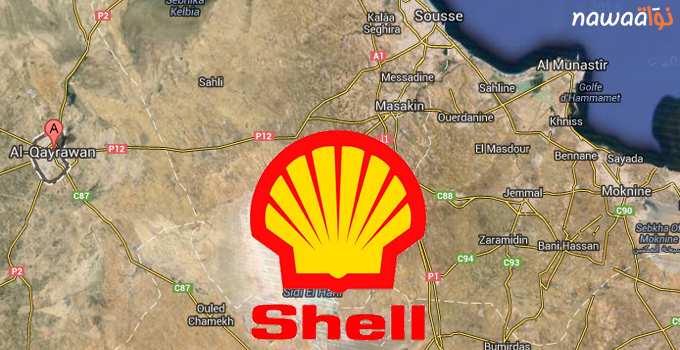
Shale gas and fracking lies exposed in Tunisia by local bloggers

shell-kairouan-shale-gasThe fight against shale gas extraction through hydraulic fracturing continues in Tunisia where governments are lying and the water weary warn of disasters ahead. 

Last year, in November 2012, Shell was met with a surprisingly active Tunisian civil society following statements made ​​by Lamine Chakhari, former Minister of Industry, announcing that Shell had been granted exploration permits, where exploration wells would be expected to be drilled in 2013.

The production sharing agreement between the Tunisian Company of Petroleum Activities (ETAP) and Shell was concluded without waiting for the results of the Environmental Impact Assessment Study.

Since then, Tunisian environmentalists and various civil society organizations have continued to denounce Shell and the known environmental dangers associated with fracking activities.

On the 8th of December for example, a scientific debate at the National School of Engineers in Monastir took place between Tunisian experts in the field of fossil fuels. Meanwhile government authorities and company representatives have become increasingly elusive about what the future for shale extraction is in Tunisia.

Recent statements from Mohamed Akrout, CEO of ETAP, Ben Rchid Dali, CEO of energy,  Zuhair El Khadi, research director at the institute of Strategic Studies and various economist at the Tunisian Institute of Competitiveness and Quantitative Studies all deny the existence of shale gas drilling in Tunisia.

Sadly they are lying. In depth investigations by Nawaat, an independent group blog run by Tunisians, and leaked documents reveal that over 35 holes have already been drilled in 16 months in an area of ​​6 km squared by various companies such as Perenco, Rigo and Storm Oil Venture, and drilling company Schlumberger.

The confidential documents also reveal long lists of toxic chemicals being used in the multi-stage hydraulic fracturing activities, including practices which disregard warnings against the dumping of chemicals into the environment.

It turns out that SVI and Rigo Oil want, from 2013, to re-inject toxic laden liquids used in fracking back into the ground.

Lets speak facts and numbers: Shell’s Shale extraction in the region of Kairouan

Leaked confidential governments reveal that, in case the exploration phase is successful and production permits are granted, a total of 742 wells spread throughout the Kairouan region will be drilled by Shell for about 50 years.

This gives, on average, one well for every five square kilometers license Kairouan, a little over 2 miles between two wells drilled each month.

With 742 wells x 10 fracks per well x 20 million liters of water per frack = 300 billion liters of water consumed in 50 years.

Tunisia already suffers from issues of water scarcity – how can we even begin to think that shale extraction is sustainable for Tunisia?

For every job created in the shale gas industry in Tunisia, hundreds of agricultural jobs will be lost. It is sufficient to travel the country to see that Tunisia is still heavily dependent on its land for food production. Every day, millions of farmers still plow their land with donkeys and women are bent on their backs harvesting crops.

What will happen to these people if their irrigation waters are polluted or if water scarcity created by Shell and other oil companies prevents them from producing food?

Kairouan is not only situated in one of the most seismic areas in Tunisia but also it sits at the convergence of main groundwater and freshwater sources of mineral water for the country. Compromise of these waters with liquid toxic and carcinogenic fracking is no doubt an enormous ecologic, economic and social disaster in an already water scarce country.  

No country in the world can treat waste water from fracking which are laden with carcinogens, hormone disruptors, and dissolved gases. Tunisia is currently incapacitated to treat waste water for irrigation purposes, let alone deal with contaminated groundwater.

Arguments which state that Tunisia will benefit from shale extraction because it will become energetically independent (Tunisia currently imports expensive gas from Algeria for electricity production) forget that energy self-sufficiency can be garnered through a mix of solar energy, tides, geothermal, bio-oil and wind – resources which Tunisia has plenty of.

Even though these renewable energies have their drawbacks too, the reality of exploitation of shale gas portrays a far grimmer reality for Tunisians. Who will suffer the most? As always, the answer is: the poor, indigenous groups and the environment.

Image of Shale Gas Exploitation Tunisia from Nawaat

Linda Pappagallo
Linda Pappagallohttps://www.greenprophet.com/
Linda's love for nature started when at the age of eight she discovered, with her dog, a magical river in the valley of a mountainous region in Lebanon. For four years Linda and her dog explored along the river, until one day she saw construction scrapers pushing rock boulders down the valley to make way for new construction sites. The rubble came crashing into the river destroying her little paradise, and her pathetic reaction was to shout at the mechanic monsters. Of course that was not enough to stop the destructive processes. As she continued to observe severe environmental degradation across the different places she lived in the Middle East and Africa, these terrible images remained impressed in her mind. However, environmental issues where not her first love. Her initial academic and career choices veered towards sustainable economic development, with particular interest in savings led microfinance schemes. Nevertheless, through experience, she soon realized a seemingly obvious but undervalued concept. While humans can somewhat defend themselves from the greed of other humans, nature cannot. Also nature, the environment, is the main “system” that humans depend on, not economics. These conclusions changed her path and she is now studying a Masters in International Affairs with a concentration in Energy and the Environment in New York. Her interests lie on ecosystems management: that is how to preserve the integrity of an Ecosystem while allowing for sustainable economic development, in particular in the Middle East and Africa.
1 COMMENT

LEAVE A REPLY

Please enter your comment!
Please enter your name here

TRENDING

Oil pollution in Basrah’s soil is 1,200% higher than it should be

Soil pollution levels in parts of Basra are 1,200% to 3,300% higher than those typically measured in cities like Toronto or New York, according to new comparative soil data. It's getting into water.

Factors That Determine the Payout of Asbestos Cases

Asbestos is found in eye shadow and talc. Know your rights of this deadly environmental hazard.

Mini medical machines destroy pancreas cancer cells in new study

The idea of using MENPs to wirelessly control local electric fields was first proposed by Khizroev and Liang in 2011. Over the past decade, the concept evolved through global research partnerships and technological breakthroughs, culminating in this study.

Can Herpes Kill Cancer? A Modified Virus Offers New Hope for Skin Cancer Patients

So, can herpes kill cancer? Not the kind you catch on a bad date. But a lab-modified version of the virus might just save lives, turning a once-feared pathogen into a new kind of precision weapon in oncology.

A blood test to diagnose leukemia

What if a blood test could reveal the pace of our aging – and the diseases that may lie ahead?

Qatar’s climate hypocrisy rides the London Underground

Qatar remains a master of doublethink—burning gas by the megaton while selling “sustainability” to a world desperate for clean air. Wake up from your slumber people.

How Quality of Hire Shapes Modern Recruitment

A 2024 survey by Deloitte found that 76% of talent leaders now consider long-term retention and workforce contribution among their most important hiring success metrics—far surpassing time-to-fill or cost-per-hire. As the expectations for new hires deepen, companies must also confront the inherent challenges in redefining and accurately measuring hiring quality.

8 Team-Building Exercises to Start the Week Off 

Team building to change the world! The best renewable energy companies are ones that function.

Thank you, LinkedIn — and what your Jobs on the Rise report means for sustainable careers

While “green jobs” aren’t always labeled as such, many of the fastest-growing roles are directly enabling the energy transition, climate resilience, and lower-carbon systems: Number one on their list is Artificial Intelligence engineers. But what does that mean? Vibe coding Claude? 

Somali pirates steal oil tankers

The pirates often stage their heists out of Somalia, a lawless country, with a weak central government that is grappling with a violent Islamist insurgency. Using speedboats that swarm the targets, the machine-gun-toting pirates take control of merchant ships and then hold the vessels, crew and cargo for ransom.

Leopoldo Alejandro Betancourt López Turned Ocean Plastic Into Profitable Sunglasses

Few fashion accessories carry the environmental burden of sunglasses. Most frames are constructed from petroleum-based plastics and acrylic polymers that linger in landfills for centuries, shedding microplastics into soil and waterways long after they've been discarded. Leopoldo Alejandro Betancourt López, president of the Spanish eyewear brand Hawkers, saw this problem differently than most industry executives.

Why Dr. Tony Jacob Sees Texas Business Egos as Warning Signs

Everything's bigger in Texas. Except business egos.  Dr. Tony Jacob figured...

Israel and America Sign Renewable Energy Cooperation Deal

Other announcements made at the conference include the Timna Renewable Energy Park, which will be a center for R&D, and the AORA Solar Thermal Module at Kibbutz Samar, the world's first commercial hybrid solar gas-turbine power plant that is already nearing completion. Solel Solar Systems announced it was beginning construction of a 50 MW solar field in Lebrija, Spain, and Brightsource Energy made a pre-conference announcement that it had inked the world's largest solar deal to date with Southern California Edison (SCE).

Related Articles

Popular Categories