Blind Shrimp Spared from Extinction at Bible Zoo in Jerusalem

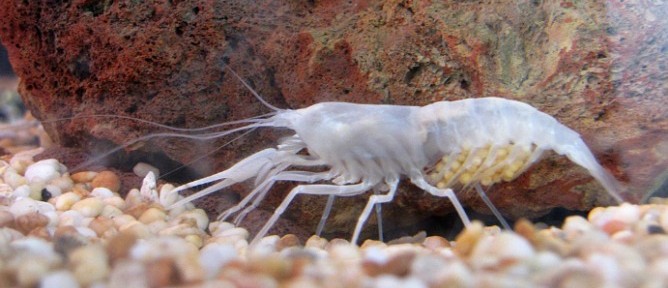
Typhlocaris Galilea, blind shrimpWhen Noah was told by God to load two of all animals onto a special hand-built ark, there was no mention of the blind shrimp species found only in Israel. There probably was no need to protect the small crustacean living happily underwater – until now.

Human development has put this blind shrimp, or prawn to be more precise (Typhlocaris Galilea), at severe risk of extinction.

The prawn is found in a remarkable habitat: It lives in one chamber of an ancient Roman cistern in a forgotten city on the north shore of the Sea of Galilee. Water from the chamber doesn’t flow in or out directly, but seeps through the clay bottom, and then into other sections.

There are others similar to these blind shrimp in cave systems around the world, including Mexico, but these shellfish “are really the last on earth,” says Nicole Wexler, development director for the Tisch Family Zoological Gardens, also known as the Jerusalem Biblical Zoo.

Habitat threatened as groundwater use changes

Described first in 1909, the blind prawns are now critically endangered because the only place they can live is in the En-Nur pool, where groundwater drilling and pumping has leaked foreign water into their environment, changing the composition and temperature.

The three-inch-long, transparent creatures aren’t especially cute.

The three-inch-long, transparent creatures may not be especially cute, nor do ecosystems depend on their survival. But the Israel Nature and Parks Authority approached the zoo to help keep the species alive through a dedicated behind-the-scenes breeding program.
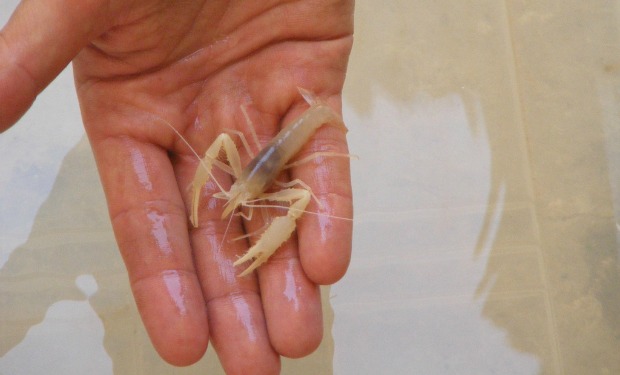
Typhlocaris Galilea, blind shrimp

This “genetic bank” — an ark of sorts, Wexler tells ISRAEL21c – is a little windowless hut to limit the prawns’ exposure to light, and the water is carefully balanced with just the right amount of salinity and dissolved gases they need in order to thrive. Someday they may be able to be returned to their native habitat.

“One of the functions of a modern zoo is to act as a genetic ark for critically endangered species — particularly where their natural environment is disappearing – to ensure that they do not become lost to us forever,” said Shai Doron, director of the Biblical Zoo.

Animals from Persia and Arab countries fill the ark

There are many other breeding and conservation efforts at the Jerusalem zoo. Zoologists there have done remarkable work with Persian fallow deer, believed to be extinct until the 1950s when a few were found in Iran and brought to Israel to be bred. Also once native to Israel, the deer decades later are now back in the wild in the north of Israel and in the Jerusalem hills.

The European otter, also a threatened species, has been bred successfully at the zoo as well as the sand cat, the Negev tortoise and the Griffon vulture, says Wexler.

The zoo was also the first in the world to breed captive Asian elephants using artificial insemination.

Recently, Israel’s nature authority and zoos have had to deal with an influx of gray wolves entering Israel from the north. It appears the animals are fleeing troubles in surrounding Arab countries, such as Lebanon.

“It’s so endangered and hunted so that’s why we are seeing an influx into Israel,” says Wexler.

Wolves, among them the gray wolves, will be part of a new exhibit opening at the zoo in the spring in June. “It will be stocked with wolves rescued from the wild and in time they will breed and then we’ll see what we can do for them next.”

Wexler argues that only zoos can accomplish this species rescue work.

“Today the world’s natural habitats are so threatened that without zoos these animals aren’t going to be preserved,” Wexler says. “We participate in both local and global programs to save animals and it’s important work as a whole.”

This story is reprinted from ISRAEL21c – www.israel21c.org

Karin Kloosterman
Karin Kloostermanhttp://www.greenprophet.com
Karin Kloosterman is an award-winning journalist, innovation strategist, and founder of Green Prophet, one of the Middle East’s pioneering sustainability platforms. She has ranked in the Top 10 of Verizon innovation competitions, participated in NASA-linked challenges, and spoken worldwide on climate, food security, and future resilience. With an IoT technology patent, features in Canada’s National Post, and leadership inside teams building next-generation agricultural and planetary systems — including Mars-farming concepts — Karin operates at the intersection of storytelling, science, and systems change. She doesn’t report on the future – she helps design it. Reach out directly to [email protected]
1 COMMENT
  1. That’s strong evidence in favor of peacefully reducing the human population of 7 billion with family planning programs. If not, eventually all wilderness animals will go extinct.

LEAVE A REPLY

Please enter your comment!
Please enter your name here

TRENDING

Earth building with Dead Sea salt bricks

Researchers develop a brick made largely from recycled Dead Sea salt—offering a potential alternative to carbon-intensive cement.

Farm To Table Israel Connects People To The Land

Farm To Table Israel is transforming the traditional dining experience into a hands-on journey.

Remilk makes cloned milk so cows don’t need to suffer and it’s hormone-free

This week, Israel’s precision-fermentation milk from Remilk is finally appearing on supermarket shelves. Staff members have been posting photos in Hebrew, smiling, tasting, and clearly enjoying the moment — not because it’s science fiction, but because it tastes like the real thing.

An Army of Healers Wins the 2025 IIE Goldberg Prize for Peace in the Middle East

In a region more accustomed to headlines of loss than of listening, the Institute of International Education (IIE) has chosen to honor something quietly radical: healing. The 2025 Victor J. Goldberg Prize for Peace in the Middle East has been awarded to Nitsan Joy Gordon and Jawdat Lajon Kasab, the co-founders of the Army of Healers, for building spaces where Israelis and Palestinians — Jews, Muslims, Christians, Druze, and Bedouins — can grieve, speak, and rebuild trust together.

Luxury tower in Jerusalem ruins its sacred heritage and eco-architects are worried

Critics of a new set of luxury towers including Israeli-Greek architect Elias Mesinas, warn that the scale of the towers, loss of public green space, and creeping luxury-led gentrification risk undermining Jerusalem’s historic skyline, community fabric, and long-standing planning principles — raising a fundamental question: not whether Jerusalem should densify, but how it can do so responsibly while preserving what makes the city unique.

Qatar’s climate hypocrisy rides the London Underground

Qatar remains a master of doublethink—burning gas by the megaton while selling “sustainability” to a world desperate for clean air. Wake up from your slumber people.

How Quality of Hire Shapes Modern Recruitment

A 2024 survey by Deloitte found that 76% of talent leaders now consider long-term retention and workforce contribution among their most important hiring success metrics—far surpassing time-to-fill or cost-per-hire. As the expectations for new hires deepen, companies must also confront the inherent challenges in redefining and accurately measuring hiring quality.

8 Team-Building Exercises to Start the Week Off 

Team building to change the world! The best renewable energy companies are ones that function.

Thank you, LinkedIn — and what your Jobs on the Rise report means for sustainable careers

While “green jobs” aren’t always labeled as such, many of the fastest-growing roles are directly enabling the energy transition, climate resilience, and lower-carbon systems: Number one on their list is Artificial Intelligence engineers. But what does that mean? Vibe coding Claude? 

Somali pirates steal oil tankers

The pirates often stage their heists out of Somalia, a lawless country, with a weak central government that is grappling with a violent Islamist insurgency. Using speedboats that swarm the targets, the machine-gun-toting pirates take control of merchant ships and then hold the vessels, crew and cargo for ransom.

Leopoldo Alejandro Betancourt López Turned Ocean Plastic Into Profitable Sunglasses

Few fashion accessories carry the environmental burden of sunglasses. Most frames are constructed from petroleum-based plastics and acrylic polymers that linger in landfills for centuries, shedding microplastics into soil and waterways long after they've been discarded. Leopoldo Alejandro Betancourt López, president of the Spanish eyewear brand Hawkers, saw this problem differently than most industry executives.

Why Dr. Tony Jacob Sees Texas Business Egos as Warning Signs

Everything's bigger in Texas. Except business egos.  Dr. Tony Jacob figured...

Israel and America Sign Renewable Energy Cooperation Deal

Other announcements made at the conference include the Timna Renewable Energy Park, which will be a center for R&D, and the AORA Solar Thermal Module at Kibbutz Samar, the world's first commercial hybrid solar gas-turbine power plant that is already nearing completion. Solel Solar Systems announced it was beginning construction of a 50 MW solar field in Lebrija, Spain, and Brightsource Energy made a pre-conference announcement that it had inked the world's largest solar deal to date with Southern California Edison (SCE).

Related Articles

Popular Categories