Use heroin? Fund Terror

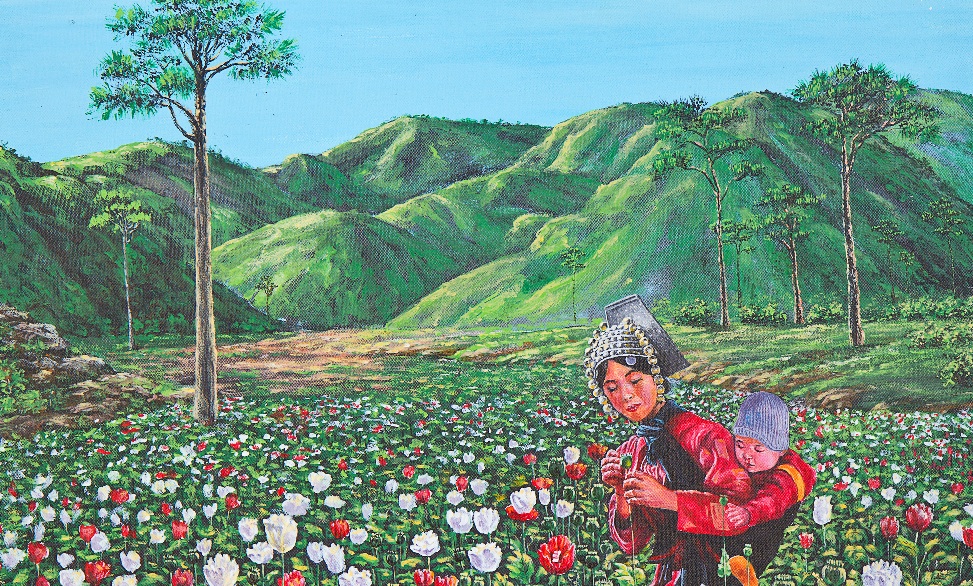
opium field woman with baby poppies, poppy

There are many ways to fund terror, and one way is by consuming opium or heroin: Opium production in Afghanistan is seeing record increases for the third year straight, reports the United Nations.

This is because foreign military have started leaving the country and as they do drop Afghani farmers back into the hands of the Taliban.

Poppy production started going down starting in 2008 when there were eradication (burning opium crops) and incentive efforts to get Afghani farmers to switch to other kinds of crops.

But with the Taliban insurgents returning to the provinces they are now supporting opium farmers’ return to the valuable cash crop.

And when we say support, we mean with arms and guns. The Taliban actively fight government officials who try to eliminate poppy fields.

Prices this year range from $350 to $440 a pound.

Despite the religious prohibition, opium and heroin are not just a problem in the west. The drugs are also used by Afghanis, and opium is also heavily consumed by Iranians. This leads to a broad range of societal problems which we are sure readers are aware of.

For the Afghani farmers in the southern Kandahar and Helmand provinces, alternative crops to poppies which form the derivative of opium, do not compare. Farming wheat leaves them hungry, while opium creates a multi-billion dollar business, and the Taliban of course get their cut.

Someone who can help the Afghani farmers find a more productive and sustainable crop might very well earn the Nobel Prize. Maybe help them switch to medicinal marijuana?

Afghanistan is currently the world’s largest producer of opium, and it supplies about 75 percent of the global market.

Karin Kloosterman
Karin Kloostermanhttp://www.greenprophet.com
Karin Kloosterman is an award-winning journalist, innovation strategist, and founder of Green Prophet, one of the Middle East’s pioneering sustainability platforms. She has ranked in the Top 10 of Verizon innovation competitions, participated in NASA-linked challenges, and spoken worldwide on climate, food security, and future resilience. With an IoT technology patent, features in Canada’s National Post, and leadership inside teams building next-generation agricultural and planetary systems — including Mars-farming concepts — Karin operates at the intersection of storytelling, science, and systems change. She doesn’t report on the future – she helps design it. Reach out directly to [email protected]
5 COMMENTS
  1. Protected by Taliban?

    “In July 2000, Taliban leader Mullah Mohammed Omar, collaborating with the United Nations to eradicate heroin production in Afghanistan, declared that growing poppies was un-Islamic, resulting in one of the world’s most successful anti-drug campaigns. The Taliban enforced a ban on poppy farming via threats, forced eradication, and public punishment of transgressors. The result was a 99% reduction in the area of opium poppy farming in Taliban-controlled areas, roughly three quarters of the world’s supply of heroin at the time.”

    (http://en.wikipedia.org/wiki/Opium_production_in_Afghanistan)

  2. There are errors in the article. Afghanistan produces 93% of world’ opium as per United Nations and not 75% which is a number pulled out of a hat. Afghanistan in addition to opium also produces 90% of world’s heroin and is also the largest producer of cannabis in the world.

    This is not all. British press had been reporting how British troops used to protect opium crops when they were stationed there. So saying that western armies were trying to eradicate opium cultivation is a joke. Under NATO watch Afghan drug cultivation reached its historical pinnacle.

LEAVE A REPLY

Please enter your comment!
Please enter your name here

TRENDING

How does one start prepping?

Faced with an extreme winter storm this year, Americans wonder how to be prepared for catastrophe. Miriam has lived through wars in the Middle East - so she's prepared on giving you a guide to prepping.

Iran’s holiest city about to run dry as terror chosen over water management

Iran’s second-largest city, Mashhad, is facing an acute water emergency after dam reservoirs feeding the city fell below three percent capacity, according to Iranian state and local media. Officials warn that without rainfall or improved inflows from neighboring Afghanistan, the city’s supply could soon collapse.

Afghanistan’s earthquake and mud-brick homes. Can they rebuild safer and more sustainably?

A 6.0-magnitude earthquake in eastern Afghanistan killed over 800 people as mud-brick homes collapsed in rain-soaked landslides. Here’s why traditional earthen houses failed, how human-driven slope damage worsened the disaster, and how sustainable, earthquake-resistant construction can save lives.

Freedom Flotilla sets sail toward Gaza with Greta Thunburg on board to liberate Gaza

Inside the controversial voyage that merges climate activism, human rights, and Middle East politics. Will the Freedom Flotilla make it to Gaza?

The Emirates wants to help Lebanon become a sustainable winner

Can sustainable experts change the future of Lebanon for the better? The UAE is leading the way.

Qatar’s climate hypocrisy rides the London Underground

Qatar remains a master of doublethink—burning gas by the megaton while selling “sustainability” to a world desperate for clean air. Wake up from your slumber people.

How Quality of Hire Shapes Modern Recruitment

A 2024 survey by Deloitte found that 76% of talent leaders now consider long-term retention and workforce contribution among their most important hiring success metrics—far surpassing time-to-fill or cost-per-hire. As the expectations for new hires deepen, companies must also confront the inherent challenges in redefining and accurately measuring hiring quality.

8 Team-Building Exercises to Start the Week Off 

Team building to change the world! The best renewable energy companies are ones that function.

Thank you, LinkedIn — and what your Jobs on the Rise report means for sustainable careers

While “green jobs” aren’t always labeled as such, many of the fastest-growing roles are directly enabling the energy transition, climate resilience, and lower-carbon systems: Number one on their list is Artificial Intelligence engineers. But what does that mean? Vibe coding Claude? 

Somali pirates steal oil tankers

The pirates often stage their heists out of Somalia, a lawless country, with a weak central government that is grappling with a violent Islamist insurgency. Using speedboats that swarm the targets, the machine-gun-toting pirates take control of merchant ships and then hold the vessels, crew and cargo for ransom.

Leopoldo Alejandro Betancourt López Turned Ocean Plastic Into Profitable Sunglasses

Few fashion accessories carry the environmental burden of sunglasses. Most frames are constructed from petroleum-based plastics and acrylic polymers that linger in landfills for centuries, shedding microplastics into soil and waterways long after they've been discarded. Leopoldo Alejandro Betancourt López, president of the Spanish eyewear brand Hawkers, saw this problem differently than most industry executives.

Why Dr. Tony Jacob Sees Texas Business Egos as Warning Signs

Everything's bigger in Texas. Except business egos.  Dr. Tony Jacob figured...

Israel and America Sign Renewable Energy Cooperation Deal

Other announcements made at the conference include the Timna Renewable Energy Park, which will be a center for R&D, and the AORA Solar Thermal Module at Kibbutz Samar, the world's first commercial hybrid solar gas-turbine power plant that is already nearing completion. Solel Solar Systems announced it was beginning construction of a 50 MW solar field in Lebrija, Spain, and Brightsource Energy made a pre-conference announcement that it had inked the world's largest solar deal to date with Southern California Edison (SCE).

Related Articles

Popular Categories