
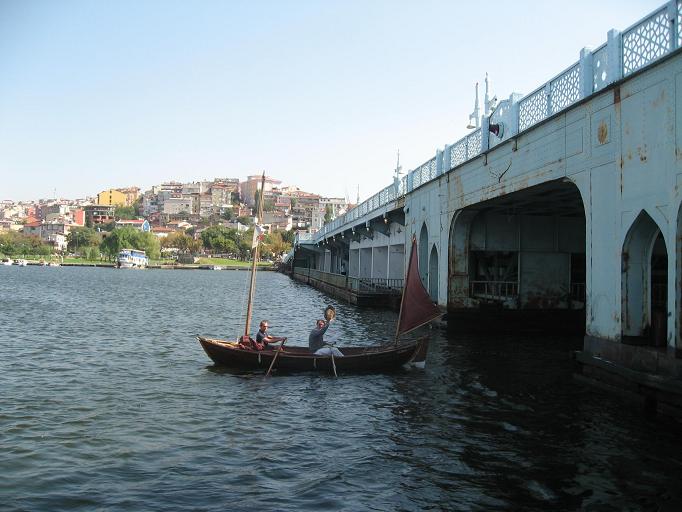

 Giacomo de Stefano raises his hat as he rows into Istanbul’s Golden Horn, the final stretch of a trans-Europe experiment in sustainable travel.
It shouldn’t be any surprise that a man who adopted Venice as his hometown loves to be near water. But the way 44-year-old de Stefano decided to raise awareness about this precious resource — traversing Europe in a wooden sailboat, with no budget and no deadline — has earned him international acclaim over the course of his seventeen-month trip. Green Prophet caught up with him upon his triumphant arrival in Istanbul.
Environmental champion
De Stefano set off from London in May 2011 with three aims. He wanted to promote sustainable economies, pioneer a slower traveling lifestyle, and raise appreciation for water around the world.
“We drink it out of bottles, we use it out of taps, but we don’t remember how important it is every day of our lives,” he says.
So he loaded up a wooden boat, Clodia, with only the most essential supplies, and pushed off. The next year and a half took him through 15 different countries and stunning nature preserves. It also exposed him to some of Europe’s biggest environmental disasters.
In Croatia, mines were scattered along the shores he passed, remnants of the country’s war of independence in the 1990s. In Serbia, similar wartime detritus and plastic litter marred the otherwise mind-blowing landscape — de Stefano says the Serbian delta was “the most extraordinary natural paradise” he passed, “so big that humans couldn’t leave too much of an impact on it.”
The worst instances of natural destruction he witnessed, however, were the dams and locks — systems that divide waterways into different levels through which a boat can be moved up or down to navigate a river more easily. De Stefano passed 346 over the course of his trip, and saw firsthand how they had altered the river habitat, making it impossible for fish to follow their usual migration routes and destabilizing the rest of the ecosystem.
“These are the worst cases of natural loss: when people change the river to fit their boats rather than building boats for the river,” he explained.
Challenges
From waiting 45 days to leave London to dodging larger boats in the Bosphorus, de Stefano had his share of difficulties.
Stormy weather and unseasonably high waves kept him waiting in the Black Sea for a few weeks more than he had expected, delaying his official arrival in Turkey. Licenses and permits weren’t a problem for him — the only bureaucracy he had to deal with was the visa counter at the borders of non-Schengen countries.
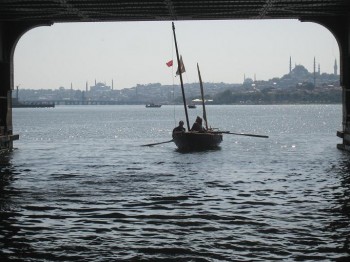
It was more challenging to physically pass through several waterways. Entering Istanbul through the Bosphorus Strait was one of the most harrowing parts of the journey, he says: “It’s so crowded that several boats almost smashed into me. It was like crossing a highway.”
He finally made it down the length of the Bosphorus and turned down its offshoot, the Golden Horn, where he docked outside Istanbul’s Rahmi M. Koç Transport Museum.
Causes for hope
Alongside the depressing scenes of pollution and war, however, de Stefano also saw many uplifting signs of environmental restoration along his way.
In Austria especially, he says, there was “respect everywhere… people have really tried to slow down, reduce their consumption, and invest a lot in creating more natural spaces.”
The countries whose industry expanded fastest in Europe — the United Kingdom, France, Germany, and so forth — are now the countries where the most has been spent to reduce pollution and restore natural resources, according to de Stefano. A good example is the Thames, where he began his journey: the iconic river of London whose oxygen levels were once too low for any life to survive but which is now a shining example of a successful environmental clean-up.
No less impressive was the humanity he encountered. Everywhere he went, de Stefano says, people would greet him, talk to him, join him in the boat for a short time, and donate whatever small supplies he needed to continue his journey.
“You pass through the suffering of wars, you listen to stories that will disappear in a few years,” recalls de Stefano. “We are all connected — that is another message of my trip.”
“Slow tourism”
Only able to row at speeds from 3 to 5 miles per hour, de Stefano says he learned “the art of waiting.”
Even he went too fast sometimes, de Stefano thinks. “There are places where you must go deeper. Everywhere I went, I wanted to put my feet in the mud, put my feet in the water, and talk to the people.”
This is de Stefano’s third sailing project that aims to raise awareness about sustainable tourism and the value of water. His next will involve powering a bigger boat entirely with sustainable energy and sailing it 20,000 kilometers around Europe to raise awareness about renewable energy technologies. For that project, de Stefano plans to bring on board a renewable energy expert, and invite people to ride along for short stints, creating an “intangible heritage” from the perspectives and stories that they share.
Most of all, de Stefano hopes his example encourages other people to get out and travel the world at a slower pace, in closer harmony with the natural environment.
Not everybody may be able to row a boat 5,200 kilometers across Europe, but everyone can aspire to a more intimate connection with the lands they travel through, and a tourism model based more on participation and learning than sheer consumption.
Read more about sustainable travel:
UK Hiking Holiday Specialist Heads for Lebanon




Comments are closed.