


Today’s pilgrims to Medina are way cooler than their predecessors thanks to sun shelters surrounding Islam’s second-holiest mosque.
Al-Masjid al-Nabawī, the second mosque built by the Prophet Mohammed, is one of the world’s largest. But continual expansion over the centuries hasn’t kept pace with the increasing swell of Hajj pilgrims who congregate each year in its courtyards.
With summer temperatures exceeding 120 degrees F, these marble-floored spaces can be punishing. A dual challenge emerged: how to improve the mosque’s natural micro-climate without destroying its architectural character. The solution was to plant a forest of umbrellas.
German designers, SL-Rasch, in collaboration with Sefar Architecture (links to PDF), conceived a landscape of high-tech sunscreens that span the 150,000 square meter forecourts, a total area larger than the mosque’s footprint. The 250 convertible umbrellas, each 20 meters tall, are sized to fill the courts’ proportions, converting the open plazas into fully covered outdoor rooms.
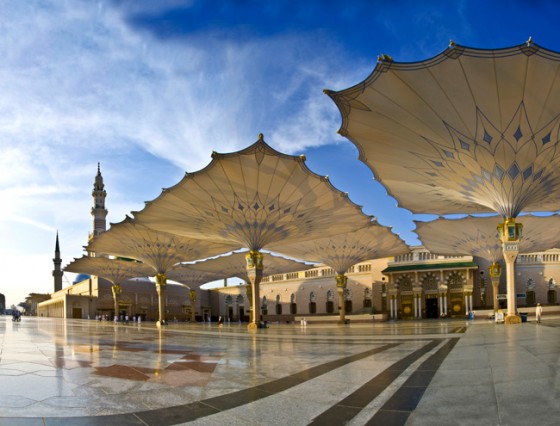
Like blooming flowers, umbrellas are programmed to fold and unfold in minutely delayed sequence to avoid collision between their moving parts. Their near-silent operation is automatically aligned with changes in daily temperature. They open each morning, creating a translucent ceiling, and retract each evening in less than three minutes, leaving a forest of 250 elegantly detailed posts towering over expansive public spaces.
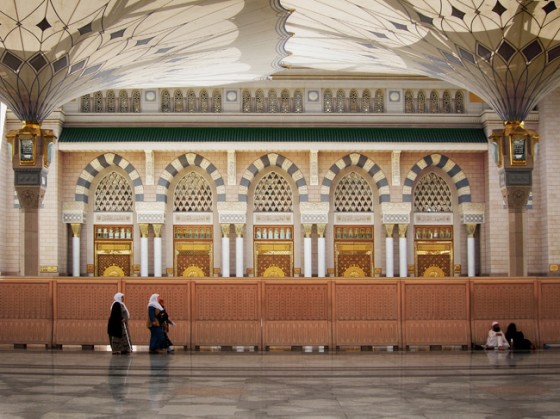
In summer, the open umbrellas provide daytime shading and reflect away much of the sun’s radiant energy. When closed at night, they allow residual heat absorbed by the stone floors and walls to escape back into the atmosphere. The process is reversed in winter. When temperatures are relatively low, umbrellas are closed during the day to allow winter sun to warm the site, and opened at night to retain heat near ground level.
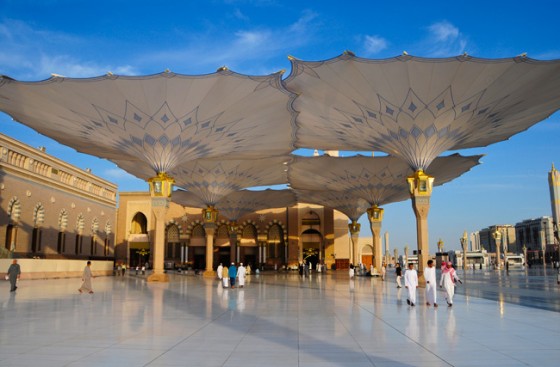
The structural posts are multi-functional. They channel infrequent rain towards the center of each column, which is connected to the building drainage system. Lamps in the column capitals provide nightime illumination.
This project has successfully reduced the courtyard’s ambient daytime temperature by 14 degrees F. Increasing bodily comfort allows pilgrims to focus on more spiritual concerns.
Twenty years ago, SL-Rasch created another solution to the climate/crowd dilemma.
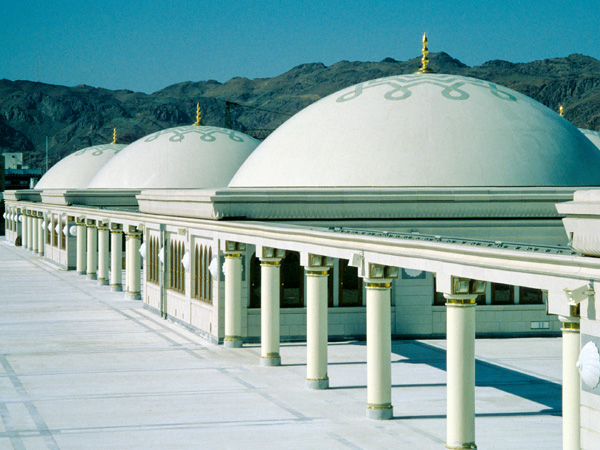 Embracing three sides of the Prophet’s Mosque, the King Fahd Bin Abdul Aziz extension provided a new 112,000 square meter area for outdoor assembly during Hajj. Innovative “sliding” domes were devised to protect the plaza from intense sunlight and heat, while providing natural light and ventilation, in a fully flexible way.
The mosque itself is air-conditioned. Lowering temperatures in the surrounding courtyards reduces cooling demand inside. Shading the courtyards accomplishes this, plus provides comfortable areas for the pilgrims outside.
The sliding domes, installed on raised rails, are moved over the open spaces to create shade in the hot season. At night, they can be slid back into “parked position” over the roofs immediately adjacent to each courtyard. As with the newer umbrellas, the process is reversed in cooler seasons.
Each dome is a sandwich made of a carbon-glass/fiber and epoxy filling with ceramic tiles integrated on top and an undersurface of intricately decorated wood laminate. Domes are edged in artificial stone to match the roof cornice of the mosque. A computerized control system glides the hefty forms quietly into place. The dome project was awarded Best Innovation prize by the International Association for Automation and Robotics in 1993.
Green Prophet eagerly looks forward to what comes next from this ingenious facility, as it blends technology with antiquity to meet the needs of its growing congregation.
Umbrella images via Sefar Architects; Dome image by Premiere Composite Technologies, LLC


It looks like the elf city in world of warcraft 😀
These pictures look amazing. The place looks so clean and new and surprisingly empty. spirulina
They’re not new actually 🙂
It have to be clean and organised, it’s a very holy place for muslims after all.
The mosque is 1400 years old, but there have been many improvement along the way, but some parts of it are still the same