
Pollution From North Africa Shuts Down Israeli Airports

pollution, north africa, dust storm, air pollution, tel aviv, eilat, israel, co2 emissions, climate changeHazy conditions stemming from dust particles that traveled from North Africa to Israel shut down two Israeli airports last week.

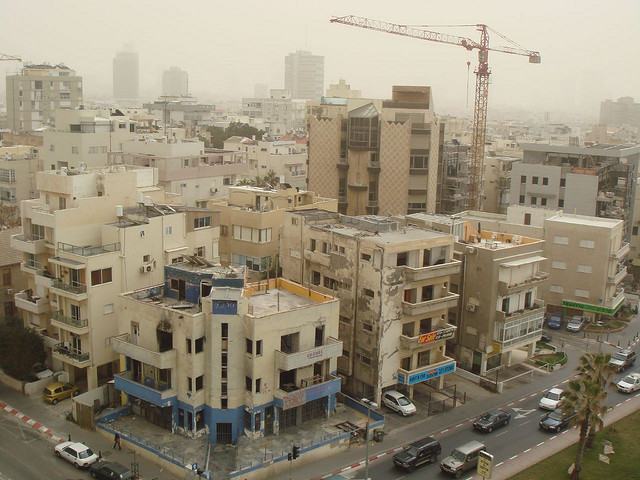
Last week two airports in Israel had to shut down because the sky was so hazy and visibility was so limited, Haaretz reports. Both the Sde Dor Airport in Tel Aviv and Eilat’s airport shut down on 7th of February as a result of air pollution concentrations more than twelve times higher than usual. These conditions are expected to continue through Wednesday.

Israel’s Environmental Ministry explained that a low pressure weather system over Southern Greece moved into Israel and trapped particulates that traveled from a dust storm in North Africa. This is not the first time that Israeli researchers have discovered pollution stemming from outside the borders – sometimes laced with heavy metals.

Pollution travels

We often note that nature has no borders and this is a classic example. Pollution from Eastern and Western Europe hover in Israeli skies 2/3 of the year, according to a Haaretz news report from last year. And for 1/5 of the year, harmful pollutants travel from Saudi Arabia, Jordan, and North Africa.

Egypt’s air pollution is particularly bad as a result of poor environmental regulations and archaic agricultural, manufacturing, and waste management protocols. Every year, residents of Cairo brace themselves for “The Black Cloud.”

This cloud of dark pollution over the cityoccurs when a low pressure system similar to the one Israel is currently experiencing coincides with farmers burning off  the by products of their annual rice harvest.

According to Haaretz, researchers from the Hebrew Univeristy and the Weizmann Institute have found toxic metals and pesticides that often travel on the backs of dust particles from countries in North Africa and elsewhere. As a result of this, they have called for regional players to establish environmental rules that protect everyone from air pollution.

Domestic pollution

In the meantime, Israel continues to pursue policies that excacerbate their own air pollution challenges. Although natural gas gives off less emissions than oil, it is by no means a “clean energy source.”

According to the IPCC Fourth Assessment Report (Working Group III Report, chapter 4), in 2004, natural gas produced about 5.3 billion tons a year of CO2 emissions. It also consists of methane, which is a far more powerful greenhouse gas than carbon dioxide, though it has a far shorter atmosphereic lifespan.

Massive gas fields discovered in the Mediterranean are expected to finally admit Israel to the Middle East fossil fuel game – albeit a little late and in the face of climate change. But this also means that the country’s air pollution – so quickly attributed to sources outside of the country – is unlikely to improve any time soon.

Meanwhile, children, elderly people, pregnant women, and people who suffer from asthma or other respatory diseases are discouraged from engaging in any strenuous activity while conditions remain hazy.

:: Haaretz

image via Austin Evan, Flickr

More on Israel’s Environmental Issues:

Israel’s Environmental Ministry Implements New Green Building Standards

Water Pollution in Israel Threatens People, Plants, and Animals
Polluting Cars May be Banned From Israel

Tafline Laylin
Tafline Laylinhttp://www.greenprophet.com
As a tour leader who led “eco-friendly” camping trips throughout North America, Tafline soon realized that she was instead leaving behind a trail of gas fumes, plastic bottles and Pringles. In fact, wherever she traveled – whether it was Viet Nam or South Africa or England – it became clear how inefficiently the mandate to re-think our consumer culture is reaching the general public. Born in Iran, raised in South Africa and the United States, she currently splits her time between Africa and the Middle East. Tafline can be reached at tafline (at) greenprophet (dot) com.

Hot this week

How Renewable Energy is Revolutionizing the Way We Power Our World

Solar has become the star of the transition thanks to modular hardware and straightforward installation. It fits dense cities and remote towns alike. Many companies are turning to rooftop arrays and carport systems - and exploring commercial solar installation as a practical way to lock in future savings.

How does one start prepping?

Faced with an extreme winter storm this year, Americans wonder how to be prepared for catastrophe. Miriam has lived through wars in the Middle East - so she's prepared on giving you a guide to prepping.

Fishermen sue tire manufacturers on behalf of the salmon

A federal trial in San Francisco has brought US tire manufacturers, fishing groups, and environmental scientists into court over a chemical most drivers have never heard of — but which scientists say may be silently reshaping aquatic ecosystems.

Listening to Water: Tarek Atoui’s Next Work for Tate Modern

Born in Beirut, Lebanon in 1980 and now living in Paris, Atoui has spent years building instruments that don’t sit comfortably in concert halls. Many of them involve water, glass, and ceramics — materials that react to sound instead of simply producing it.

Leading Through a Dual-Energy Transition: Balancing Decarbonisation with Energy Security

Experience in one area of the energy industry isn't enough to guarantee readiness across all the others. That's where a structured program like an MBA in energy can come in. Today's advanced curricula explore energy economics, finance, policy, and strategic management alongside the technical subjects. And when pursuing an energy MBA online, professionals can skill up and retrain without having to step out of the labor market -- an important perk at a time when skilled professionals are already in short supply.

Topics

How Renewable Energy is Revolutionizing the Way We Power Our World

Solar has become the star of the transition thanks to modular hardware and straightforward installation. It fits dense cities and remote towns alike. Many companies are turning to rooftop arrays and carport systems - and exploring commercial solar installation as a practical way to lock in future savings.

How does one start prepping?

Faced with an extreme winter storm this year, Americans wonder how to be prepared for catastrophe. Miriam has lived through wars in the Middle East - so she's prepared on giving you a guide to prepping.

Fishermen sue tire manufacturers on behalf of the salmon

A federal trial in San Francisco has brought US tire manufacturers, fishing groups, and environmental scientists into court over a chemical most drivers have never heard of — but which scientists say may be silently reshaping aquatic ecosystems.

Listening to Water: Tarek Atoui’s Next Work for Tate Modern

Born in Beirut, Lebanon in 1980 and now living in Paris, Atoui has spent years building instruments that don’t sit comfortably in concert halls. Many of them involve water, glass, and ceramics — materials that react to sound instead of simply producing it.

Leading Through a Dual-Energy Transition: Balancing Decarbonisation with Energy Security

Experience in one area of the energy industry isn't enough to guarantee readiness across all the others. That's where a structured program like an MBA in energy can come in. Today's advanced curricula explore energy economics, finance, policy, and strategic management alongside the technical subjects. And when pursuing an energy MBA online, professionals can skill up and retrain without having to step out of the labor market -- an important perk at a time when skilled professionals are already in short supply.

From Green Energy to Healthy Societies: Why old systems thinking is becoming relevant again

Across the Middle East and North Africa, large investments are being made in green hydrogen, renewable energy, water infrastructure and sustainability. Most of these efforts are discussed in the context of climate change, decarbonization and economic diversification. That framing is important, but it may not capture their full value.

We saw peace – an interreligious encounter deep in our eyes

They came from Israel, Palestine, Jordan, Iraq, Yemen, Morocco, Tunisia, Lebanon, Egypt… There are Sunni Muslims, Shiite Muslims, Jews (Orthodox and Reform), Orthodox Christians, Coptic Christians, Protestant Christians, Druze, Baha'is, a Scientologist.

Can biochar reduce ‘Forever Chemicals’ in food if it’s used in farms?

Biochar is produced by heating organic material in a low-oxygen environment so it does not burn. This process, known as pyrolysis, transforms plant matter into a stable, carbon-rich material.

Related Articles

Popular Categories