

Dubai is not the first Middle Eastern country you think of when you think climate-friendly. That’s about to change.
Dubai will develop a strategy to reduce carbon dioxide and greenhouse gas emissions, as well as recommendations for ultimately monetising them through a groundbreaking carbon trading scheme, it was announced today.
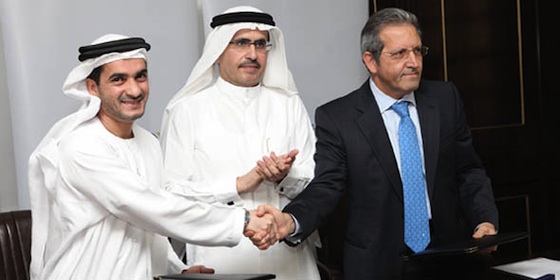
“Our commitment towards a green economy starts today with the creation of a platform to monitor and benchmark our carbon performance, ” said His Excellency Saeed Al Tayer, VP of Dubai Supreme Council of Energy (DSCE) who made the extraordinary announcement, flanked by Waleed Salman, Chairman of the Dubai Carbon Centre of Excellence (DCCE) and Nejib Zaafrani, CEO of DSCE. “Any policy or activity cannot be properly assessed unless it is measurable and quantifiable.”
Both organizations see this as an opportunity to encourage low-carbon industries and attract foreign investment. Like its utilities, that last year addressed energy waste that is among the highest in the world, what makes Al Tayer’s announced decision all the more bold is that the DSCE is – like most OPEC nations’ energy councils, of course – very oil-centric.
The DCCE, only formed in April 2011, to encourage and complement a business-led drive towards de-carbonising the UAE economy, will bring expertise that will help the Council develop emissions reduction frameworks aligned with global standards, said Waleed, who expects to harness the many economic opportunities of emissions reduction.
Waleed’s organization has partnered with the Emirate’s energy council to verify preliminary studies on carbon dioxide emissions. (Last year, Dubai launched the first carbon calculator in Arabic for residents)
Starting from a carbon dioxide baseline study by the DSCE in the fourth quarter of 2011, the DCCE will complete a detailed inventory of Dubai’s greenhouse gas emissions in line with the requirements of the International Panel on Climate Change, and the United Nations Framework Convention on Climate Change.
Emirate-wide research on greenhouse gas emissions will be be continued and frameworks developed with relevant industries aimed at introducing a comprehensive carbon dioxide abatement programme.
It will recommend viable targets for reducing carbon dioxide and greenhouse gases and a methodology to monetise emissions, similar to the European Trading Scheme, the Clean Development Mechanism developed under the Kyoto Protocol, and other carbon reduction schemes.
The Middle East will play a key role in this December’s international climate negotiations – to be held in Qatar this year – considering the region’s interest in furthering the rules and limitations on carbon capture.
Zaafrani said: “We also aspire to play an active role at the federal level in the UAE’s efforts to develop and implement Carbon Capture and Storage (CCS) activities, through the DCCE.”
A very interesting development, and a long-awaited serious attempt by Dubai at a solution to climate change which will hit the region hard. This year Dubai ended fossil fuel subsidies (Dubai Ends Cheap Local Gas) one of the most recommended way to reduce fossil fuel dependence.
Together with its very tough new building standards we could see Dubai begin to shed its image of fatuous and purposeless consumption (Dubai Breaks its Own Record for the World’s Tallest Hotel) and move to the forefront of implementing long term sustainable solutions to humanity’s real problems. Certainly, it is financially well positioned for succeeding in a more sustainable route to a more pleasant future.
Related stories:
Dubai’s New Net Zero Building Codes
Dubai Gets Frozen Air From Europe
Dubai to Invest $3 Billion in 1000 MW Solar Farm! …But Slowly



Well, there will be another one cap-and-trade after EU ETS, California and Australia schemes. That’s good.
A few points on this post. Dubai is not a country but a (con)federal unit. Also, there’s a very long way from ‘recommendations’ to actually having a carbon market up and running, as you well know, which is why the title is quite misleading in my view. With its small oil reserves dwindling and extremely low economic dependence on fossil fuels, one could hardly argue that Dubai is an OPEC exporter (particularly given that it does not consider itself bound by the organisation’s production quotas). Could you please elaborate on what you mean with the DCSE being ‘very oil-centric’. The 2030 energy strategy will be based on gas, renewables and ‘clean’ coal, right? Finally, are you suggesting that Dubai would have ended subsidies on utilities? In fact, with the Arab Spring and the still on-going economic slowdown, utility prices have been frozen for the coming years.