
Afghanistan’s irrigation network gets an eco upgrade

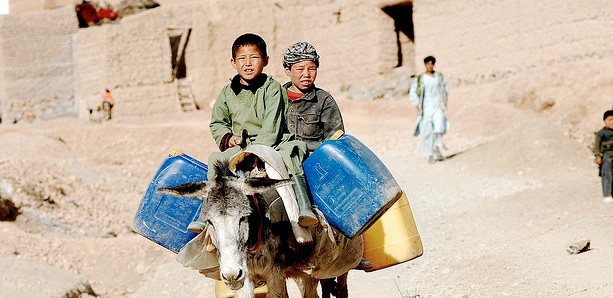
afghan boys carrying water on donkeyWorld Banks funds new irrigation project for Afghans.

The UN Food and Agriculture Organization is boosting its technical support for rehabilitation of Afghanistan‘s dilapidated traditional irrigation systems, in a bid to help farmers increase crop production. The initiative also aims to improve the knowledge and skills that farmers need to run and maintain irrigation systems.

The UN organization has signed a $27.7 million agreement with the Afghan Ministry of Energy and Water to provide technical assistance, including expertise and training for implementation of the Irrigation Restoration and Development Project (IRDP). This comes after decades of war in Afghanistan and migration away from rural areas have contributed to the degradation and neglect of the country’s irrigation system.

The lack of efficient irrigation facilities has left many farmers without sufficient water for agriculture, including the production of wheat, the country’s main staple food crop. But in recent years, the country’s Ministry of Energy and Water has placed a priority on water resources development within its National Development Strategy.

“The irrigation systems had suffered over the past three decades, not only because of a lack of investment, but also because people were moving away from the rural areas, leaving no one to maintain the systems or transfer indigenous skills to the younger generation. When there was a flood, for instance, there was no one to repair or clean up damaged canals or dams. So farmers in rural areas were not able to get enough water to cultivate their fields. As a result, they produced fewer crops,” said Pasquale Steduto, head of FAO’s Water Development and Management Unit.

The project is primarily funded by a grant from the World Bank with an additional contribution from the Government of Afghanistan. It builds on experience gained from FAO’s implementation of the Bank’s Emergency Irrigation Rehabilitation Project, which was completed in December 2011.

That emergency project strengthened the capacity of the Ministry’s Project Coordination Unit to plan and manage the rehabilitation of irrigation systems. The new six-year restoration and development project plans to follow up by designing and developing small storage dams, in addition to rehabilitating irrigation systems.

It will also complete development of hydro-meteorological networks and services to monitor weather conditions, water flow and water quality issues, and will include training in operation and maintenance of the networks.

Better irrigation, more crops

FAO will help the Ministry of Energy and Water by training personnel and assisting in the use of modern design and management methods. The initiative will also train farmers in improved water management practices, and operation and maintenance of irrigation systems.

The overall project objective is to increase agricultural productivity and production in the project areas, in line with the Afghanistan National Development Strategy.

The rehabilitation of irrigation schemes around the country are expected to cover a total irrigated area of about 300 000 ha, increase irrigated areas by about 15 percent, lead to an increase in the crop yield of around 20 percent, and benefit around 230 000 households.

“Wheat is the most important crop for Afghanistan because for 80-100 percent of the population, it is the number-one staple crop. And roughly 80 percent of the land which farmers cultivated is tilled for wheat. So any reduction in the production of wheat means a shortage of food. It directly affects the food security situation in Afghanistan,” said Steduto.

::FAO


TRENDING

Forever chemicals banned from Europe’s drinking water

The EU is taking a bold step in making sure all European Union member states worked to monitor and reduce PFAS levels in drinking water.

Elon Musk to create Mars base station on the Moon

For those unaware, SpaceX has already shifted focus to building a self-growing city on the Moon, as we can potentially achieve that in less than 10 years, whereas Mars would take 20+ years.

Astro uses AI to help procure land for renewable energy

For oil-rich, environmentally vigilant Gulf states, Astro isn’t just another startup story. It is a blueprint for accelerating an energy transition that is now existential, not optional.

Sink holes from over-watering farmers’ fields

Sinkholes are rapidly appearing in Turkey’s central Anatolian farming region, particularly around Konya and Karapınar. These giant gaping holes in the ground in areas of farmland, known locally as obruk, are not random geological events. They are linked to prolonged drought, climate-driven heat stress, and heavy groundwater extraction for agriculture in one of the country’s most important breadbaskets.

Oil pollution in Basrah’s soil is 1,200% higher than it should be

Soil pollution levels in parts of Basra are 1,200% to 3,300% higher than those typically measured in cities like Toronto or New York, according to new comparative soil data. It's getting into water.

Turning Your Energy Consultancy into an LLC: 4 Legal Steps for Founders in Texas

If you are starting a renewable energy business in Texas, learn how to start an LLC by the books.

Tracking the Impacts of a Hydroelectric Dam Along the Tigris River

For the next two months, I'll be taking a break from my usual Green Prophet posts to report on a transnational environmental issue: the Ilısu Dam currently under construction in Turkey, and the ways it will transform life along the Tigris River.

6 Payment Processors With the Fastest Onboarding for SMBs

Get your SMB up and running fast with these 6 payment processors. Compare the quickest onboarding options to start accepting customer payments without delay.

Qatar’s climate hypocrisy rides the London Underground

Qatar remains a master of doublethink—burning gas by the megaton while selling “sustainability” to a world desperate for clean air. Wake up from your slumber people.

How Quality of Hire Shapes Modern Recruitment

A 2024 survey by Deloitte found that 76% of talent leaders now consider long-term retention and workforce contribution among their most important hiring success metrics—far surpassing time-to-fill or cost-per-hire. As the expectations for new hires deepen, companies must also confront the inherent challenges in redefining and accurately measuring hiring quality.

8 Team-Building Exercises to Start the Week Off 

Team building to change the world! The best renewable energy companies are ones that function.

Thank you, LinkedIn — and what your Jobs on the Rise report means for sustainable careers

While “green jobs” aren’t always labeled as such, many of the fastest-growing roles are directly enabling the energy transition, climate resilience, and lower-carbon systems: Number one on their list is Artificial Intelligence engineers. But what does that mean? Vibe coding Claude? 

Somali pirates steal oil tankers

The pirates often stage their heists out of Somalia, a lawless country, with a weak central government that is grappling with a violent Islamist insurgency. Using speedboats that swarm the targets, the machine-gun-toting pirates take control of merchant ships and then hold the vessels, crew and cargo for ransom.

Related Articles

Popular Categories