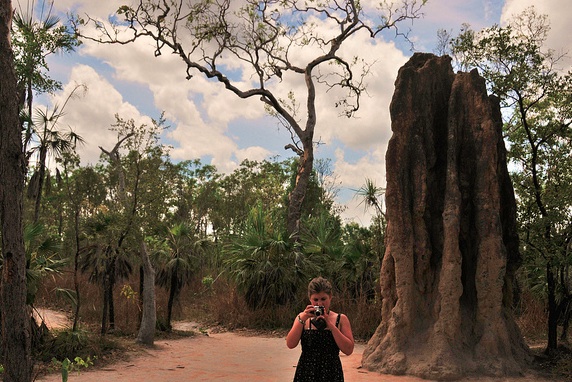
Termite Mounds Inspire Energy Neutral Buildings

termite mound, adelaide, biomimicryMr. Dubai, why not build your hotel like a termite would?

Green Prophet has written many articles on green building, and the revival of beautiful earth architecture in the Middle East. Earth architecture is certainly a more sustainable and interesting alternative solution – for those lucky enough to own some rural land, but can buildings made from earth be a viable solution for cities? Can earth architecture sustain the ever increasing urban population?

Personally I do not think so. If the entire population of New York, for example, were to live in earth buildings, the total surface area required to fit everyone would be huge. In the end the per capita carbon foot print may be even larger (more roads will be required and greater distances travelled which releases more CO2 for example).

Given that in 2008, for the first time in history, more than half of the human population lived in urban areas and that by 2030, especially in the developing world, towns and cities are expected to harbor up to 81% of the world population; how and what should sustainable architecture and living in urban areas look like?

One solution is to observe nature, and apply its solutions to “human problems”. Nature has had 3.8 billion years’ worth of evolution and trial and error to perfect solutions so that it can become self-sustaining, so learning from it seems like a clever idea.

Biomimicry essentially seeks inspiration from natures’ genius and creativity to improve efficiency and sustainability in the “human” world we have created.  A perfect example is how termite mounds have inspired clever ventilation systems in architecture that reduce energy usage and costs.

Natures’ solution:

Termites farm their own food source, a type of fungus, inside the 1 to 3 meter tall mounds they build from debris and soil. This fungus must be kept at exactly 30.5 °C, while temperatures outside range from 2 °C at night to 40 °C during the day.

Termites have devised (links to PDF) a system of vents and channels inside the mounds so that the temperature inside the mound can be maintained constant at 30.5 °C (side note: will global warming affect this? How will termites adapt? Will they adapt quick enough?).

Termites then open and close a series of vents throughout the mound so that air can circulates in a way that heats or cools the mounds.

Application to modern construction:

This “passive ventilation” system of adjusted convection currents has been applied by architects to design buildings like the Eastgate center in Zimbabwe. The Eastgate center is designed to draw outside air into the building’s floor and offices; the air is then warmed if the building mass is warmer than the air or cooled if the building mass is colder than the air before exiting via chimneys at the top (which are opened or closed depending on the required internal temperatures).

This system is so efficient that the Eastgate complex does not need to use air conditioning , as a result it has avoided $3.5 million in air conditioning equipment and uses only 35 % of the energy required for temperature regulation as a conventional building of similar size, with similar exterior temperatures.

These cost savings have translated into 20% lower rental rates than for tenants living in nearby buildings as well as a significant reduction in the buildings’ environmental impact.

Now, given that CO2 emissions are expected to double in the next 30 years in the Middle East, and emissions from air conditioning (especially in the Gulf states) also contributes to the regions’ carbon foot print ; self thermoregulating buildings in the Middle East could realistically accommodate increasing urban populations while reducing the carbon footprint from air conditioning.

Oil rich countries have the luxury of being a little more extravagant in their construction choices; why not build smartly like termites do? Mr Dubai, why not build your hotel like a termite would?

Image via 1234abcd

Linda Pappagallo
Linda Pappagallohttps://www.greenprophet.com/
Linda's love for nature started when at the age of eight she discovered, with her dog, a magical river in the valley of a mountainous region in Lebanon. For four years Linda and her dog explored along the river, until one day she saw construction scrapers pushing rock boulders down the valley to make way for new construction sites. The rubble came crashing into the river destroying her little paradise, and her pathetic reaction was to shout at the mechanic monsters. Of course that was not enough to stop the destructive processes. As she continued to observe severe environmental degradation across the different places she lived in the Middle East and Africa, these terrible images remained impressed in her mind. However, environmental issues where not her first love. Her initial academic and career choices veered towards sustainable economic development, with particular interest in savings led microfinance schemes. Nevertheless, through experience, she soon realized a seemingly obvious but undervalued concept. While humans can somewhat defend themselves from the greed of other humans, nature cannot. Also nature, the environment, is the main “system” that humans depend on, not economics. These conclusions changed her path and she is now studying a Masters in International Affairs with a concentration in Energy and the Environment in New York. Her interests lie on ecosystems management: that is how to preserve the integrity of an Ecosystem while allowing for sustainable economic development, in particular in the Middle East and Africa.

LEAVE A REPLY

Please enter your comment!
Please enter your name here

TRENDING

Astro uses AI to help procure land for renewable energy

For oil-rich, environmentally vigilant Gulf states, Astro isn’t just another startup story. It is a blueprint for accelerating an energy transition that is now existential, not optional.

How you create green steel on a blockchain

The thing about raw materials is that once they are melted down, you can't prove the source of the material. Same is true with gold, cucumbers and even forged products that look the same as the real thing. When it comes to steel, and how we produce it, it has a massive carbon problem. What's happening in Japan right now could change how we think about heavy industry and climate action.

Runners Can Break Guinness World Records at the Dubai Marathon in 2026

Runners at the Dubai Marathon will have a rare chance to enter the Guinness World Records archive this year, as the global record-keeping authority partners with the marathon to mark the race’s 25th anniversary.

Thank you, LinkedIn — and what your Jobs on the Rise report means for sustainable careers

While “green jobs” aren’t always labeled as such, many of the fastest-growing roles are directly enabling the energy transition, climate resilience, and lower-carbon systems: Number one on their list is Artificial Intelligence engineers. But what does that mean? Vibe coding Claude? 

Dubai developer uproots ancient Italian olive trees, $270,000 USD each for “eco” project

Flying centuries-old trees across continents via specialized cargo burns enormous fossil fuels. Replanting them in a desert climate—no matter how advanced the irrigation or “heritage preservation techniques”—places immense stress on organisms that evolved for Mediterranean seasons, soils, and rainfall patterns. And we've seen that the UAE is not capable of taking care of trees so survival rates are uncertain.

Qatar’s climate hypocrisy rides the London Underground

Qatar remains a master of doublethink—burning gas by the megaton while selling “sustainability” to a world desperate for clean air. Wake up from your slumber people.

How Quality of Hire Shapes Modern Recruitment

A 2024 survey by Deloitte found that 76% of talent leaders now consider long-term retention and workforce contribution among their most important hiring success metrics—far surpassing time-to-fill or cost-per-hire. As the expectations for new hires deepen, companies must also confront the inherent challenges in redefining and accurately measuring hiring quality.

8 Team-Building Exercises to Start the Week Off 

Team building to change the world! The best renewable energy companies are ones that function.

Thank you, LinkedIn — and what your Jobs on the Rise report means for sustainable careers

While “green jobs” aren’t always labeled as such, many of the fastest-growing roles are directly enabling the energy transition, climate resilience, and lower-carbon systems: Number one on their list is Artificial Intelligence engineers. But what does that mean? Vibe coding Claude? 

Somali pirates steal oil tankers

The pirates often stage their heists out of Somalia, a lawless country, with a weak central government that is grappling with a violent Islamist insurgency. Using speedboats that swarm the targets, the machine-gun-toting pirates take control of merchant ships and then hold the vessels, crew and cargo for ransom.

Leopoldo Alejandro Betancourt López Turned Ocean Plastic Into Profitable Sunglasses

Few fashion accessories carry the environmental burden of sunglasses. Most frames are constructed from petroleum-based plastics and acrylic polymers that linger in landfills for centuries, shedding microplastics into soil and waterways long after they've been discarded. Leopoldo Alejandro Betancourt López, president of the Spanish eyewear brand Hawkers, saw this problem differently than most industry executives.

Why Dr. Tony Jacob Sees Texas Business Egos as Warning Signs

Everything's bigger in Texas. Except business egos.  Dr. Tony Jacob figured...

Israel and America Sign Renewable Energy Cooperation Deal

Other announcements made at the conference include the Timna Renewable Energy Park, which will be a center for R&D, and the AORA Solar Thermal Module at Kibbutz Samar, the world's first commercial hybrid solar gas-turbine power plant that is already nearing completion. Solel Solar Systems announced it was beginning construction of a 50 MW solar field in Lebrija, Spain, and Brightsource Energy made a pre-conference announcement that it had inked the world's largest solar deal to date with Southern California Edison (SCE).

Related Articles

Popular Categories