Police Beat, Tie-Up, and Fire On Citizens Protesting Dying Ramsar Protected Lake in Iran

environmental activism, Lake Urmia, Iran,

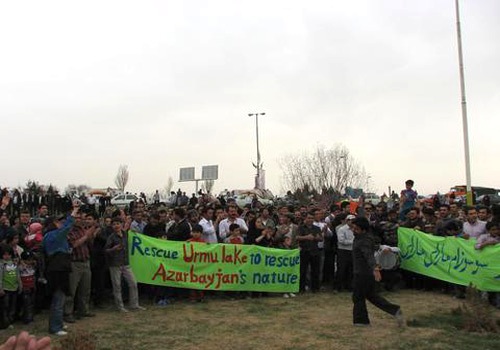
Police violently repressed activists protesting the nearly irreversible damage done to the Middle East’s largest salt lake over the weekend. This image was taken of a protest earlier this year.

Like a chain of dominos, citizen protests are erupting everywhere: following the Tunisian and Egyptian revolutions catalyzed in part by skyrocketing food prices, political protests have swept throughout the Arab world. But it hasn’t stopped there, and not all battles are political.

In Jordan, ordinary people are protesting government plans to include nuclear power in its arsenal of energy sources, while in the United States, Bill McKibben and other well-respected community members, including Jim Hansen from NASA, have been arrested for marching against the Keystone XL Pipeline –  a carbon bomb that climatologists say would officially end the battle against climate change (humanity 0 vs. climate change 7 billion). But none of these latter environmental events has garnered such an extreme response as the Lake Orumiyeh protests in Iran, where bloggers report that people are being arrested, beaten, and in some cases tied to trees for protesting the slow death of the world’s second largest salt lake.
environmental degradation, Lake Urmia, Iran, Salt Lake, protestors

Dried up Mecca

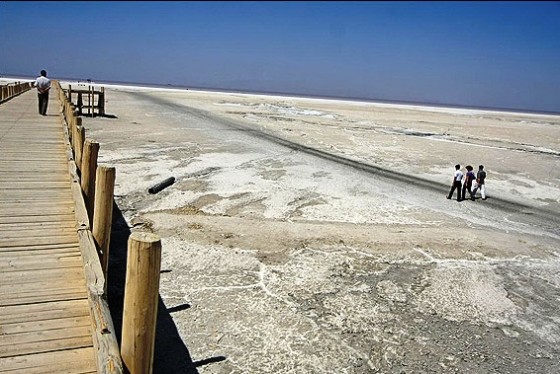
In part because of drought and in part because of poorly managed dam construction and irrigation projects, Lake Orumiyeh or Urmia in Northwestern Iran has shrunk to roughly 60% of its original size. Once a mecca for flamingos and other wildlife, the dying lake now more closely resembles a dusty moonscape.

Residents in Azerbaijan that rely on the Ramsar protected site for their sustenance claim that Revolutionary Guards are responsible for shrinking lake levels and the subsequent rise in salinity and decrease in biodiversity. Global Voices claims that if Lake Urmia dries up completely, millions of people will have to settle elsewhere.

Authorities get dirty
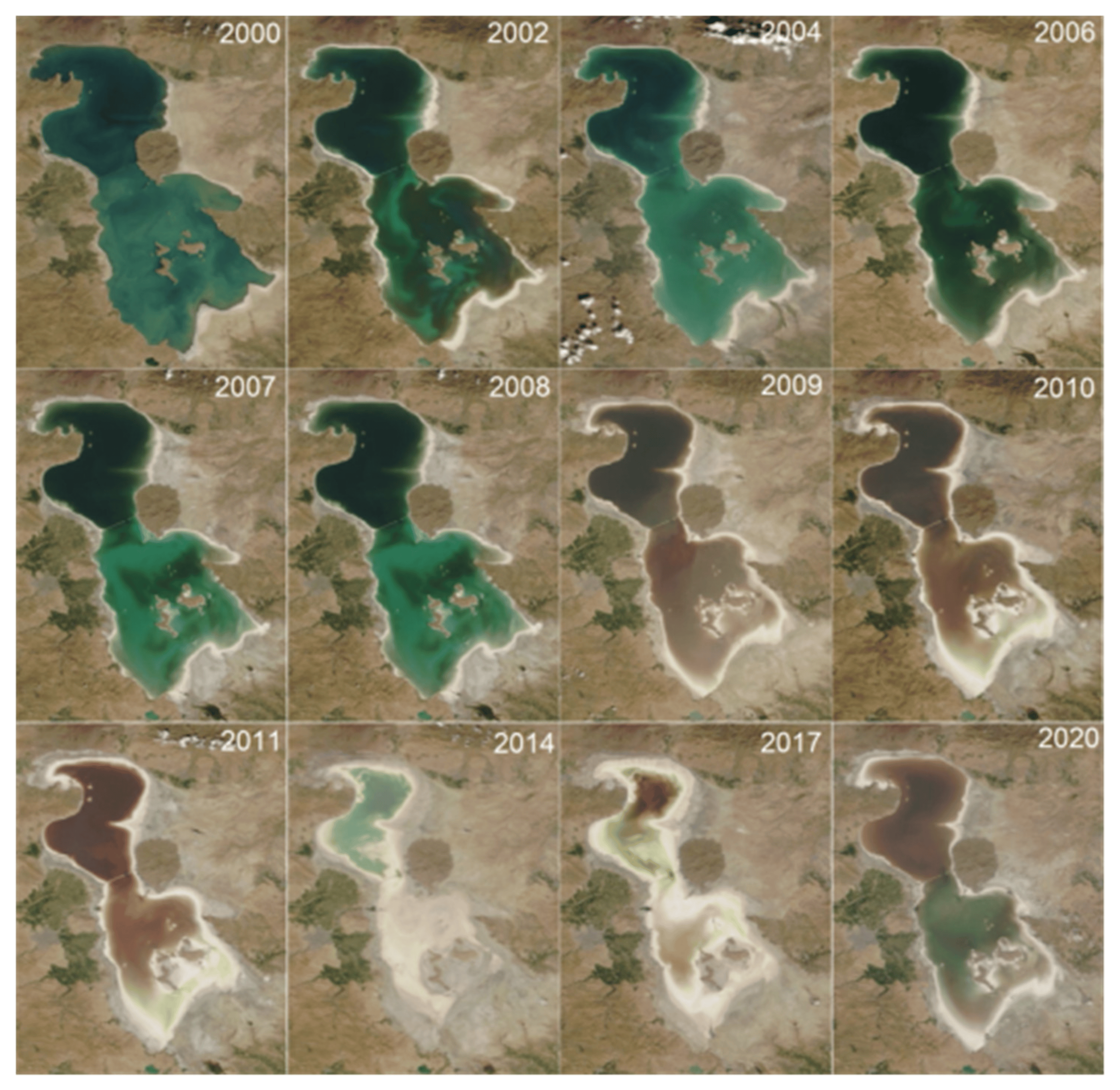
Lake Urmia according to NASA, over time

Spurred on by these concerns, thousands of protestors spilled into the streets of Tabriz and Urmia last weekend in order to put pressure on the government to step up conservation efforts. But eyewitnesses report that protests quickly took an ominous turn.

According to one blogger, Urmuiscielli, policemen beat and arrested protestors, some of whom were tied to trees.

Although the police crackdown was censored in the mainstream Iranian press, Iran’s Independent Press picked up the story, and the blogosphere was populated by video footage and calls for other citizens to support Azeri activists and re-launch anti-regime demonstrations.

Crimes against humanity

If taken seriously, the increase of environmentally-themed disputes between citizens and their governments, even in the Middle East, could spur a whole new era of accountability measures. Protestors who show little willingness to compromise until real action is taken have the power to disrupt the smooth functioning of society to such an extent that governments (a la Egypt) will have no choice but to instill effect change.

And eventually, when environmental degradation is unequivocally linked to an increase in environmental refugees, green-minded lawmakers such as Polly Higgins, who has been campaigning the United Nations to make Ecocide a crime against humanity, will be better poised for success.

Of course, none of this will happen in Iran anytime soon given that country’s oppressive regime and appalling environmental record, even though these protests show an increasingly emboldened (or desperate?) populace.

:: Global Voices

More on Iranian Environmental Issues:
Saltier than the Dead Sea, Lake Orumiyeh is in Trouble

Iran Lacks Water Planning

Iran and Qatar Align to Help the Environment

Tafline Laylin
Tafline Laylinhttp://www.greenprophet.com
As a tour leader who led “eco-friendly” camping trips throughout North America, Tafline soon realized that she was instead leaving behind a trail of gas fumes, plastic bottles and Pringles. In fact, wherever she traveled – whether it was Viet Nam or South Africa or England – it became clear how inefficiently the mandate to re-think our consumer culture is reaching the general public. Born in Iran, raised in South Africa and the United States, she currently splits her time between Africa and the Middle East. Tafline can be reached at tafline (at) greenprophet (dot) com.
2 COMMENTS

Comments are closed.

Hot this week

Why Health Systems Are Reaching a Turning Point

Health emerges from a continuous energy and material flow from water through food to human physiology. Technical energy systems support this cycle through water treatment, agriculture, and infrastructure.

Sustainability That Sells: How Profit and Purpose Come Together in the Hive

Whether you are a commercial grower, hobbyist beekeeper or retail equipment supplier, this system opens a new income stream with minimal environmental impact.

The Fitness App Revolution: Building the Future of Wellness Through Strategic Development

In an era where smartphones are ubiquitous and health consciousness is at an all-time high, the fitness industry has undergone a radical digital transformation. Fitness applications have moved far beyond simple pedometers, evolving into comprehensive wellness platforms that serve as personal trainers, nutritionists, and community hubs right in our pockets.

A Brief History of Basil From India to Italy

Beloved, fortunate, sweet, and royal; an herb with a long and storied history in Asia and across the world. Called by many names, basil has featured in previous Green Prophet articles, so enjoy another serving, a brief history of basil.

How Renewable Energy is Revolutionizing the Way We Power Our World

Solar has become the star of the transition thanks to modular hardware and straightforward installation. It fits dense cities and remote towns alike. Many companies are turning to rooftop arrays and carport systems - and exploring commercial solar installation as a practical way to lock in future savings.

Topics

Why Health Systems Are Reaching a Turning Point

Health emerges from a continuous energy and material flow from water through food to human physiology. Technical energy systems support this cycle through water treatment, agriculture, and infrastructure.

Sustainability That Sells: How Profit and Purpose Come Together in the Hive

Whether you are a commercial grower, hobbyist beekeeper or retail equipment supplier, this system opens a new income stream with minimal environmental impact.

The Fitness App Revolution: Building the Future of Wellness Through Strategic Development

In an era where smartphones are ubiquitous and health consciousness is at an all-time high, the fitness industry has undergone a radical digital transformation. Fitness applications have moved far beyond simple pedometers, evolving into comprehensive wellness platforms that serve as personal trainers, nutritionists, and community hubs right in our pockets.

A Brief History of Basil From India to Italy

Beloved, fortunate, sweet, and royal; an herb with a long and storied history in Asia and across the world. Called by many names, basil has featured in previous Green Prophet articles, so enjoy another serving, a brief history of basil.

How Renewable Energy is Revolutionizing the Way We Power Our World

Solar has become the star of the transition thanks to modular hardware and straightforward installation. It fits dense cities and remote towns alike. Many companies are turning to rooftop arrays and carport systems - and exploring commercial solar installation as a practical way to lock in future savings.

How does one start prepping?

Faced with an extreme winter storm this year, Americans wonder how to be prepared for catastrophe. Miriam has lived through wars in the Middle East - so she's prepared on giving you a guide to prepping.

Fishermen sue tire manufacturers on behalf of the salmon

A federal trial in San Francisco has brought US tire manufacturers, fishing groups, and environmental scientists into court over a chemical most drivers have never heard of — but which scientists say may be silently reshaping aquatic ecosystems.

Listening to Water: Tarek Atoui’s Next Work for Tate Modern

Born in Beirut, Lebanon in 1980 and now living in Paris, Atoui has spent years building instruments that don’t sit comfortably in concert halls. Many of them involve water, glass, and ceramics — materials that react to sound instead of simply producing it.

Related Articles

Popular Categories