
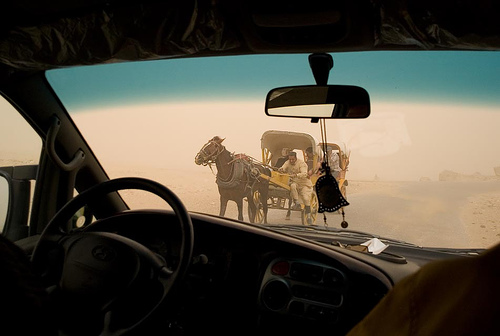


For those of us who live in the Middle East, those hot dry heat waves known as khamsini (in Arabic) or sharav (the Hebrew term) appear to be becoming more frequent, as well as more intense.
They also seem to be occurring during times of the year when they ordinarily are not supposed to – such as in what should be the winter rainy season.
A khamsini heat wave or dust storm as often occurs along with the heat wave, is usually characterized by intense dry heat, often accompanied by high winds. Temperatures can rise into the 40 degree celsius range and can be so intense that it can be actually dangerous to venture out of doors due to the intense heat and large amounts of dust the often come along with it.
A recent article in the Jordan Times mentioned that dust and sand storms caused by khamsini conditions were so bad that a number of roads were considered to be dangerous to drive on.
The risk of forest and brush fires are very high during this time, and in Israel, fires caused by sharav conditions have often occurred on the country’s Carmel Mountain range as well as in the mountains and hills in and around Jerusalem.
The word khamsini comes from the Arabic word hamsin which means 50, and refers to the 50 day period (usually between early February and May) when such weather conditions are most likely to occur. Spelled khamsin, khamseen, chamsin or hamsin (Egyptian Arabic: خمسين khamsīn, “fifty”), they are now occurring more frequently in the early and late summer when ground conditions are their driest and are can even be compared to sirocco heat waves which occur in Spain and other Mediterranean countries, often causing disastrous forest and brush fires.
Weather patterns have changed considerably during the past few years, and many meteorologists and climatologists are attributing these changes to global warming. The term ‘desertification‘ is also being used to indicate that as these weather patterns occur more frequently, the result in overall drier weather which can literally bring the desert closer to areas now considered less arid.
An intense khamsini can literally absorb all surface moisture on plants and topsoil and be dangerous for both humans and animals.
As concern for the consequences of global warming increases, the study of these seasonal (and non-seasonal) weather patterns will continue to receive the attention of regional scientists and agronomists to determine their effects on existing and future food supplies, as well as available ground water resources.
Could global warming be the basis for future wars in the Middle East, and are khamsinis a tell-tale sign of what’s to come?
More on global warming:
Do Middle East Cracks In The Earth Increase Carbon Emissions?
Israel Election Promises on Radiation and Global Warming
Water, War and Global Warming in the Middle East


[…] during the spring and early summer months, and occasionally during the fall, you might experience a hamsin, a hot wind that blows in from the south or southeast. The extreme heat can raise temperatures […]
[…] Khamsin means “fifty” in Arabic, a reference to the duration (in days) of this annual weather event where dust-filled windstorms blow sporadically over springtime months. Storms sometime descend like hurricanes, leaving behind an agitated atmosphere loaded with a fine grit that coats every surface, blocks the sun, and clogs your ears and nose. In between windy onslaughts, the air stays choked with sandy particles. The sky turns dingy and the temperature drops. […]
[…] Got it? These temperatures are definitely not typical for mid-October in Israel. (pssst…climate change) After lunch at Beit Guvrin, an underground ancient city and olive press factory, things cooled […]
[…] East is experiencing a strange transition from winter to summer. One day it’s hot, with a dry chamsin wind that sweeps in with a cloud of fine red dust. Bad news for asthmatics. The next day is […]
[…] funny! Also funny is that Taxman, to whom this purview really belongs, will be HIKING MASADA in a SHARAV today–no dust, just unseasonably […]
[…] Such a JNF Billion Tree Campaign would support and complement the action areas referred to above, as well as helping Israel to become a net negative contributor to man-made Climate Change. It would complete the transformation of Israel’s landscape and climate (which began with Zionist colonisation 150-odd years ago), and could quite conceivably mitigate much of the local impact of Global Warming and desertification. […]