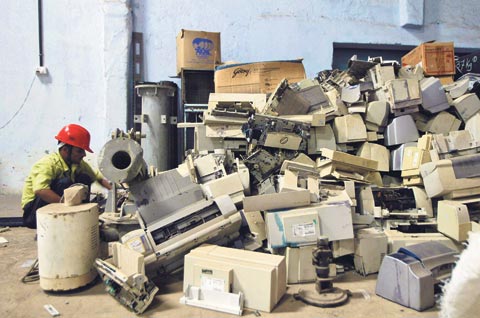
Turkish Government Gets Ready to Deal with Electronic Waste

As you sit in front of your computer now, reading the latest from Green Prophet, we challenge you to hark back to all of your former computers, printers, phones, batteries… you name it. 

Could you say where they are right now?  Unless you’re a pack rat, you probably got rid of them when they stopped working.  And how did you dispose of them?

Innocently enough, many of you probably threw them out with the regular trash. 

Unfortunately, that probably means that the plastic parts of those electronic devices will never biodegrade and will outlive you (and your children), and that the metal parts have disintegrated and trickled into the soil and water system.  Not to mention the clogging of landfills.  Among other bad things.

As with many other countries where the fast development of technology and increasing consumption of electronic devices has taken place, Turkey is experiencing a growing problem of electronic waste. 

Or, for those greenies in the know, e-waste (add that term to other green favorites – carborexic and vegawarian).

The per capita rate of electronic waste per person in Turkey was more than 2.5 kilograms in 2008, half of which is not disposed of properly or recycled.  And so the Turkish authorities are taking action, with the Environment and Forest Ministry aiming to collect 50 percent of e-waste in Turkey.

New regulations are expected to go into effect in the middle of 2009.

According to regulations approved by the EU in 2002, companies that produce electronic goods are responsible for overseeing the collection and disposal of electronic waste.  But environmental engineer at the Electronic Waste Recycling Company in Izmir, Metin Karacam, says that most recycling campaigns run by electronics distributors are based on the self interests of the companies rather than the interests of the customers.

There are currently three companies in Turkey that specialize in the collection and disposal of electronic waste.  Two of them operate only in Izmir and one operates in both Izmir and Istanbul, and they work with a special certificate from the Ministry of Environment and Forestry.

:: Today’s Zaman

Read more about electronic waste::
Re-Routing Deadly Electronic Waste
15 Ways to Mod and Upcycle Your Redundant PC
Israeli Entrepreneur Helps Found Succesful Electronics Recycling Website

Karen Chernick
Karen Chernickhttps://www.greenprophet.com/
Much to the disappointment of her Moroccan grandmother, Karen became a vegetarian at the age of seven because of a heartfelt respect for other forms of life. She also began her journey to understand her surroundings and her impact on the environment. She even starting an elementary school Ecology Club and an environmental newsletter in the 3rd grade. (The proceeds of the newsletter went to non-profit environmental organizations, of course.) She now studies in New York. Karen can be reached at karen (at) greenprophet (dot) com.
2 COMMENTS

LEAVE A REPLY

Please enter your comment!
Please enter your name here

TRENDING

Sink holes from over-watering farmers’ fields

Sinkholes are rapidly appearing in Turkey’s central Anatolian farming region, particularly around Konya and Karapınar. These giant gaping holes in the ground in areas of farmland, known locally as obruk, are not random geological events. They are linked to prolonged drought, climate-driven heat stress, and heavy groundwater extraction for agriculture in one of the country’s most important breadbaskets.

Urban miner Sortera raises $45 million USD to pull aluminum from the scrap pile

Sortera Technologies, founded in 2020 by Nalin Kumar and Manuel Garcia, is emerging as a major U.S. circular-industry player. Led by CEO Michael Siemer, the company uses AI and advanced sensors to turn scrap metal into high-value aluminum alloys. Its new ~$45 million funding round signals investor appetite for industrial decarbonisation—where emissions cuts come not from PR-friendly solar installs, but from upgrading the materials that power EVs, solar frames, and construction.

Creative Gifts for Christmas

With the gift holidays officially open now is the...

Waste Reform from the Ground Up: How Trash Balers Are Helping Cities Rethink Sustainability

If you’ve ever watched a recycling truck weaving through city streets, you’ve seen the problem firsthand. Most of what we call “recycling” still depends on long-distance transportation and centralized sorting facilities. Those systems are energy-intensive and prone to contamination — the dreaded mix of wet food, plastic wrap, and paper that renders recyclables useless.

Iran’s water mafia and thirst for war leaves the country on brink of being dry

Iran’s Lake Urmia, once the Middle East’s largest saltwater lake, has shrunk by 90 percent due to mismanagement, dams, and drought. As Tehran pours billions into foreign conflicts, water activists face repression at home. The crisis mirrors Syria’s drought-driven unrest, showing how water scarcity can destabilize entire regions.

Qatar’s climate hypocrisy rides the London Underground

Qatar remains a master of doublethink—burning gas by the megaton while selling “sustainability” to a world desperate for clean air. Wake up from your slumber people.

How Quality of Hire Shapes Modern Recruitment

A 2024 survey by Deloitte found that 76% of talent leaders now consider long-term retention and workforce contribution among their most important hiring success metrics—far surpassing time-to-fill or cost-per-hire. As the expectations for new hires deepen, companies must also confront the inherent challenges in redefining and accurately measuring hiring quality.

8 Team-Building Exercises to Start the Week Off 

Team building to change the world! The best renewable energy companies are ones that function.

Thank you, LinkedIn — and what your Jobs on the Rise report means for sustainable careers

While “green jobs” aren’t always labeled as such, many of the fastest-growing roles are directly enabling the energy transition, climate resilience, and lower-carbon systems: Number one on their list is Artificial Intelligence engineers. But what does that mean? Vibe coding Claude? 

Somali pirates steal oil tankers

The pirates often stage their heists out of Somalia, a lawless country, with a weak central government that is grappling with a violent Islamist insurgency. Using speedboats that swarm the targets, the machine-gun-toting pirates take control of merchant ships and then hold the vessels, crew and cargo for ransom.

Leopoldo Alejandro Betancourt López Turned Ocean Plastic Into Profitable Sunglasses

Few fashion accessories carry the environmental burden of sunglasses. Most frames are constructed from petroleum-based plastics and acrylic polymers that linger in landfills for centuries, shedding microplastics into soil and waterways long after they've been discarded. Leopoldo Alejandro Betancourt López, president of the Spanish eyewear brand Hawkers, saw this problem differently than most industry executives.

Why Dr. Tony Jacob Sees Texas Business Egos as Warning Signs

Everything's bigger in Texas. Except business egos.  Dr. Tony Jacob figured...

Israel and America Sign Renewable Energy Cooperation Deal

Other announcements made at the conference include the Timna Renewable Energy Park, which will be a center for R&D, and the AORA Solar Thermal Module at Kibbutz Samar, the world's first commercial hybrid solar gas-turbine power plant that is already nearing completion. Solel Solar Systems announced it was beginning construction of a 50 MW solar field in Lebrija, Spain, and Brightsource Energy made a pre-conference announcement that it had inked the world's largest solar deal to date with Southern California Edison (SCE).

Related Articles

Popular Categories