

 Yom Kippur, which starts tomorrow evening, is a time of reflection, atonement, and looking forward to the year ahead. It is also the only day of the year in Israel when everyone universally powers down – no cars are driven, no TV is broadcast, the radio waves are silent and no businesses are open. It is also, then, Israel’s greenest day of the year.
It is a day that reminds us of simpler ways of living that connect us more deeply to those around us rather than the machines around us. Yom Kippur is a day that families go for walks and ride bikes together, spend time reading together, and stay close to home. (Check out the photo above taken by fellow Green Prophet Jesse Fox from Yom Kippur 2008 in Tel Aviv.)
While this powering down might not be sustainable over an extended period of time, Yom Kippur can certainly remind us that being green by steering away from electronic distractions can improve our quality of life.

 Tigo Energy’s inside the box thinking, optimizes solar power plant output


 London fashion week show viewers may have been shocked earlier this week when London-based Lebanese designer Ziad Ghanem’s line came down the runway. Initiated by a video introduction asking the viewers to break free from consumerism and follow their own hearts, repeating the line “I lost my head the day I found my heart,” the show was definitely nothing like mainstream high fashion.


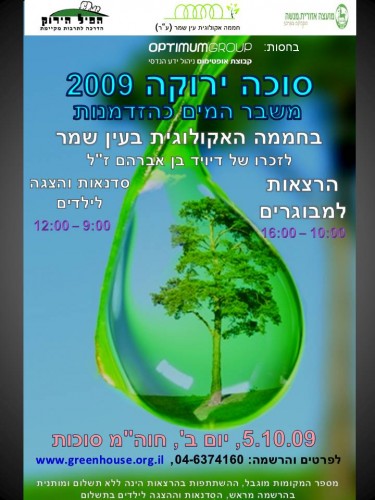
 The high holidays keep marching on, and after a reflective and sustainable Rosh Hashanah (and Yom Kippur) comes a (hopefully green) Sukkot.


 Tel Aviv based designer, Limor Matityahoo, has been involved with crafts for as long as she can remember. Among her many skills, Limor is a textile designer, a makeup artist, a cake decorator, and an interactive product manager. Most recently her curiosity, playfulness and skill have brought her to upcycled and recycled crafts made from plastic bags. And we’re very glad that they did.

 Think Again is a series that provides fun ideas for how to reuse items in your home that you would normally throw out or recycle. Reusing is higher on the “green” food chain than recycling, because getting another use out of an object is always more effective than spending the energy to recycle it. Plus, trying to reuse can force us to be creative!