Creators who want to influence people for good should also think carefully about tone. Environmental storytelling does not need to lecture or shame audiences. It can invite curiosity instead.
The company's Next Generation Process (NGP) Pilot Plant in London, Ontario, has officially moved into initial operating campaigns, generating the kind of structured, repeatable data that separates laboratory promise from commercial viability.
In the modern nutrition universe, that level of commitment deserves an applause. But for those who don’t live in a Nordic fishing village, the nutrition company Zinzino has built its omega-3 research and formulations around these principles, combining biomarker testing, antioxidant protection and traceable sourcing across both sustainably harvested small-fish oils and a vegan marine-microalgae alternative.
Dubai Municipality has set up 12 AI-powered "Ehsan Stations" to safely and officially feed strays. The city also officially supports Trap-Neuter-Return (TNR) programs.
Creators who want to influence people for good should also think carefully about tone. Environmental storytelling does not need to lecture or shame audiences. It can invite curiosity instead.
The company's Next Generation Process (NGP) Pilot Plant in London, Ontario, has officially moved into initial operating campaigns, generating the kind of structured, repeatable data that separates laboratory promise from commercial viability.
In the modern nutrition universe, that level of commitment deserves an applause. But for those who don’t live in a Nordic fishing village, the nutrition company Zinzino has built its omega-3 research and formulations around these principles, combining biomarker testing, antioxidant protection and traceable sourcing across both sustainably harvested small-fish oils and a vegan marine-microalgae alternative.
Dubai Municipality has set up 12 AI-powered "Ehsan Stations" to safely and officially feed strays. The city also officially supports Trap-Neuter-Return (TNR) programs.
Creators who want to influence people for good should also think carefully about tone. Environmental storytelling does not need to lecture or shame audiences. It can invite curiosity instead.
The company's Next Generation Process (NGP) Pilot Plant in London, Ontario, has officially moved into initial operating campaigns, generating the kind of structured, repeatable data that separates laboratory promise from commercial viability.
In the modern nutrition universe, that level of commitment deserves an applause. But for those who don’t live in a Nordic fishing village, the nutrition company Zinzino has built its omega-3 research and formulations around these principles, combining biomarker testing, antioxidant protection and traceable sourcing across both sustainably harvested small-fish oils and a vegan marine-microalgae alternative.
Dubai Municipality has set up 12 AI-powered "Ehsan Stations" to safely and officially feed strays. The city also officially supports Trap-Neuter-Return (TNR) programs.
Creators who want to influence people for good should also think carefully about tone. Environmental storytelling does not need to lecture or shame audiences. It can invite curiosity instead.
The company's Next Generation Process (NGP) Pilot Plant in London, Ontario, has officially moved into initial operating campaigns, generating the kind of structured, repeatable data that separates laboratory promise from commercial viability.
In the modern nutrition universe, that level of commitment deserves an applause. But for those who don’t live in a Nordic fishing village, the nutrition company Zinzino has built its omega-3 research and formulations around these principles, combining biomarker testing, antioxidant protection and traceable sourcing across both sustainably harvested small-fish oils and a vegan marine-microalgae alternative.
Dubai Municipality has set up 12 AI-powered "Ehsan Stations" to safely and officially feed strays. The city also officially supports Trap-Neuter-Return (TNR) programs.
Creators who want to influence people for good should also think carefully about tone. Environmental storytelling does not need to lecture or shame audiences. It can invite curiosity instead.
The company's Next Generation Process (NGP) Pilot Plant in London, Ontario, has officially moved into initial operating campaigns, generating the kind of structured, repeatable data that separates laboratory promise from commercial viability.
In the modern nutrition universe, that level of commitment deserves an applause. But for those who don’t live in a Nordic fishing village, the nutrition company Zinzino has built its omega-3 research and formulations around these principles, combining biomarker testing, antioxidant protection and traceable sourcing across both sustainably harvested small-fish oils and a vegan marine-microalgae alternative.
Dubai Municipality has set up 12 AI-powered "Ehsan Stations" to safely and officially feed strays. The city also officially supports Trap-Neuter-Return (TNR) programs.
Creators who want to influence people for good should also think carefully about tone. Environmental storytelling does not need to lecture or shame audiences. It can invite curiosity instead.
The company's Next Generation Process (NGP) Pilot Plant in London, Ontario, has officially moved into initial operating campaigns, generating the kind of structured, repeatable data that separates laboratory promise from commercial viability.
In the modern nutrition universe, that level of commitment deserves an applause. But for those who don’t live in a Nordic fishing village, the nutrition company Zinzino has built its omega-3 research and formulations around these principles, combining biomarker testing, antioxidant protection and traceable sourcing across both sustainably harvested small-fish oils and a vegan marine-microalgae alternative.
Dubai Municipality has set up 12 AI-powered "Ehsan Stations" to safely and officially feed strays. The city also officially supports Trap-Neuter-Return (TNR) programs.
Creators who want to influence people for good should also think carefully about tone. Environmental storytelling does not need to lecture or shame audiences. It can invite curiosity instead.
The company's Next Generation Process (NGP) Pilot Plant in London, Ontario, has officially moved into initial operating campaigns, generating the kind of structured, repeatable data that separates laboratory promise from commercial viability.
In the modern nutrition universe, that level of commitment deserves an applause. But for those who don’t live in a Nordic fishing village, the nutrition company Zinzino has built its omega-3 research and formulations around these principles, combining biomarker testing, antioxidant protection and traceable sourcing across both sustainably harvested small-fish oils and a vegan marine-microalgae alternative.
Dubai Municipality has set up 12 AI-powered "Ehsan Stations" to safely and officially feed strays. The city also officially supports Trap-Neuter-Return (TNR) programs.
Creators who want to influence people for good should also think carefully about tone. Environmental storytelling does not need to lecture or shame audiences. It can invite curiosity instead.
The company's Next Generation Process (NGP) Pilot Plant in London, Ontario, has officially moved into initial operating campaigns, generating the kind of structured, repeatable data that separates laboratory promise from commercial viability.
In the modern nutrition universe, that level of commitment deserves an applause. But for those who don’t live in a Nordic fishing village, the nutrition company Zinzino has built its omega-3 research and formulations around these principles, combining biomarker testing, antioxidant protection and traceable sourcing across both sustainably harvested small-fish oils and a vegan marine-microalgae alternative.
Dubai Municipality has set up 12 AI-powered "Ehsan Stations" to safely and officially feed strays. The city also officially supports Trap-Neuter-Return (TNR) programs.
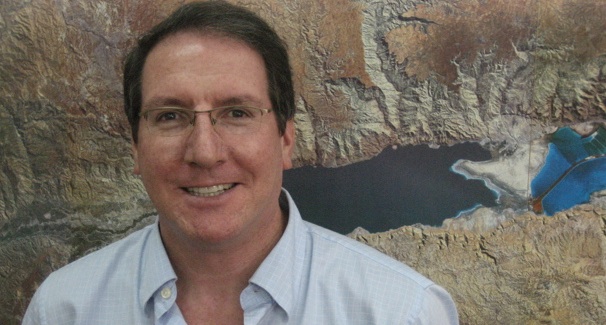
The WATEC conference is now on in Tel Aviv. Let’s look at some new technologies attempting to collect energy with every flush, and to detect leaky pipes with drone planes. (Above: Gadi Hareli from Leviathan- Reuters)
Imagine being able to detect leaks and water pipes and create hydro-electric power at the same time. Two Israeli companies, Arad Technologies and Leviathan Energy appear to have done this, and the result is not only the saving of millions of gallons of lost water by finding leaks in water piping, but in creating hydro-electricity from water flow pressure in the pipes at the same time.
Founded in 2000, and covered by Ari Rabinovich in Reuters, Arad Technologies, part of the Arad Group, was created by two large agricultural Kibbutzim to find a solution to chronic water loses from leaking pipes and water mains.
California Governor Arnold Schwarzenegger returned to Israel to sign a renewable energy R&D cooperation agreement with the Israeli government and the fifth annual WATEC international water exhibition kicked off in Tel Aviv. For these stories and the rest of the nine headlines from the past week, check below.
The book was sold-out even before its official release on November 4, says Saul Singer, author and columnist from Jerusalem. Singer co-wrote Start-Up Nation with Dan Senor, a prominent news analyst and businessman from New York. The two take a look at Israel’s trillion dollar high-tech industry and the nation’s improbable success – against all odds.
The most amazing thing about chronicling Israel’s high-tech industry, Singer tells ISRAEL21c, is that no-one has done it before. In the book, he and Senor explore how a small country of only 7.1 million people – a nation in a constant state of war and with no natural resources – has carved out a lucrative niche for itself in high-tech on a par in scale and calibre with America’s top companies.
Tom Brokaw from NBC News has praised the book, as has the president of eBay. When ISRAEL21c was interviewing Singer and Senor, the two were busy wrapping up an article on Start-Up Nation with Bloomberg News. This followed a very successful placement on the Meet the Press TV show in the US, where Senor was recently featured.
The two are also looking into ways for carbon capture –a method which proposes to suck up and store greenhouse gas emissions.
Although many of the chemicals produced by the American chemical giant are used in the petroleum distilling and petrochemical industries, with much of the company’s “raw material” is coming from Saudi Arabia.
Both Dow executives and the Saudi Arabian government know they need to become involved in projects that are more environmentally friendly; especially in the energy market.
KAUST is a new graduate level academic institution that just opened its doors in September, and whose campus has been designed to be more eco-sustainable and better adapted to being located in the harsh, hot climate of the Arabia Peninsula.
In addition to the joint chemical derivatives projects, Dow also plans to explore being involved in ecological projects which will be carried out at KAUST’s Research Park and Innovations Cluster. Some of these projects include CO2 capture, enhanced oil recovery, water desalination, solar energy and wind energy.
CO2 capture and storage or CCS, sequesters carbon dioxide gas that is present during the petroleum distillation process to prevent it from escaping into the atmosphere and contributing to global warming.
Dow for its part, appears to be getting more involved in areas dealing with the environment and the company’s social responsibility towards helping the planet after so many years of being heavily connected with the petroleum industry and its effect on the world environment.
Trying to find solutions to the water resource problems that many countries face, including Saudi Arabia, is now an important part of Dow’s environmental responsibility goals. Dow was part of August’s World Water Week, held in Stockholm, where delegates from nations all over the world met to explore ways in which countries can work together to find solutions to preserving present fresh water resources, recycling waste water, and producing fresh water from desalination and other means.
For its part, the Kingdom of Saudi Arabia now has what is said to be the world’s largest desalination plant and is now able to produce 70% of its fresh water from reverse osmosis and other methods of desalination.
These will be some of the projects that both Dow and KAUST research teams will be jointly involved in within the framework of this agreement, as well as the chemical derivatives research, which hopefully will not be dedicated to the long term continuation and dependence on fossil fuels.
Five years ago this past May, California Governor Arnold Schwarzenegger introduced five Israeli companies as part of his plan to create more than 800 new jobs in California. He urged dozens of other Israeli corporate executives to invest and expand their businesses in the state.
“I promised I would travel the world to sell California and find employers to provide new jobs for Californians,” Schwarzenegger told a group of more than 200 Israeli and American business leaders, venture capitalists and entrepreneurs at the Tel Aviv Hilton.
He’s baaaaack. Globes reports that the former Terminator movie actor lovingly known as The Governator is due to sign a renewable energy cooperation deal with Israel’s Minister of Industry, Trade and Labor Benjamin Ben-Eliezer.
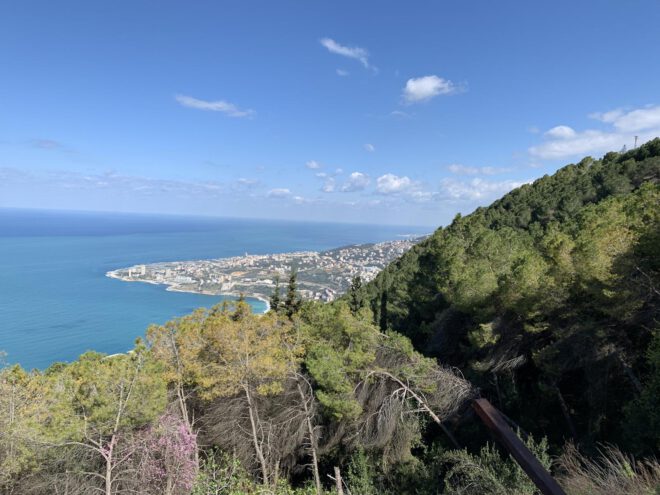
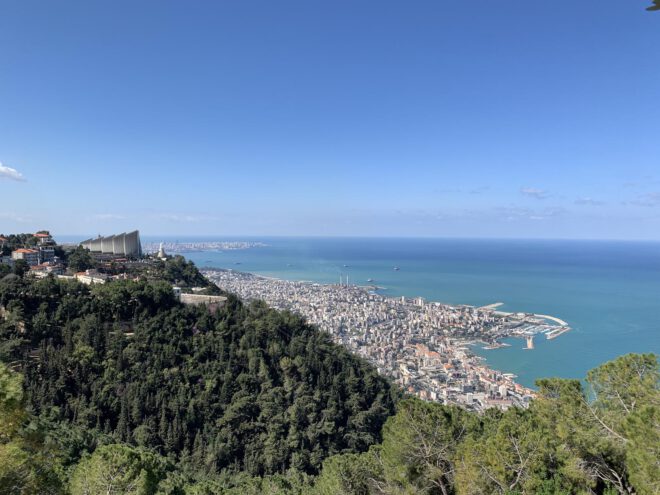
Lebanon’s Harissa Forest is only 400 square hectares in size, but it is considered one of ten Mediterranean forest attractions from a sheer beauty and conservation standpoint.
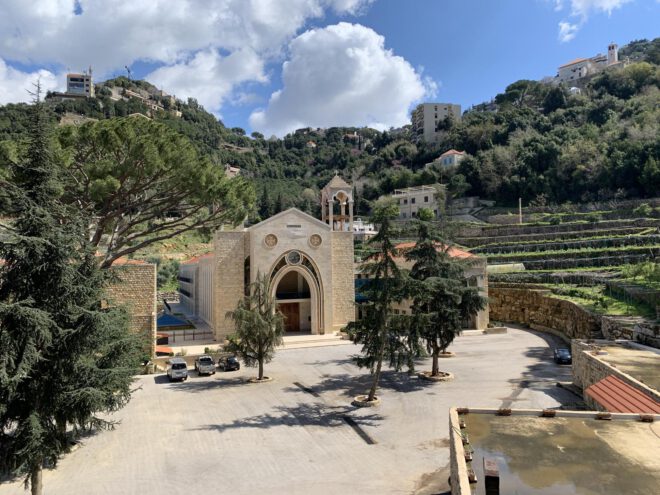
Located on a hillside above the predominantly Christian city of Jounieh, the more than 1,000 year old forest had been threatened by real estate developers and construction contractors who wanted to include the area in a series of holiday resort developments that included a cable car (pictured above), restaurants and night clubs. But it’s thanks to the work of a church that generations in the future will get to experience this natural treasure.
Unique in both its flora and fauna, the Harissa Forest, despite its small land area, contains more than 27 endangered and 52 rare plant species, as well as 168 species of animals, 152 types of butterflies and 69 species of birds.
Most, it not all of this national treasure might have been destroyed or severely altered, had not the Maronite Church stepped in and declared the forest to be the word’s first “Maronite Protected Environment”.
The Maronite Church, an eastern branch of the Catholic Church, is one of the oldest Christian sects and has been in existence since Roman times. It’s a predominant sect of Christianity in the Near Middle East.
It owns considerable property in Lebanon, including a good portion of the Harissa Forest itself. Due to concern out of seeing this lovely natural heritage fall victim to commercial interests, the Church leaders in Lebanon, led by the Maronite Patriarch himself, Nasrallah Boutros Sfeir decided to declare the forest to be a natural reserve and as such would be afforded the Church’s protection.
The Maronite Church has also become involved in helping to preserve other natural locations in Lebanon and has opened an ecology center, as well as sponsoring environmental education and action programs in more than 75 villages and towns.
The church’s actions involving preserving the environment has resulted in its being considered as one of the main environmental protectors in Lebanon, according to Martin Palmer, Chief Administrator of the Alliance of Religions and Conservation (ARC).
(Update 2019: ARC has closed down saying its work has been done.)
The Harrisa forest is just one of Lebanon’s natural sites mentioned by Green Prophet. A previous article noted work being done by activists to save the country’s historic cedars in the Chouf Cedars Forest, Lebanon’s largest cedar grove, from the ravages of climate change.
By being active in environmental and ecological projects in Lebanon, the Maronite Church, the country’s largest Christian sect, can be great influence on helping to preserve some of the oldest and most historic forest areas in the Eastern Mediterranean. They can set an example for the rest of the Middle East to follow.
Update in 2013: Caretaker Environment Minister Nazem Khoury announced that the Harissa Mountain area in Jounieh would be converted into a nature reserve in cooperation with the Maronite Patriarchate and the Jounieh Municipality.
“The reserve will be a major resource, not just for the residents of Kesrouan, but also for all Lebanese,” he said. The decision was announced after Khoury, caretaker Information Minister Walid Daouk and Jounieh Mayor Antoine Frem, toured several sites in the Kesrouan town.
The tour included the Green Garden project, which will be inaugurated in September, when its doors will be open to tourists and residents. Khoury also followed up on the issue of illegal entry fees at public beaches by going on a short cruise along Jounieh’s coastline.
Daouk saluted the efforts of the Jounieh municipality for developing the region and increasing its number of green spaces.
It all sounds very grandiose and really too good to be true, but a number of Persian Gulf states, including Abu Dhabi, Dubai, Bahrain and Qatar are hoping to be able to satisfy a good portion of their massive energy needs through alternative and renewable energy sources, instead of relying mostly on oil.
In a part of the world that experiences some of the hottest summer temperatures, averaging above 44 degrees Celsius during at least 4 months of the year; and whose energy growth use is growing by more than 10% per annum, these countries have their work cut out for them to be able to realize 70% of their total energy needs from alterntive and renewable energy by the year 2030.
Islam’s holy city Medina is about to become green model for Muslim world.
On November 4, 2009, UK-based the Alliance of Religions and Conservation (ARC), in working with the U.N., hosted 200 representatives from nine major world religions spanning over 60 different religious organizations. For a background, read Green Prophet’s post Interfaith Initiative plans to mobilize billions.
Baha’i, Buddhists, Christians, Hindus, Jews, Muslims, Shintoists, Taoists and Sikhs all gathered at London’s Windsor Castle with a united environmental agenda. In an era of increasing religious divide, a once little thought of topic known as “the environment” was able to bring together ancient faith groups to discuss a modern solution.
And with Islam at the forefront of today’s news, Muslim leaders proved Islam’s ability to adapt and meet new needs.
Under the newfound coalition toward eco-commitment and a Muslim Seven Year Plan, Medina, Islam’s second most important city after Mecca, is to serve as a model green city. This move is critical since Saudi Arabia is essentially, for better or worse, presently the pillar of the Arab nations.
Nearly one month before the climate talks in Copenhagen begin, a crucial event to reach out to the eighty-five per cent of humanity who follow a religion kicked off in London’s Windsor Castle.
From 2-4 November, UN Secretary-General Ban Ki-moon co-hosted the global gathering of inter-faith leaders: Faith Commitments for a Living Planet. The meeting has important implications for the Middle East where faith plays a dominant role in culture and society.
At the event organized by Prince Philip and the Alliance of Religions and Conservation (ARC), religious leaders from all the major faith traditions highlighted the earth’s fragility, and discussed initiatives to protect it against the ravages of climate change.
Could Prof. Colin Price’s new discovery become a new tool for monitoring the effects of climate change?
Sunspots, which rotate around the sun’s surface, tell us a great deal about our own planet. Scientists rely on them, for instance, to measure the sun’s rotation or to prepare long-range forecasts of the Earth’s health. Some new sun waves discovered recently challenge current theories in physics and shed light on new theories about the stars.
But there are some years, like this one, where it’s not possible to see sunspots clearly. When we’re at this “solar minimum,” very few, if any, sunspots are visible from Earth. That poses a problem for scientists in a new scientific field called “Space Weather,” which studies the interaction between the sun and the Earth’s environment.
Thanks to a serendipitous discovery by Tel Aviv University’s Prof. Colin Price, head of TAU’s Department of Geophysics and Planetary Science, and his graduate student Yuval Reuveni, science now has a more definitive and reliable tool for measuring the sun’s rotation when sunspots aren’t visible — and even when they are. The research, published in the Journal of Geophysical Research – Space Physics, could have important implications for understanding the interactions between the sun and the Earth. Best of all, it’s based on observations of common, garden-variety lightning strikes here on Earth.
Waxing and waning, every 27 days
Using Very Low Frequency (VLF) wire antennas that resemble clotheslines, Prof. Price and his team monitored distant lightning strikes from a field station in Israel’s Negev Desert. Observing lightning signals from Africa, they noticed a strange phenomenon in the lightning strike data — a phenomenon that slowly appeared and disappeared every 27 days, the length of a single full rotation of the sun.
“Even though Africa is thousands of miles from Israel, lightning signals there bounce off the Earth’s ionosphere — the envelope surrounding the Earth — as they move from Africa to Israel,” Prof. Price explains. “We noticed that this bouncing was modulated by the sun, changing throughout its 27-day cycle. The variability of the lightning activity occurring in sync with the sun’s rotation suggested that the sun somehow regulates the lightning pattern.”
He describes it as akin to hearing music or voices from across a lake: depending on the humidity, temperature and wind, sometimes they’re crystal clear and sometimes they’re inaudible. He discovered a similar anomaly in the lightning data due to the changes in the Earth’s ionosphere — signals waxed and waned on a 27-day cycle. Prof. Price was able to show that this variability in the data was not due to changes in the lightning activity itself, but to changes in the Earth’s ionosphere, suspiciously in tandem with the sun’s rotation.
Taking the pulse of the sun
The discovery describes a phenomenon not clearly understood by scientists. Prof. Price, an acclaimed climate change scientist, believes it may help scientists formulate new questions about the sun’s effect on our climate. “This is such a basic parameter and not much is known about it,” says Prof. Price. “We know that Earth rotates once every 24 hours, and the moon once every 27.3 days. But we haven’t been able to precisely measure the rotation rate of the sun, which is a ball of gas rather than a solid object; 27 days is only an approximation. Our findings provide a more accurate way of knowing the real rotation rate, and how it changes over time,” he says.
Prof. Price cannot yet say how this finding will impact life on Earth. “It’s an interesting field to explore,” he says, “because nothing has been done to investigate the links between changing weather patterns and the rotation of the sun.
“Short-term changes in solar activity can also impact satellite performance, navigational accuracy, the health of astronauts, and even electrical power grid failures here on Earth. Many scientists claim that the sun’s variability is linked to changes in climate and weather patterns, so the small changes we observed every 27 days could also be related to small variations in weather patterns.
“Our data may help researchers examine short-term connections between weather, climate, and sun cycles. With this tool, we now have a good system for measuring the pulse of the sun.”
While most people in Israel went about their normal everyday routines, a considerable number of dedicated ones went out last Monday into the country’s fields, forests, parks and beaches to pick up trash.
At least for one day they make their country a little bit cleaner by taking part in the international annual Clean Up The World community clean-up and environmental campaign.
More than 170,000 people from all walks of life were out filling up big green plastic bags with all kinds of trash, ranging from discarded cigarettes and packages, empty bottles of all types, leftover food and trash from beach and forest picnic sites, and numerous other items discarded by thoughtless people.
If any of you were able to make Sunday’s renewable energy conference in Jerusalem or in San Francisco, you may have gained a better insight of the joint renewable energy projects that Israel and the US are involved in.
The one-day conference was held in the American Jewish Committee’s Jerusalem headquarters in Beit Moses, and included speakers such as Dr. Isaac Berzin, director of the Herzliya-based Inter Disciplinary Center’s Institute for Renewable Energy. For background reading, Green Prophet has a great story about Berzin’s algae-for-biofuel solution here.
The conference was timed to occur jointly with the Jewish Response to the Energy Challenge conference occurring in San Francisco, California, in which a number of Israeli and American clean tech projects are being displayed.
The keynote address, given by Dr. Berzin entitled “Assuming leadership in the post oil world” dealt with countries whose renewable energy would be advanced enough to make them key players in a world where oil will no longer be considered as a key energy source.
He also showed participants his video, which made a showing on Green Prophet. You can see his video here: We call it pollution, they call it gourmet food. Berzin has a $100 million algae biofuel reactor project now in place in Arizona. He is akin to being a rock star in the clean technology sector.
Isaac Berzin
Stressing the meeting as a Jewish event, a heated panel discussion followed, dealing with manners in which Israel and the US will help preserve each other’s national security through cooperation in renewable energy projects, particularly solar energy, now involving companies like BrightSource.
Israel and the US entered into a joint renewable energy agreement at the 2009 Eilat Renewable Energy Conference with the purpose of creating a renewable energy storage initiative to reduce dependence on oil and other fossil fuels. As more renewable energy projects are created, less reliance will be needed on fossil fuels; which may eventually begin to reverse some of the problems caused by global warming.
Green Prophet is delighted to be teaming up today worldwide with Eco Libris, an environmentally friendly green printing company, and their Green Books campaign. Eco Libris is run by Israeli Raz Godelnik, and has been featured on Green Prophet here where we interviewed Raz.
The campaign plans 100 reviews of green themed books around the world on blogs and websites. Further information about the campaign and links to other reviews is via this campaign Green Books campaign link.
The Middle East as a region does not need any help fueling conflicts. Unfortunately, it does that pretty well on its own.
Which is why the future threat of water scarcity in the region is not only an environmental concern, but a scary political scenario as well. Water scarcity in a geographic area notorious for lack of cooperation could easily develop into a water war.
But not everyone sees this problem as a recipe for violence. Some see it as an opportunity for peace.
Enter the idea of hydro-diplomacy.
Fadi Comair, the Director General of the Ministry of Energy and Water (MEW) in Lebanon recently wrote a book on the subject titled “Water Management and Hydro-Diplomacy in the Middle East” which suggests that the waters of the Jordan River Basin should be equitably managed by a single, multinational water authority.
Advertising itself as Israel’s first food-focused conference, “Mazon Le-Machshava” or food for thought, opens in the Tel Aviv port next Thursday, November 19.
In addition to a Top Chef-style cookdown to produce the tastiest meal with the lowest carbon footprint, the conference also promises conversations about farming, energy and water.
It taps into a growing trend – organic farming has a following not only in Israel, but also in the West Bank and Jordan.

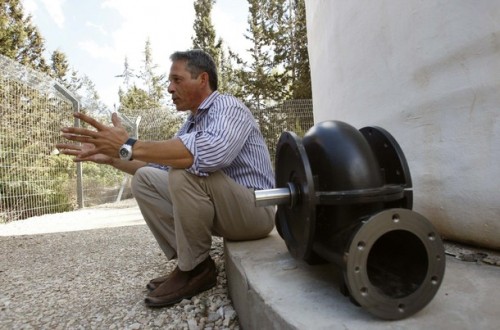
 The WATEC conference is now on in Tel Aviv. Let’s look at some new technologies attempting to collect energy with every flush, and to detect leaky pipes with drone planes. (Above: Gadi Hareli from Leviathan- Reuters)


 Dow Chemical Company, a worldwide leader in the global chemical industry, and sponsor of the 2010




 Islam’s holy city Medina is about to become green model for Muslim world.
 Could Prof. Colin Price’s new discovery become a new tool for monitoring the effects of climate change?