Home Blog Page 657

Green Pillow Talk: Sustainable and Healthy Choices For Your Bed

8

sex bedroom green photoWith all the time we spend in bed, it behooves us to make sure they are safe as well as comfortable.

Our pillows can do more than cradle and support heads and necks. Use the wrong kind, and they can make you toss and turn in your sleep. That is why this post is dedicated to making sure that your ‘pillow talk’ –– and pillows –– includes words like, green, clean and sustainable.

Conventional pillows typically contain petroleum chemicals that release volatile organic compounds into the air in your home.  Fire-retardant, non-iron, moisture-resistant pillows are made from compounds that are bad for your health and bad for the planet. Not to mention that many synthetic pillows make great incubators for dust mites, one of the leading allergens that are irritating to lungs, particularly in people with asthma. Yuck.

There are alternatives that are natural-filled and appealing to all personal pillow preferences. When you are choosing, don’t just consider what goes in the inside; make sure it is covered in organic cotton too. Below is a list of popular option, available from many vendors via the web. We’ve personally tested all four, and can vouch for the pros and cons. If readers know where to purchase any of these in the Middle East, we ask you to share this information in the comment section.

  • Natural Shredded Rubber
    A byproduct of the rubber tree, this renewable resource is sometimes called latex. Great for people with allergies and chemical sensitivities, these pillows offer firm support. They may take some getting used to and some sleepers don’t like the smell that new pillows give off. Make sure to avoid synthetic rubber.
  • Wool Fiber
    Choose pure virgin wool. Its many benefits include breathability, flame resistance, moisture absorbency, and bacteria/dust mite resistance. They also maintain temperature during hot or cold climates. Drawbacks: these pillows may be too firm for some, and they can flatten out over time.
  • Feathers/Down
    Pillows made from duck or goose feathers and/or down, and very comfortable, and come in a variety of qualities and price points. The higher the down content, the softer the pillow but higher the cost. May not be firm enough for all sleepers, or appropriate for people with allergies. They also need to be regularly ‘fluffed.’
  • Buckwheat Hull
    Buckweat hull pillows conform to the contours of your head and neck. They offer excellent insulation during summer and winter climates, and generally are reasonably priced. It may take some getting used to as they are ‘noisy’ when you turn in your sleep. They also need to be replaced, and don’t control for odor as well as some other options.

Greening your bedroom is a personal choice that must take budget and comfort into consideration. It may not be feasible for everyone to replace their entire bedroom and bedding with organic, health-conscious products, which is why we recommend starting with your pillow.

As for the next step, we suggest sleeping naked. It’s as natural as the day you were born, and makes breakfast in bed all the more fun. Stay tuned for more ways to make your sex life green, and your green life sexy. Or read our past post on Greening Your Bedroom.
The Best Way to Keep Buildings Green is Not to Build New Ones

2

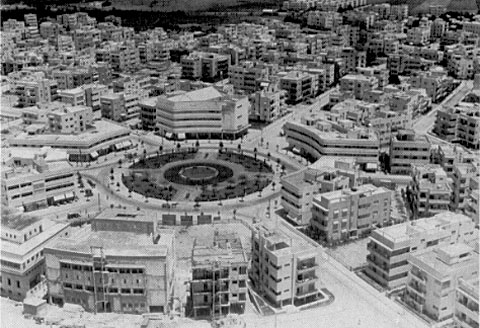
Central Tel Aviv, Cira 1940’s: A Sustainable Idea Then and Now

All over the Middle East, many old and often historical buildings are being torn down in order to “make way” for new, modern ones. This trend is especially true in cities like Cairo, Egypt and Tel Aviv, Israel, where the quaint and classical architecture of the “colonial period” (which also applies to India) is often forced to give way to glass faced skyscrapers which even though are claimed to be safer in the event of earthquakes and other natural disasters are less sustainable in regards to keeping them cool in summer or warm in winter.

This issue was expressed in an article in Treehugger where they reported that older styles of architecture, built before the “thermostat age” we live in now, had to be constructed to enable people to cope with the climate they lived in – particularly in regions where people experienced extreme changes in temperature during various times of the year.

Dubai-based Timelinks Designs Modern Ziggurat

3

ziggurat timelinksIs it really sensible to squish one million people into this self-sustaining city/building?

Like many of Dubai’s projects The World, which will exacerbate shoreline erosion and habitat loss, and Burj Dabai, reputedly the world’s tallest building, are flashy and expensive.  They are also divorced from the United Arab Emirates’ environmental hazards such as scant freshwater supply and desertification, and though undeniably clever, their eco-footprints are questionable. Timelinks, a consortium of urban planners, scientists, and architectural designers, has designed another less-than-sensible solution to the UAE’s environmental and urban crises.  They call it the Ziggurat.

AGRAme, Honeywell, and Biofuel Projects in Dubai

samphire for biofuel imageHoneywell launches project that converts the oil from salicornia plants, commonly known as samphire into biofuel at Dubai’s AGRAme conference later this month. Image via me’enthedogs.
Global issues concerning green agriculture and energy sustainability have raised many viability questions during the early 21st century. Collaborate efforts of world leaders, non-profits, and research institutes have made great achievements in the area. Units like the CGI and Doug Band tackle Haitian Rice Crop Sustainability through the IRRI (International Rice Research Institute), while also manipulating emission reduction in the San Francisco Bay Area of the USA. Although, the US isn’t the only one playing their role!

Organizations like Ultra Green Middle East tackle issues like water treatment/purification, waste-to-energy and establish LEED eco-friendly buildings. Subsequently, continued success of green initiatives within the Middle East has led us to some of the greatest agricultural innovations yet.

Grow Old With The Sun As Israel’s Migdal Invests in Sunday Solar

1

A large insurance company from Israel invests about $30 milliom in solar energy company Sunday. Image via mcohenchromiste.

The sun makes us old and wrinkly, but in Israel getting some “sun” through your pension plan can make you green. Without the possibility of buying green bonds, many Israelis wonder how they can invest in solar energy (it’s a question I’ve asked to people in the government), and now by subscribing to Migdal, a major insurance broker and holding company, some of your pension plan will be diverted to making good energy: Migdal just invested $30 million in Sunday Energy

Ilana Meallem Is The Green Peacemaker of the Middle East

1

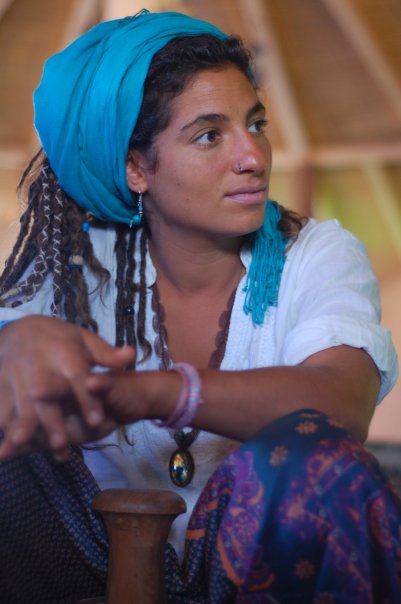
A young, ‘green’ peacemaker Ilana Meallem, who first wanted to serve her country in the army, now devotes herself to coexistence and environmental good works.

You’ll find her wherever the peacemakers and ecologists roam, at venues like the annual United Religions Initiative Middle East North Africa (MENA) region conference.

Today Ilana Muallem is one of the most remarkable “green” activists in the Middle East, inspiring, educating, promoting and drawing ecologically sound practices. In addition to leading EcoSpirit Middle East retreats in Jordan for young activists in the region, she is also currently in the process of creating an ecologically-built retreat, solar-powered of course, which will serve as a home and studio for young peacemakers from the Middle East region.

Thirty-two-year-old Meallem, a Londoner by birth, fell in love with Israel at an early age. She lived in the country for a year when she was two, and the memory somehow became a part of her identity. Raised in an orthodox family, her father was an Israeli-Egyptian who moved to the British city, and her mother, a British Jew. By the time she turned 18, the teenager was already working on enlisting in the Israel Defense Forces, strongly motivated to serve her new country.

When she said goodbye to her parents, two brothers and sister in England, en route to her new life in Israel, one brother’s parting words were: “Trust everyone.”

Book Review: Strategy for Sustainability by Adam Werbach – A Primer for Third Wing Environmentalism or a Harbinger of the Black Swan?

6

stratgy sustainability book cover I find it fitting and perhaps a little ironic that I was asked to write a review about Adam Werbach’s popular book, Strategy for Sustainability, a book addressed to corporations large and small about how they can operate as leaders in sustainability.

Perhaps because  my senior thesis as an undergraduate English  major, was entitled “The Paradox of Corporate Environmentalism.”

I wrote that paper back in 1997 while attending University of California, Santa Barbara. I  had the privilege of interviewing Congressman Henry Waxman (his son and I befriended one another at Tel Aviv University) for my thesis.

Extensive research and this interview with one of the true pioneers of incentive systems for marketable discharge permits, helped shape my view on corporate environmentalism. I learned a lot about various factions within the Green movement, corporate citizenship vs. government regulation, and the central role that economics played in all of these topics. My thesis volunteered that corporate citizenship was incredibly rare and statistically insignificant, like Nassim Nicholas Taleb’s Black Swan.

In Strategy for Sustainability, Werbach clearly takes another point of view with regard to corporate citizenship and I must admit it is a bit infectious.

Israel prepares to combat greenhouse gas emissions

4

(Image via go-green.com)

Israel’s cabinet approved a joint proposal by the Ministry of Environmental Protection and the Ministry of Finance on Sunday to formulate a national plan on greenhouse gas emissions, the Globes newspaper reported.

An inter-ministerial committee will be formed to study a range of issues, including energy efficiency, green construction, and the ramifications for Israeli industry and exports. The committee will be chaired by the director-general of the Ministry of Finance, Haim Shani, and is expected to submit its recommendations for an operational plan by October 2010.

In proposing a concerted national effort to reduce greenhouse gas emissions, the Ministry of Environmental Protection and Ministry of Finance emphasized the potential benefits for the Israeli economy and local cleantech industries in particular. Reducing emissions of greenhouse gases is also a condition for Israel joining the OECD, the Globes report notes.

The minister of environmental protection, Gilad Erdan, has been lobbying for the establishment of a greenhouse gases committee for several months. Erdan is scheduled to deliver a keynote address tomorrow at the Environment 2020 conference in Tel Aviv in a session entitled “Environmental Vision for the Next Decade.”

Samir Kassir Square Blends the Organic with the Urban in Beirut

3

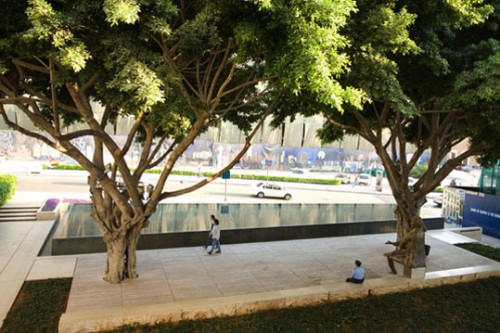
Samir Kassir Square beirut lebanonWhen you live in a city and pass the same developed areas day after day, you can forget that the concrete jungle is unnatural.  Sure, it may feel natural to you after a while, but you would undoubtedly also enjoy some greenery.  Some botanical specimens to offset the amounts of carbon dioxide released by the buses, taxis, and private vehicles.  Which is why contemporary urban planners and architects often try to fuse the urban with the organic.
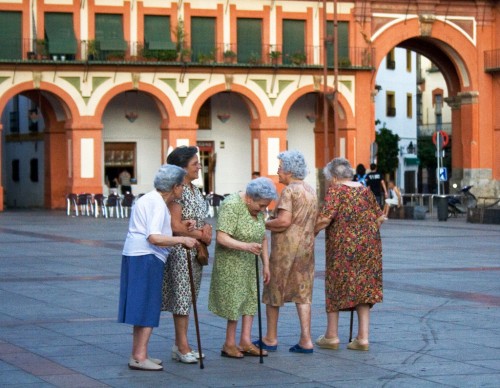
This fusion can be seen in Samir Kassir Square in the heart of Beirut, where two old Ficus trees provide shade and serenity.  The surrounding garden, composed mostly of pools of running water, are also intended to cause passersby to feel connected to a more natural environment (although this Green Prophet wonders how water efficient the pools actually are).

Saudi Arabia Has the Highest Road Accident Death Toll in the World

Saudi car art

Time to turn Saudi youth onto bicycling: video of dangerous stunts on the rise in young Saudi males who purposefully “drift” cars.

An average of 17 Saudi Arabian residents die on the country’s roads each day, a report by the Kingdom’s General Directorate of Traffic has revealed. The news comes after the World Health Organization found Saudi Arabia to have the world’s highest number of deaths from road accidents, which now make up the country’s principal cause of death in adult males aged 16 to 36. First reported by the Saudi daily Arab News, the study found that 6,485 people had died and more than 36,000 were injured in over 485,000 traffic accidents during 2008 and 2009.

There was no official reaction to the unfortunate world record, and Saudi analysts pointed to larger underlying problems.

“The driving problems are with young people,” Ali Abdul-Rahman Al-Mazyad, a Saudi columnist in Riyadh told The Media Line. “There are very little outlets for young people to enjoy themselves and kids basically do what they want.”

“There is also not such great education in schools about driving and respecting the road,” he said. “Drug use is also a contributing factor. These are the central problems.”

The report found that almost a third of traffic accidents in the Saudi capital Riyadh were due to drivers jumping red lights, followed by 18 percent of accidents caused by illegal U-turns. The most common dangerous driving activities were speeding, sudden stops and speaking on the phone while driving.

Over the past two decades Saudi Arabia has recorded 4 million traffic accidents, leading to 86,000 deaths and 611,000 injuries, 7 percent of which resulted in permanent disabilities.

A recent study at the King Abdul Aziz City for Science and Technology (KACST), a Riyadh-based scientific research group, warned that if the current rise in road accident rates is not curbed, Saudi Arabia will have over 4 million traffic accidents a year by 2030. Oh, and Saudi Arabia wants to be the next Ibiza!

Silvio Saadi, a Jeddah-based businessman and film producer, argued that both the government and an out-of-control youth culture were to blame.

“You won’t believe what you see,” he told The Media Line. “It’s just crazy.”

“Saudis often try to drift with normal cars and thousands of spectators on the sides of the street,” he said, referring to an informal motor sport in which drivers intentionally over-steer so as to lose traction and drift on the road. “Sometimes the car drifts into the spectators, slamming them into buildings along the sidewalk.”

Saadi said that while the government has made some initiatives, they have fallen short of an aggressive road safety campaign.

“Outside the city, the police often cannot stop them,” he said. “The police are actually scared because there can be thousands of them. A few years ago they built a Jeddah raceway to attract young people to do it on the track instead of on the streets, but people still like to do it the old fashioned Bedouin way.”

“We get approached every year by government departments to produce public service announcements about speeding but most of the time nothing comes of it,” Saadi added. “Who knows what happens, but there is a lot of corruption. They probably take budgets from the government to do public service announcements and then don’t do it.”

Video of crazy road stunt as Saudi youth skate on the road.

[youtube width=”560″ height=”400″]http://www.youtube.com/watch?v=PJupNDIKkEk[/youtube]

Saudi Arabia has long had a taste for expensive cars, and spottings of young Saudis cruising the streets of Jeddah and Riyadh in Maseratis, Ferraris, Porsches and Harley Davidson motorbikes are increasingly commonplace.

One of the Middle East’s largest car markets, automobile sales make up about three percent of Saudi Arabia’s gross domestic product.

Following overstated fears that the global recession might seriously weaken the Arab world’s largest economy, Saudi car sales are now expected to boom. The kingdom’s car market, including both commercial automobiles and transport infrastructure, is currently worth about $9 billion. The market is expected to grow by 30 percent in 2010.

Over 675,000 cars are expected to be sold in 2010 to a population of just under 25 million.

(This story by Benjamin Joffe-Walt is reprinted with permission by The Media Line, the Mideast News Source.)

If you have read to the end of this, try making a positive change in the Middle East. Support designs like this that give refugees a dignified way to transition.

Fast Food Causing Increase in Colon Cancer in Cairo

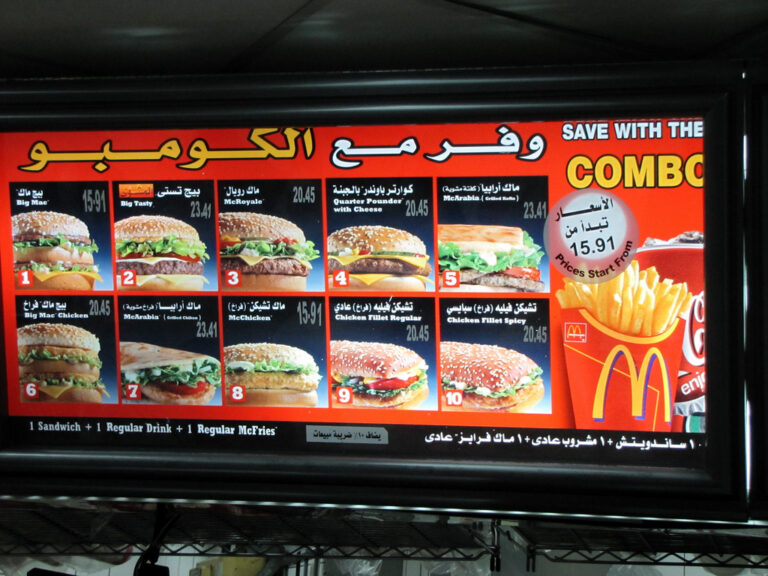
Mcdonald's sign in Arabic, combo, EgyptEgyptians are seeing soaring rates of colon cancer and obesity. Researcher links this to a change in diet. A McDonald’s sign in Arabic. Image via davidberkowitz

Professor of Oncology and the Director of the al-Qasr el-Aini Center for the Treatment of Tumors Yasser Abdul Kader said that colon cancer in Egypt ranges from between two to 6% of the total amount of cancer cases reported annually in Egypt.

He said that the number of colon cancer cases in Egypt is three-times higher among men than women. According to the professor, who was speaking at a local conference on the occasion of the international month to raise awareness of colon cancer, said that 30% of patients infected are younger than 45-years-old.

Abdul Kader added that the cause of the spread of colon cancer in Egypt is “due to the change of food habits of the citizens, as well as reliance on fast food, which is saturated fat and the prevalence of obesity.”

Why is there so much colon cancer in Egypt?

He continued that “in addition to this, smoking is another cause for the spread, and lifestyles do not encourage exercise and type II diabetes, indicating that colon cancer can be easily treated on the condition of early diagnosis, where the treatment success rate is high and can reach 90 percent in that situation.”

For his part, Mohammed Abul, a professor of nutrition at Cairo University, said that there is a close relationship between obesity and tumors of the digestive system, pointing out that the prevalence of obesity in Egypt is “up to 50 percent in men and more than 70 percent in women, as well as a faulty diet for most people, especially with the increasing rates of eating red meat at the expense of vegetables and fruit and the lack of exercise and sports, as well as avoiding eating fiber and preferring food with high salt.”

Mohsen Mokhtar, an Assistant Professor of Oncology and head of the Cancer Patients Support Association stressed that the association has launched an awareness campaign for the prevention and early detection of colon cancer, warning that “colon cancer is one of the main tumors affecting the digestive system, where the rate of infection is 5% of total cases of cancer in the world.”

He added that the total deaths per year are about 700,000 across the world, with 2000 cases a day, pointing to the presence of worrisome signs in Egypt “for a higher incidence of cancer among young people under the age of 30.”

More eco news from Cairo:
Egypt Builds Climate Change Plan For Delta Region
Egypt Makes Sharm Eco-Friendly
Baby Crocodile Boards Plane in Egypt

Rethinking Climate Change Under the Middle East Sun

1

Sea levels off Israel’s coast have been rising and falling over the last 2,500 years suggesting that short-term trends of rising sea levels may not necessarily reveal a long-term trend.

Researchers around the world are putting their minds together, focusing on both global and local patterns to find symptoms of climate change. Is there going to be global warming or cooling, from climate change? How can confusing statistics leaked to the media, set the record straight so limits can be set? From coring into ice samples at the North Pole, to measuring coral reef damage in the Red Sea, scientists want to know how man-made global warming will affect nature, and our place in it. With the basic tools of science, I’ve dug up three new studies from Israel: These researchers are looking to the past and present to understand climate in the Middle East — evidence which could be useful on the global scale.

PART III: The ABCs of Middle-Eastern Spice Medicines from Hyssop to Nutmeg

3

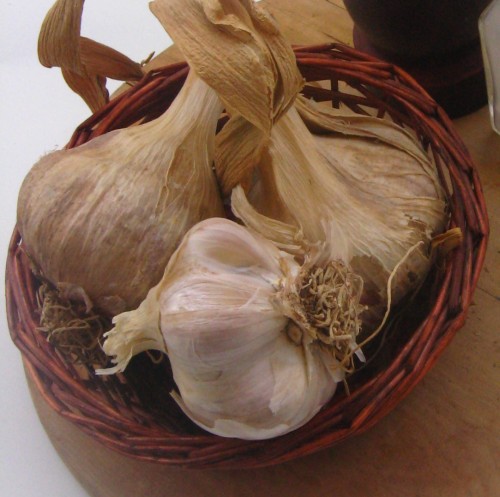
photo of garlic
Kitchen spices as medicine are a green way to get a useful, and always on hand supply, when you need it. Choose organic when you can.

This is the third post in a series on medicinal spices. You can read Part I and Part II by following the above links. If you’re a Green Prophet, you know that simplifying your life and using less chemicals can be good on you and the environment. Heading through the alphabet, today, we’re discovering the surprising properties of H to N: the value of hyssop, juniper berries, nigella, and nutmeg/mace.

SolarEdge and Flextronics Create Solar Energy Products – and Jobs

3

solaredge flextronic solar energy middle east
Israeli startup SolarEdge partners with NASDAQ-traded Flextronics (FLEX) to ramp up solar energy harvesting systems.

Solar energy projects in Israel’s northern sectors are sure to get a boost from a signed agreement between SolarEdge Technologies Ltd and   Flextronics Inc to produce  systems for improving the efficiency of photovoltaic panels at Flextronics’ plant in Migdal Ha’Emek – to be sold all over the world.

SolarEdge which develops a system that maximizes power harvesting from PV installations (PowerBoxes – which are power optimizers that connect to the solar panels, as well as a DC-AC inverter and a monitoring portal), aims to ramp up production of solar power harvesting systems. The company was mentioned by Green Prophet back in August, 2008, in the article A Quick Guide to Israel Solar Energy Companies. And was recently voted by FAST as a Top 10 innovative company. SolarEdge is expecting sales of over 45MW (Mega Watts) of its products for 2010.

Egypt Tries to Attract Eco-Tourists to Sharm el-Sheikh With Promises of Carbon Neutrality

2

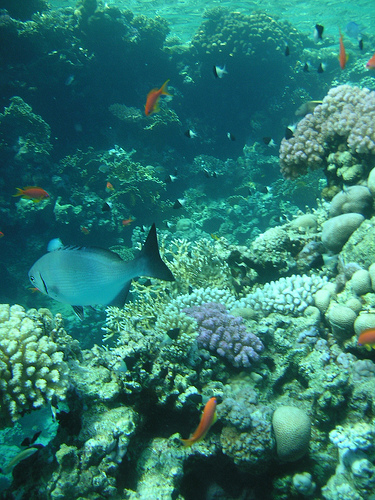
[image via: robert_hornung]

Sharm el-Sheikh, in the Sinai region of Egypt, has been a thriving tourist location for decades due to its incredible beaches and vast coral reefs.  Its great attraction to tourists has also been its downfall, however.  The reefs are currently under threat due to the dust caused by erosion.

With tourism accounting for a major part of Egypt’s GDP, something had to be done to protect Egypt’s natural (and money-making) resource, and grant it legitimacy in a world that increasingly wants to see environmental conservation efforts.

Egypt therefore recently announced its plan to become completely carbon neutral by 2020.  The $238 million project hopes to accomplish this through the introduction of renewable energy, reduction of water use, improvement of waste management, and, in the future, the use of electric boats and hybrid buses.

The green initiatives are planned to start this month and be completed by the end of 2010.  These early initiatives include new diving restrictions to help preserve already damaged reefs, and the powering of street lights with solar energy.