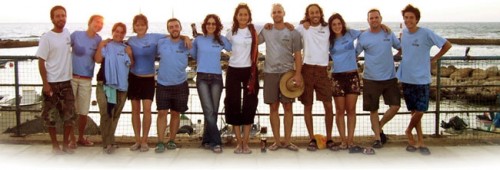
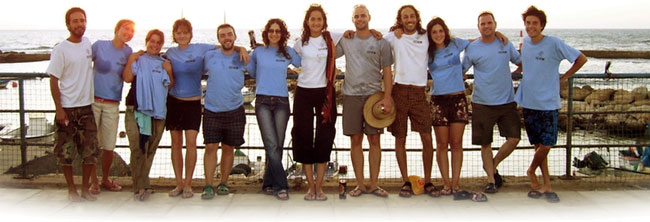
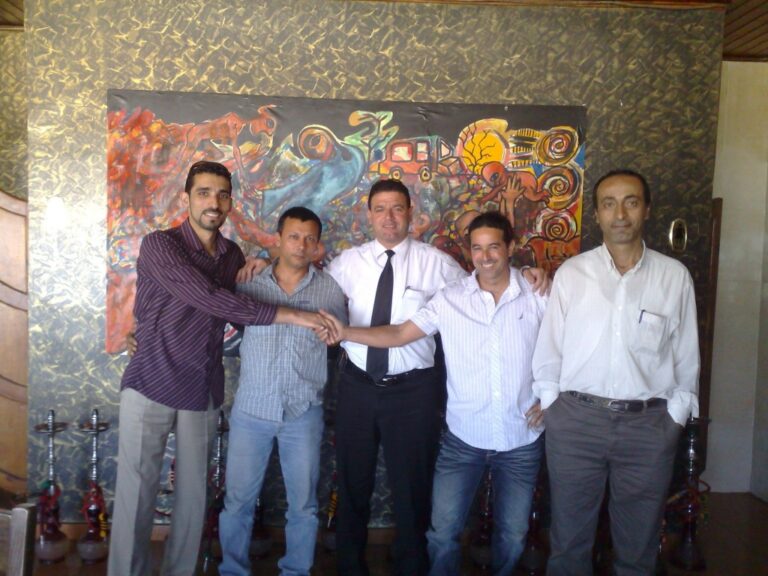
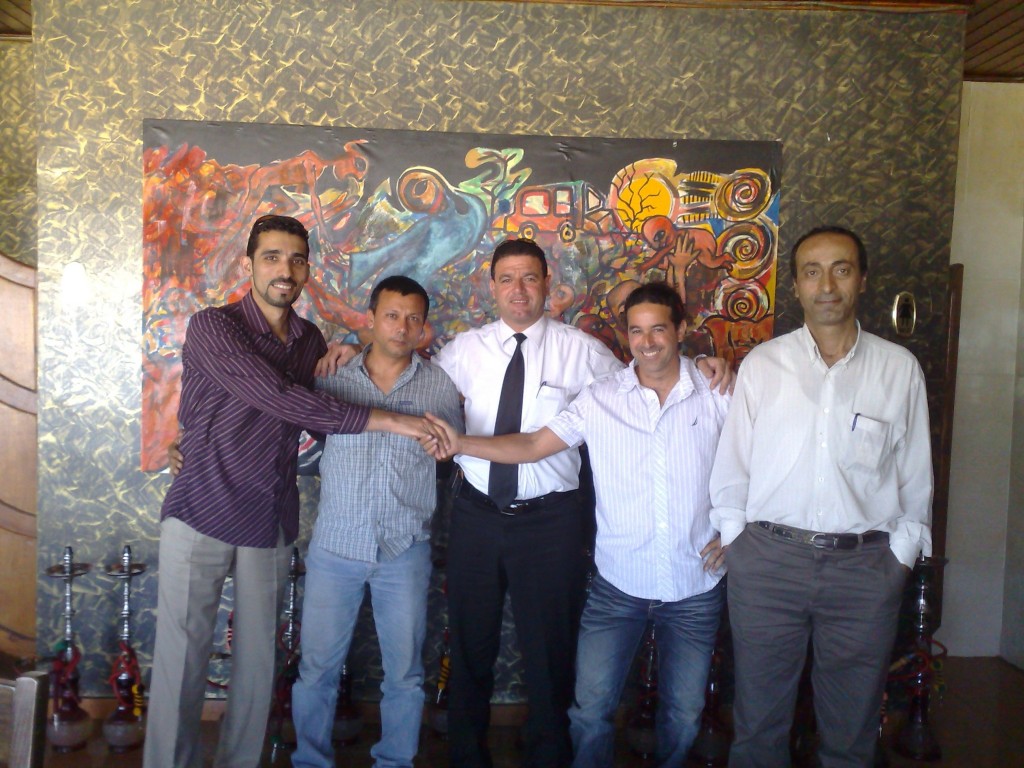
Jonathan Gilben, co-founder of GoEco, talks about his passion for eco-tourism. (Jonathan pictured at the center of this photograph and in the video clip below.)
A few weeks ago we wrote about GoEco, an organization founded by Jonathan Gilben and Jonathan Tal in 2005 that has pioneered bringing the concept of volunteer eco-tourism to Israel. We were so inspired by the organization’s altruistic mission and by its ability to attract good-doing volunteers that we decided to get in touch with Jonathan (Gilben, that is) and hear a little more about their programs.
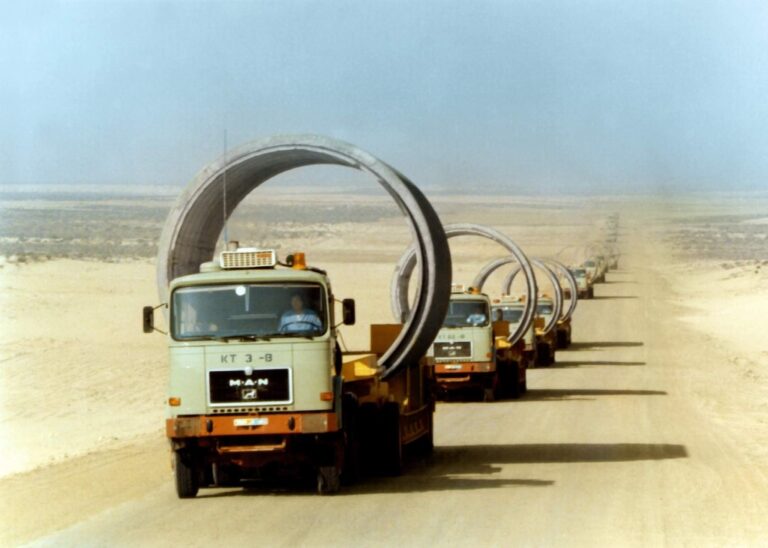
To make up for the gap in its traditional supplies, the Libyan government, headed by Gaddafi, undertook the largest civil engineering project in the world, popularly known as The Great Man Made River Project (GMMR), to green the northern deserts of Libya
Libya invests $20 billion in massive man made river to irrigate the thirsty nation. It took new roads to build, and a vast amount of resources. So far investment interest from the US has been poor.
BENGHAZI, Libya — From the sky, Libya’s Grand Omar Mukhtar Reservoir resembles a shimmering blue circle nestled in the desert sands. At ground level, the artificial lake is so vast that it’s impossible to photograph the whole structure with anything but a fisheye lens.
In fact, it takes a good 10 minutes to drive around the reservoir’s 3.5-kilometer perimeter gravel road. Holding 24 million cubic meters of water, Omar Mukhtar is the second-largest reservoir in the world — and a crucial element in Libya’s ambitious, $20 billion Great Man-Made River (GMMR) project.
“Before the implementation of the GMMR, the Libyan people were desperate for a few drops of water throughout the year,” says a government brochure describing the project. “Now, with a daily flow of over six million cubic meters, there is enough water to supply each citizen in the Great Jamahiriya with over 1,000 liters per day. In addition, 135,000 hectares of land will be freed from drought.”
The GMMR ranks easily as the largest and most expensive irrigation project in world history. Conceived in the late 1960s, its mission is simple: to pump water from Libya’s vast, underground Nubian Sandstone Aquifer System in the south to populated coastal areas in the north where most of the country’s six million inhabitants live and work.
Phase I of the GMMR, with a price tag of $5.5 billion, commenced in 1984 and since 1991 brings two million cubic meters of water daily from the immense Sarir and Tazerbo basins 1,200 kilometers north to the coastal strip between Sirte and Benghazi.
Phase II, costing just over $8 billion, carries 2.5 million cubic meters per day from the Murzuq Basin, feeding the cities between Sirte and Tripoli. Libya’s capital received its first supplies of GMMR water in September 1996.
Following the completion of Phase II, a third phase — estimated to cost $6 billion — was built to connect the two existing networks. Total production of the GMMR comes to 6.43 million cubic meters a day, using 1,149 production wells, most of them more than 500 meters deep.
Over the next 50 years, cumulative investment is expected to hit $33.7 billion, with total production of 120 billion cubic meters of water, said quality control manager Salim al-Hawari.
Without the GMMR, it’s evident that Libya would soon face a crisis of enormous proportions. According to the UN Development Program, available renewable water per person in Libya is expected to drop from the 1955 benchmark of 4,103 cubic meters annually to only 332 cubic meters by 2025.
Al-Hawari bushed off concerns by environmentalists that the water in the Nubian Sandstone Aquifer System — which accumulated during the last ice age — may actually run out within half a century at present rates of consumption.
“Total volume of fresh groundwater stored in the Nubian Aquifer is about 373 billion cubic meters. Therefore, if annual groundwater extraction of 1.38 billion cubic meters remains constant, recoverable reserves should last for a period of 4,860 years,” said the engineer, interviewed at GMMR’s Phase II headquarters in Qasser Bin Ghashir, just outside Tripoli.
To put things into perspective, the total quantity of cement used to build the GMMR is enough to build a concrete road from Tripoli to Sydney, Australia. If superimposed on a map of the United States, the GMMR — which Col. Muammar Qaddafi has called the “eighth wonder of the world” — would easily stretch from Louisiana to western New Mexico and up into northern Colorado.
Despite its massive cost, civil engineer Abdulmajid M. Elgaoud said Libya had no other alternative.
“I think it’s quite clear,” said Elgaoud, who as secretary of the People’s Committee has overall responsibility for the GMMR’s management and implementation. He said his country’s options were limited to piping fresh water from Greece across the Mediterranean to Libya; transporting water by ship or building desalination plants.
Based on official studies, the Great Man-Made River Authority (website not working Nov, 2019) concluded that one Libyan dinar would buy 0.74 cubic meters of piped water, 0.79 cubic meters of desalinated water or 1.05 cubic meters of water transported by ship. By comparison, the GMMR provides a whopping nine cubic meters of freshwater for that same Libyan dinar.
“Desalination plants were among the options, but so far, it’s expensive, because we’d have to generate power and then use this power to run the desal plants. So accordingly, if the cost of power is high, so would the cost of desalinated water. That’s one reason the water from our project is much more feasible,” Elgaoud said.
In addition, he explained, “the desalination plants would be on the coast, and the water needed for agriculture is inland, so you’d have to pump the desalinated water again to irrigated areas, and that would be expensive. So in fact, the cost of our tap water today is 28 cents per cubic meter, while desalinated water wouldn’t cost less than 85 cents. And when you add that to the cost of pumping the water inland, it comes to between $2.50 and $3.00 per cubic meter. So in fact, our water is quite economical.”
At present, 70 percent of the water produced by the GMMR goes to agriculture, with another 28 percent for municipal use (drinking water) and the remaining 2 percent for factories and industries.
All pipes used in the project are manufactured in Libya in accordance with American Water Works Association standards. Two factories, in Sarir and Brega, produce a combined 200 four-meter-diameter pipes per day. Since production began in September 1986, the two plants have manufactured around 530,000 pre-stressed concrete cylinder pipes weighing 75 to 83 metric tons apiece. Laid end to end, the pipes would stretch 4,000 kilometers.
“We monitor the pipes 24 hours a day using satellite technology, because if there’s any corrision, the pipes will burst,” said Elgaoud, noting that several thousands of kilometers of special-haul roads had to be built across the desert just to transport the pipes to where they needed to go. The pipes are laid in trenches seven meters deep and must be buried underground, he said, because of the extremely high pressures involved.
Elgaoud said the GMMR continues to expand, offering enormous potential for joint ventures and investment by American companies. “But this depends on the willingness of American companies to come and establish joint ventures,” he said. “Honestly, we expected more interest than we’ve seen up to now.”
On the other hand, Elgaoud praised an irrigation venture between his agency and two U.S. equipment manufacturers, Valmont and Case, that aims to grow wheat, corn and other crops on previously unusable land. “We think this project could be an example for other investments if it succeeds,” he said, “and I think it’s going to succeed.”
(This guest post is written by Larry Luxner, journalist and photographer.)
New construction in the West Bank, a national water scandal, a shift to green by kibbutzim, and more headlines related to Israeli cleantech and the environment.Image via alicia bramlett.
During the week of June 22, 2010 news spread that a male birth control pill has been created (by an Israeli professor). Such a pill, once on the market, could help protect the environment as well. Meanwhile, BP’s oil spill in the Gulf of Mexico has Israel carefully planning its delivery of the natural gas it recently discovered, and BrightSource Energy’s planned solar plant in the Mojave Desert is expected to be the most efficient in the world. For these stories and more, see this week’s headlines below.
It’s as though oil drilling has reached a holding pattern off the Red Sea coast of Egypt as the media, investors, drilling companies, governments and NGOs work to establish or even decide on the cause of the oil spill off the coast of Egypt’s Red Sea last week. Some say the spill was caused by a leaking rig; others blame the spill on the hot weather releasing oil from previous bilge dumps (like from Russian tankers). But stocks of oil and gas companies invested in the region are taking a nosedive. Bloomberg reports that stocks of the Maridive & Oil Services SAE, an Egyptian marine and oil services company, fell to their lowest levels in the past 13 months. The spill, lo and behold, will hurt the company’s profits.
BP to go ahead with deepwater drilling in the Mediterranean Sea, off the coast of Libya, which holds Africa’s largest oil reserves – the 9th largest in the world. Should activists be alarmed? Above: pivot irrigation in the Sahara, paid for by Libyan oil wealth.
While a tropical storm approaching the Gulf of Mexico might worsen the BP oil disaster, Libya is going to allow the same company to begin drilling in its offshore deepwater region next month. Shukri Ghanem, the head of Libya’s National Oil Company who serves also as Libya’s de facto Oil Minister, confirmed on June 27 the 2007 agreement with BP, which allows it to drill in the Libyan deepwater region of the Mediterranean Sea. This is despite the negative news about oil pills, not only in the United States, but more recently in the Red Sea, off the coast of Egypt.
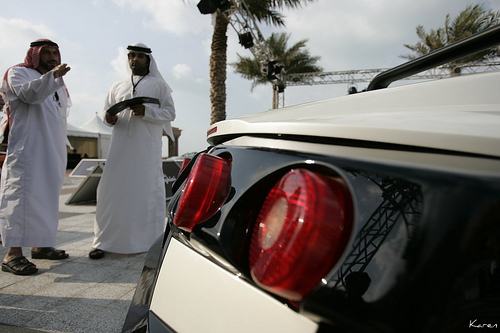
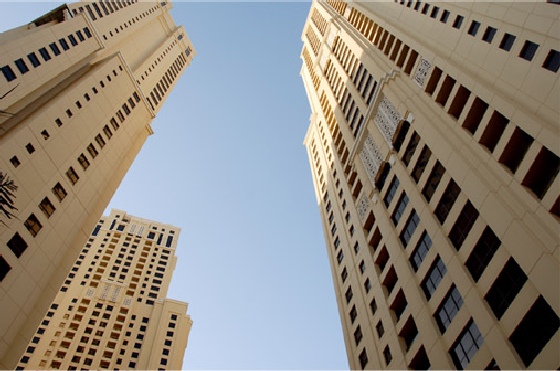
Abu Dhabi tells its residents not to pollute the environment by abandoning their cars. [image via: k.a.r.e.n]
We’ve heard of personal cars causing all kinds of pollution – air pollution, noise pollution… But abandoned cars polluting the streets and parking lots of a city? That’s taking pollution to a different level. And the Municipality of Abu Dhabi has decided that it won’t tolerate it anymore, calling on owners of personal vehicles not to abandon their cars in roads, parking lots, or public places.
Who to believe? That Dubai properties hasn’t paid or that Hopkins Architects reneged on their agreement?
There are different species of architectural firms operating in the feeding frenzy that is Dubai. Some, such as Foster&Partners, are contributing to the country’s environmental malaise, while others, such as Studied Impact, are trying a bit harder to reduce their environmental impact. Others still are suing for recompense.
Ira wrote about the Palestinian-Israeli wind power cooperation deal last week. Karin updates us with details on how Brothers Engineering Group plans on rolling out new business with Israel Wind Energy.
A path toward peace may be blowing in the wind, if a new wind energy project between a Palestinian and an Israeli company succeeds. The two companies, Israel Wind Power based in Ramat Gan, near Tel Aviv and Brothers Engineering Group from Bethlehem in the West Bank, have just announced their intention to cooperate in the building and selling of wind turbines in the West Bank region and beyond.
Will Alaska’s crystal clear lakes quench the thirst of the Middle East?
It looks like the old water trading game is once again getting attention. While it formerly involved such schemes as towing icebergs from Antarctica to Saudi Arabia, as well as bringing water in converted tanker vessels from Turkey (which now has a severe fresh water shortage itself ), we now have a new water importing scheme to dream about. This new plan involves bringing fresh water from an even further location: an Alaskan lake known as Blue Lake, located near the town of Sitka in southeastern Alaska. Reported on the National Geographic environmental news site, Alaska has numerous deep, clean lakes full of fresh water that is constantly being renewed. In fact, water in lakes like Blue Lake is a completely renewable resource.”
Kibbutz Sde Elihuya, home to organic agriculture in Israel. Mario Levi brought the idea of manure for compost from Italy
Treat all five of your senses with a Bio-Tour of organic agriculture at Kibbutz Sde Eliyahu.
With the summer in full swing (and heat, and humidity), we have featured a variety of eco-tourism options in the Middle East over the past few weeks. Some options have been delicious (such as the organic goat cheese farm in northern Israel) and some have been aesthetically fascinating (such as the public buses-turned-bed and breakfast suites in the Negev desert), but not all have been multi-sensual. Kibbutz Sde Eliyahu, one of the foremost organic kibbutzes in Israel, claims that it can provide an eco-tour that will please all five senses.
Kibbutz Sde Eliyahu invites visitors to what it calls a “Bio-Tour”, which they describe as a “unique tour in the clean air and the chemical free environment of organic farming at its best. Experience with all your senses. See, hear, smell, taste and feel.”
The Bio-Tours have a variety of attractions, and can therefore be tailored to each group, whether you decide to go alone, with family, with young children, or with friends. The lengths of the tours can vary as well, and usually range between 2-3 hours.
Various stops on the extensive Bio-Tour can include:
the organic pomegranate vineyard
the kibbutz’s compost heap
facilities for growing, drying and processing organic herbs S.D.E. Spice Factory
the fish farm
the Bio-Bee factory that manufactures insects as an organic form of pest control
Miriam recommends natural teas and a tincture for third-trimester ladies – and their husbands.
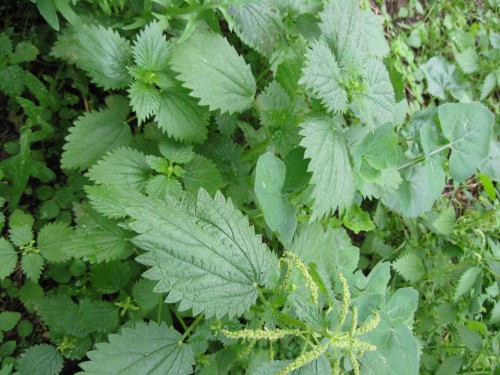
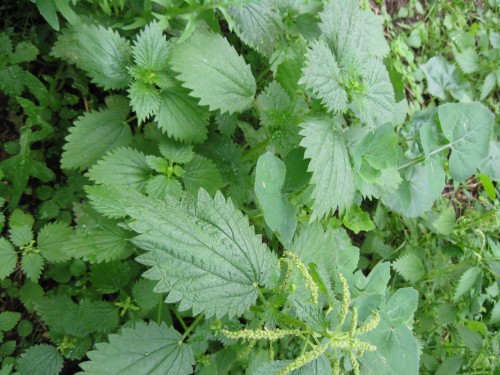
Having actively worked as a doulah for many years, I’ve always used herbalist’s wisdom to support women in pregnancy. Here are some herbs to ease the wait of the lady in waiting: The third trimester can be trying. Exhaustion, possibly return of nausea, feeling fed up. To strengthen the adrenals, supplement minerals and boost hemoglobin, drink this simple nettles tea:
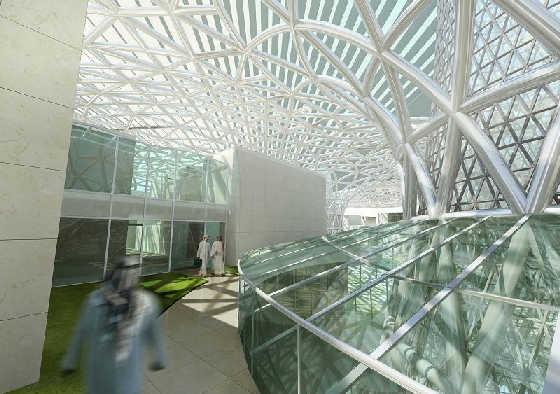
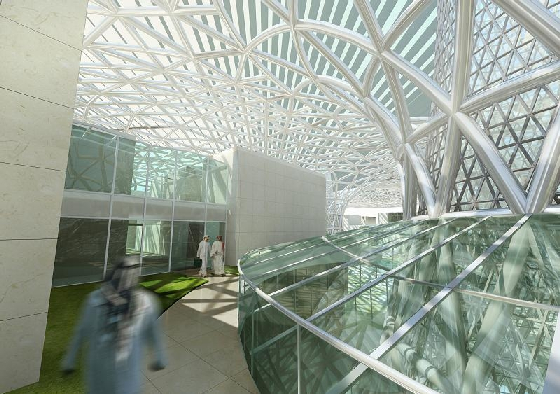
Abu Dhabi’s oil wealth funds energy infrastructure transformation with General Electric at the helm.
In 2005, a light bulb went off for GE, which pledged to spend $1.5 billion on alternative technology by 2010. Their Ecomagination department eclipsed that goal in 2009 and has recently committed a further $10billion to the cause. Masdar City in Abu Dhabi will be the first to showcase the results.
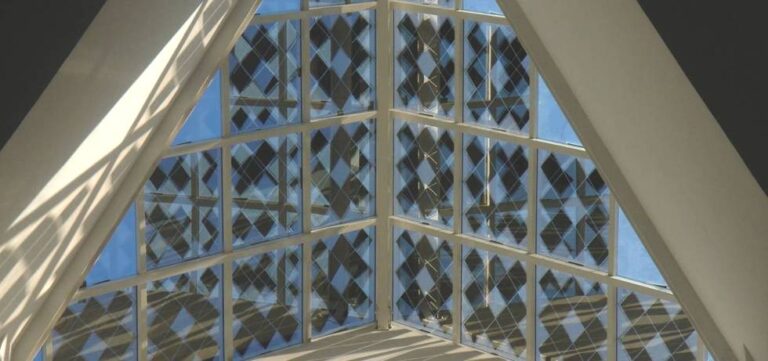
Naps Systems Oy, a Finnish solar panel company is providing boutique solar panel services to the Middle East. They mix aesthetics, quality and service with good green energy.
Working with airports in Morocco (above picture) and gas pipelines in Libya to prevent corrosion, the Finnish solar panel producer and integrator Naps Systems Oy is comfortable working with major industrial firms, and would be happy to customize solar panels for special building projects.
While some efficiency may be lost in ordering solar panels beyond the common dark blue, Naps’ CEO and President Timo Rosenlöf tells Green Prophet that he sees no reason why solar panels shouldn’t be produced in different hues, or in special designs, even at the cost of efficiency. Green Prophet met Rosenlöf on our recent clean tech media tour of Finland; and he is very interested in doing more business with the Middle East.
When we think of the environment today, the West looks like the clear leader. But did you know that some of the world’s most important discoveries originated in the Middle East?
The Middle East, perhaps because of its challenging environment, has seen the genesis of many environmental discoveries and techniques. Some of these are so ancient and ubiquitous that we take them for granted: domestic animals; agriculture; and of course cities. The five discoveries listed here range in age from seven thousand years to cutting-edge, and yet they all remain important today.
Irrigation qanats from Iran
The Persian Qanat: Aerial View, Jupar
Agricultural irrigation has been invented at many times and places. However, by far the earliest civilizations to use irrigation were the Egyptians and Mesopotamians.
Irrigation systems in the fertile crescent were used to raise barley in otherwise arid land; they date back to at least 5,000 BC, and quite possibly earlier. Some of these systems, such as the qanats in Iran, are still in use today after nearly 3000 years of operation.
Windmills did not appear in Europe until the 1200s, but they are mentioned in Persian texts as early as the 600s AD, and al-Masudi’s description of Sistan in 950 AD makes it clear that they were already commonplace in that region. (It seems likely that waterwheels are also of Middle Eastern origin, but the earliest known examples are Roman.)
The vast bulk of all wind power, historically, has been used to drive sailing vessels. Still, after a millennium and a half, fixed-point wind power remains one of the most promising methods of generating clean energy.
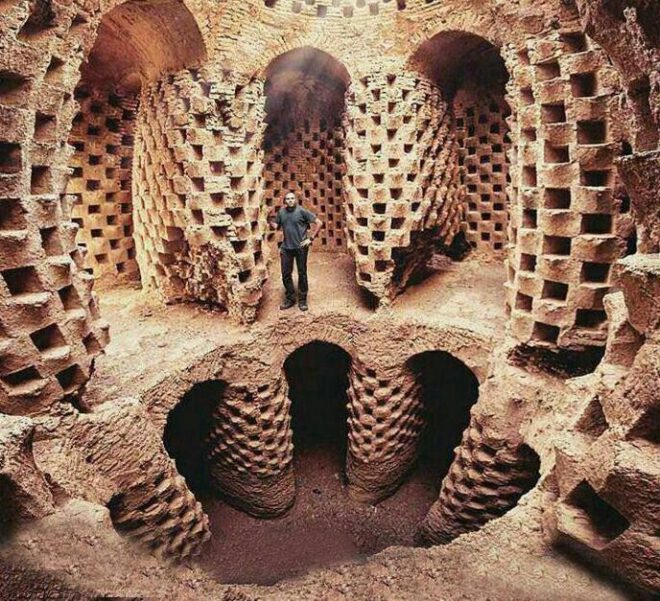
Harvesting Fertilizer from Doves
Dovecoats in Isfahan
The famous medieval dovecotes or pigeon towers of Esfahan, in Iran, are usually regarded as architectural attractions. But they are also the most visible part of a larger technology: harvesting fertilizer.The purpose of the dovecotes is to harvest nitrogen and phosphorus from pigeon droppings, and replenish the marginal soils of the region.
A related, though less dramatic technique is to graze sheep and goats over gardens after the harvest. There is an important environmental lesson here.
Just as early societies struggled to avoid using high-quality fertilizer as low-quality fuel, modern societies struggle to recycle livestock waste, while we simultaneously expend large sums on producing synthetic fertilizer.
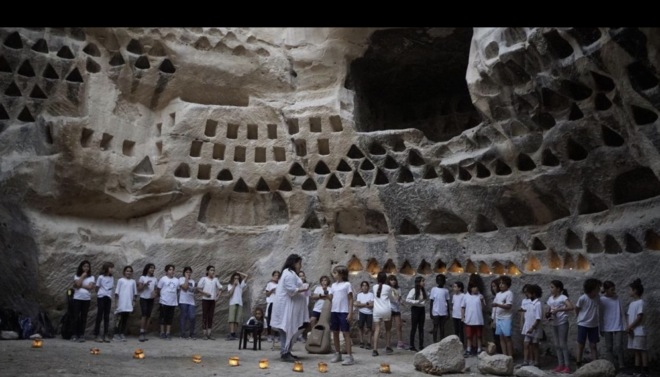
Dovecoats in Israel
Reforestation and Erosion Control
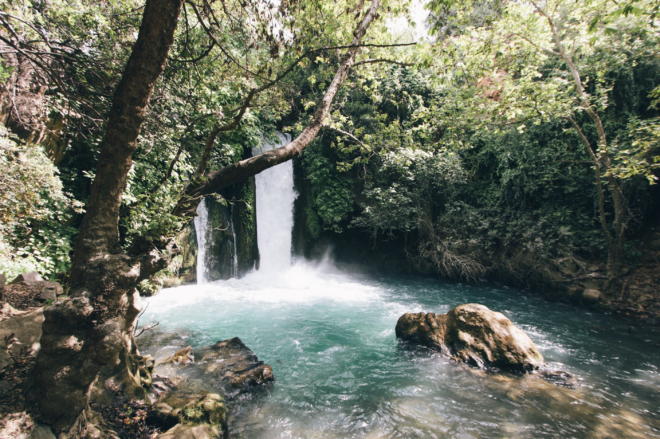
Ein Gedi, Israel
The Middle East was heavily deforested by the dawn of history, and combatting erosion and desertification have been constant challenges. It has long been both the birthplace and the best testing grounds for erosion control techniques, ranging from ancient terracing to modern synthetic, modular water diversion blocks.
Israel has run a particularly successful reforestation campaign in the last half-century, being one of relatively few countries worldwide to show a net gain in forest cover. Israeli immigrant Moshe Alamaro has also been one of the major proponents of aerial reforestation, using repurposed military technologies to plant seedlings in remote or hard-to-access regions.
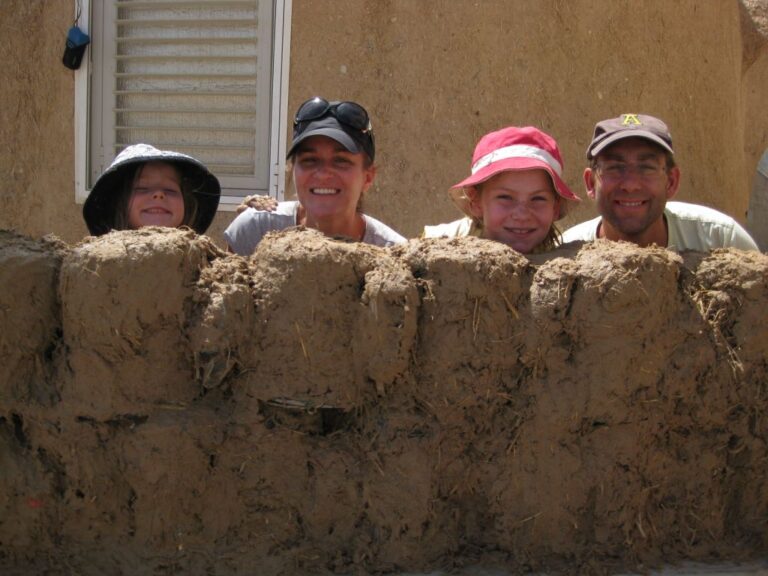
An Australian family of five goes on a 5-month worldwide eco-tour. Their adventure begins at Kibbutz Lotan in Israel as GoEco volunteers for 5 weeks. Read about the Wood-Auster family experience, told by dad Arron.
My wife Amy and I (Arron) made a decision to pull our family out of the day-to-day suburban world in Australia and venture on 5-month world trip. We wanted an experience that would expose our family of 5 to new cultures, languages, foods and most importantly different ways in which other families and societies co-exist in a less consumption-oriented way.
But was this possible? One month at Kibbutz Lotan in the Arava Desert in Israel ticked all the boxes and – as we were to discover – many more.


 New construction in the West Bank, a national water scandal, a shift to green by kibbutzim, and more headlines related to Israeli cleantech and the environment.Image via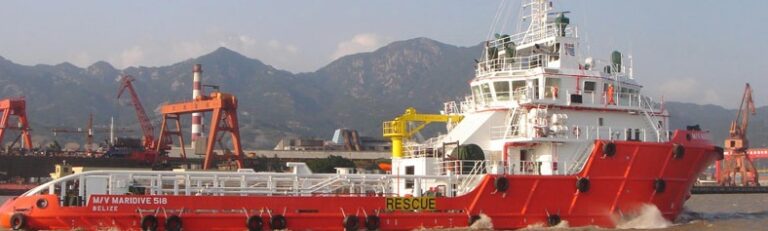
 A Maridive rescue boat.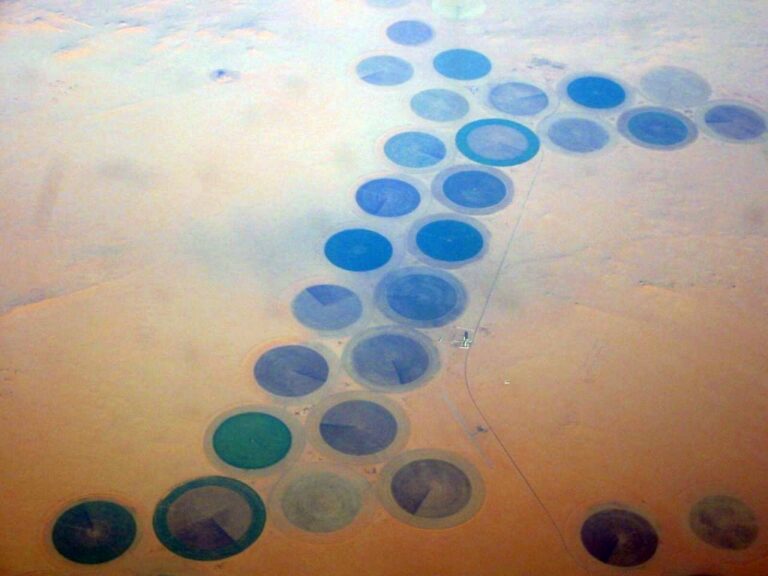
 BP to go ahead with deepwater drilling in the Mediterranean Sea, off the coast of Libya, which holds Africa’s largest oil reserves – the 9th largest in the world. Should activists be alarmed? Above: pivot irrigation in the Sahara, paid for by Libyan oil wealth.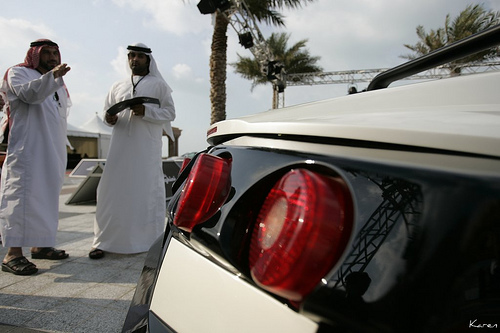

 Ira wrote about the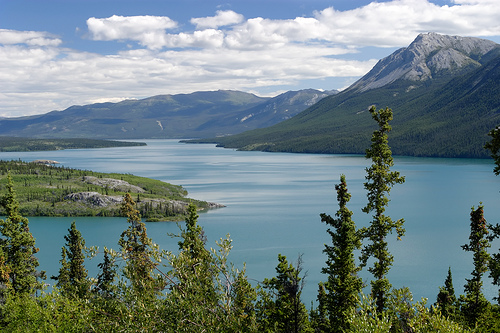
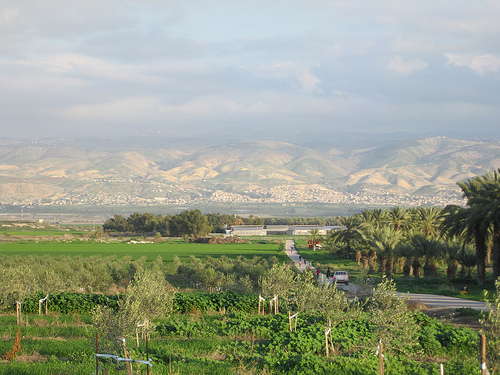
 Will Alaska’s crystal clear lakes quench the thirst of the Middle East?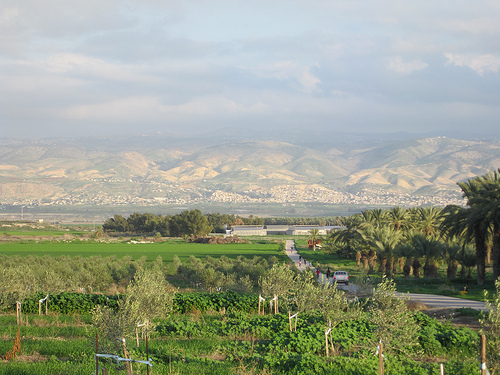
 Naps Systems Oy, a Finnish solar panel company is providing boutique solar panel services to the Middle East. They mix aesthetics, quality and service with good green energy.
 When we think of the environment today, the West looks like the clear leader. But did you know that some of the world’s most important discoveries originated in the Middle East?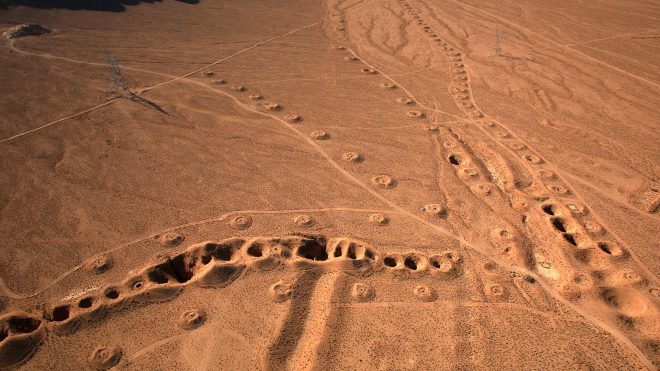

 An Australian family of five goes on a 5-month worldwide eco-tour. Their adventure begins at Kibbutz Lotan in Israel as GoEco volunteers for 5 weeks. Read about the