Medical device industrial designer creates eco-friendly Amazonian vibrators.
Award-winning designer, Ofer Zick, didn’t intend to be a green advocate when he founded ‘ThinkingOfYou – Erotic Icons’, but his grown-up T.O.Y. provides sustainable pleasure nonetheless (see the box below to learn more about what makes adult toys green). As an industrial designer, his specialty is medical devices, but his passions have always run a bit more personal. For as long as he can recall, Ofer Zick – former-director and current senior lecturer at Israel’s Holon Institute of Technology department of Industrial Design – has had an interest in the elegance of the human form. “I was drawing pictures of women when I was a young boy,” he told me in an exclusive interview.
Brought up by a single mother (his father died early in his life), this married father of two learned early on to appreciate womankind, something that ultimately served him well when he founded Toy-Thinking Of You (T.O.Y.). His Israeli company markets a possible first of its kind: a high-end, reasonably priced aesthetically captivating and functional erotic art.
Over the course of a several chats, he shared his passion for sustainable design, and why he wants to revolutionize an industry that’s known more for being seedy, rather than sensual. Turns out, Zick’s vision offers more aesthetic pleasure with less carbon footprint. The only question he can’t yet answer is: Is the world ready for T.O.Y.?
 Green Prophet: Tell me how and why you decided to start T.O.Y. and why vibrators?
Ofer Zick: I’ve been designing products for 20 years. My education is as a designer, and I teach as well. I was a bit fed up of giving my talents up to others. I decided about 5 years ago to design products for myself. That was the beginning. When I was thinking of an area, the idea of sex toys came up, though I had my concerns at first.
I started to do as I always do for all products I design. I did research, first to know the market, and second because sex toys are related to porn and don’t have the best image. I went to Berlin to see a big show, and just to travel around and meet people in industry. I must say that the first 10 min in that huge hall was shocking! The people there turned out to be wonderful too, by the way.
Then I focused. I checked out what kind of products were on the market, and found the gap: high quality products at a reasonable price. Most were very low quality products, or the high ones were extremely expensive.
That’s when I knew this is the place for me, an industrial designer. I design for people. Like I teach my students, we have to give them the best products they can afford. That’s my philosophy in general.
“Design is the ability to recognize, analyze interpret and translate necessity to a new user experience. What this means is that you have to find something people need, and then give them the full experience. It’s not just functional; aesthetic issues are part of it too.” Ofer Zick
GP: Tell me about the recent design show in Italy. What were people’s reactions?
OZ: My design was recently seen at the Promise Design Show in Milan, which is the largest design convention in Europe. There was a booth from Israeli designers, and the curator asked me to send him a few projects from the past few years. I sent him a product from T.O.Y, and was amazed he chose this for the exhibition.
The surprise was that he was open-minded enough to put a sex toy in a design exhibition. He put it in the right place – the idea of the product is the design. It’s the first time that a sex toy was presented in a design show. The audience is design addicts, not people looking for sex. Next, the exhibition is traveling to Paris and Lisbon.
What I heard from friends was that it was a big attraction. People loved it! From this show alone, we saw a 15% increase in orders.
 GP: Tell me about sustainable design. Did you seek out to create something environmentally friendly?
OZ: Everything I do I take into consideration environmental issues. When you are making a product, you have to ask yourself, what will happen at the end of its life? Design for disassembly is a big issue for design today.
For example, one of the last products I made was a new colonoscope. The inserter was supposed to be from silicon and plastic. This was supposed to be disposable, one examination for one patient. I knew that meant a lot of silicon in the garbage! I made the handle not disposable, and I reduced the silicon disposal from 90% to 20%.
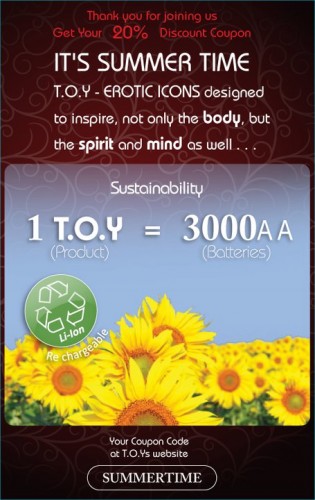
Let’s talk about T.O.Y. A big problem with vibrators is the battery issue. Green products should save on batteries and money. One lifecycle of my product will save someone about 3000 batteries! That’s a lot of waste and chemicals that are saved from going into the garbage.
In addition, the materials we use are medical grade. It’s also designed for disassemble. The silicon isn’t over-molded when you take it off. Of course, there’s more we can do to make things more sustainable. We are working to get there. The charging base also serves as an ambient nightlight. Duel purpose fun!
GP: Your design is both functional and artistic. Is the world ready for your creation?
OZ: It’s a tricky question. What I did which is different from other adult products is that I took it outside the drawer. I took a product that people hide and put it out. That is why the reason the cradle was made to also be an atmosphere light. You don’t realize it immediately as a sex toy.
People accept sex more easily when it is wrapped with an artistic cover. A picture of a naked is woman okay, but they have a harder time putting out a sex toy. I believe that sexuality should be spoken about and be presented.
I have a teenager girl at home. In my opinion, sexuality is related to maturity. We can’t push it forward, and we need to teach them what is age appropriate. We can’t fight lady gaga and fashion world and film industry. We are already on that hill, so we have to educate that sexuality is okay. As a society today, our kids are more neglected and growing themselves, in part because of the way we work and behave and the tempo of our lives. We have to be there for them a little more including teaching them about sex in a healthy way.

T.O.Y.-Thinkingofyou.com manufactures and markets three products in their Calla Lily Collection: The Sahara, the Amazon and the Everest. Currently, all are available in black silicon, but Zick has designed the Amazon to also come in shades of lilac, pale pink and light blue.
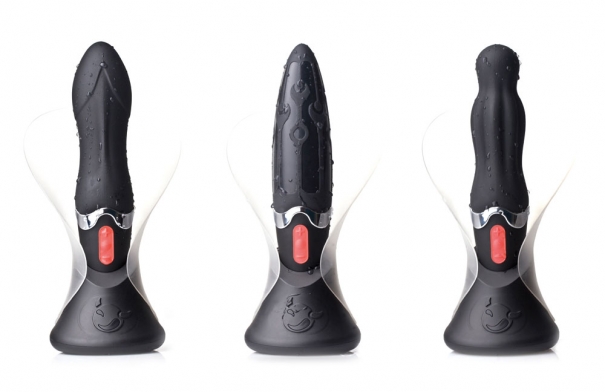

All are waterproof and C.E. certified, have very silent batteries, made of medical grade materials (unusual for sex toys), and available to consumers in Israel, the Middle East and internationally for an approximate price of $141.00.
Green Adult Toy Guidelines
When shopping for something that’s intimate and sustainable – better for you and the planet (afterall, we don’t want to put carcinogens or other harmful compounds in our bodies) – consider the following:
Materials: Look for products made from people and eco-safe compounds. To the best of our current knowledge, these include annealed glass, silicone, stainless steel, Lucite, ceramic or hypoallergenic thermoplastic elastomer.
Avoid phthalates or PVC-based products (they often have a stronger smell, a possible giveaway), compounds used to make them squishier.
Rechargeable: Old-fashion batteries are a green No-No; better options include rechargeable batteries, something that uses a charging base, or solar-powered.
Biodegradability: Silicone and Lucite don’t decompose, but they are recyclable. Glass goodies are also recyclable, and the production is relatively nontoxic. Word of caution though: don’t drop them. This can result in fractures; making your glass toy something you don’t want to play with.
Read more on eco-sexuality issues:
One of a Kind Online Muslim Sex Shop: Al Asira
Fundamentals of Eco-Sexuality: Is Conscious Sex the Way Towards Global Peace?
How do Tree Humpers Prevent Pregnancy?
Ins and Outs of Personal Lubricants









 On June 17th, she started to drive the car, not pose in front of it.


























 Providing a progress report,