Dubai’s Greener Future Begins Now At the Dubai Global Energy Forum

dubai, energy, sheikh, forum
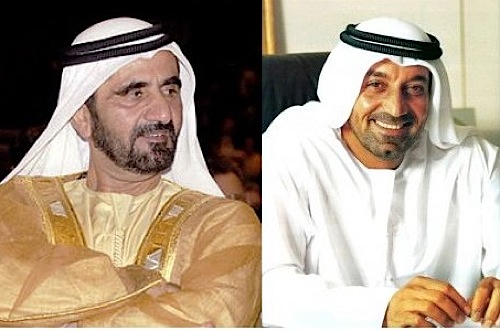
HH Sheikh Mohammed bin Rashid Al Maktoum and HH Sheikh Ahmed Bin Saeed Al Maktoum are both involved with the first ever Global Energy Forum in Dubai and hopefully a cleaner future.

Just ahead of Earth Day 2011, it’s the beginning of the end for Dubai’s waste era. Yesterday HH Sheikh Mohammed bin Rashhid Al Maktoum – Vice President and Prime Minister of the United Arab Emirates and Ruler of Dubai – inaugurated Dubai’s very first Global Energy Forum. Organized by the Dubai Supreme Council of Energy, the three day event that ends on April 19th, 2011, signals a very real shift in Dubai’s attitude towards energy.

It demonstrates an awareness on high that the glory days of fossil fuels are over and new heights need to be achieved in renewables. Although nuclear energy (and “clean” coal) features high on the Emirate’s list of alternatives, the forum being held at the Dubai World Trade Center has gathered some of the world’s most prominent leaders to discuss a cleaner future.

Among the most senior experts, policy makers, researchers, and corporate heads present at the event are Dr. Mohamed El Baradei, former Director General of the International Atomic Energy Authority and Nobel Peace Prize winner, Dr. APJ Abdul Kalm, the 11th President of India, Adnan Amir, the Director General of the International Renewable Energy Agency (IRENA), and Simon Cooper, the Deputy Chair and CEO of HSBC MENA.

The forum aims to provide a platform for participants to exchange views on the different policies of energy, both regionally and internationally, from technical, commercial, financial and regulatory viewpoints. This includes technologies, investment opportunities, economic diversification, market indicators and maximizing investment revenues in the fields of energy, particularly oil, gas alternative and renewable energy.

In addition, the forum seeks to share current and future policies and best practices as applied by international major companies. Also on the agenda are the most important issues of environment and sustainability that affect both the region and the world.

On the other side of our warming planet, a significant gathering of 5,000 activists led by Bill McKibben will gather across from the United States White House to protest soft energy policies by the world’s largest emitter of carbon dioxide emissions. Head of 350.org, one of the largest, most influential environmental organizations in human history, McKibben said in a recent Power Shift speech that if we do not change energy policies now, temperatures will rise by another five degrees by the end of the century.

Our current climate changes – the melting arctic, unbearable temperatures, and flooding that has left millions of Pakistani homeless – are the result of a mere one degree celsius change.

“This city looks clean and sparkling. No. This city is as polluted as Beijing, but instead of coal pollution, it’s money pollution,” said Bill McKibben of Washington D.C.

Let’s hope that the DGEF will initiate a more meaningful shift in Dubai’s policies than America has been able to achieve.

More on energy policy in the United Arab Emirates:

Clinton Lauds Masdar City’s Renewable Energy Efforts
Nuclear-Powered Water for the UAE?

Abu Dhabi Sees Renewable Energy as Profitable Energy

Tafline Laylin
Tafline Laylinhttp://www.greenprophet.com
As a tour leader who led “eco-friendly” camping trips throughout North America, Tafline soon realized that she was instead leaving behind a trail of gas fumes, plastic bottles and Pringles. In fact, wherever she traveled – whether it was Viet Nam or South Africa or England – it became clear how inefficiently the mandate to re-think our consumer culture is reaching the general public. Born in Iran, raised in South Africa and the United States, she currently splits her time between Africa and the Middle East. Tafline can be reached at tafline (at) greenprophet (dot) com.

Read More

1 COMMENT

TRENDING

Understanding Food Production: Karl Studer on the Urban-Rural Knowledge Gap

Karl Studer occupies an unusual position in American business. As President of Quanta Services, he oversees electrical infrastructure operations across the United States, Canada, and Australia, managing thousands of employees and multibillion-dollar projects.

Tigris River oil spill highlights Iraq’s environmental oversight and our addiction to oil

A fresh oil spill in the Tigris River, filmed by an Iraqi university student, has reignited concern over Iraq's polluted waterways. From ancient Mesopotamia to modern Basra, the country's dependence on oil has come at a steep environmental and human cost, with activists warning that unchecked contamination is putting ecosystems and public health at risk.

Doctor-Led Direct Hair Transplant: What Surgeon Involvement Means for Outcomes

Hair restoration technology continues to evolve, but the surgeon behind the procedure remains the most important factor. Doctor-led hair transplants emphasize careful diagnosis, conservative donor management, natural hairline design, and long-term planning rather than simply maximizing graft counts. By treating donor hair as a limited resource and tailoring each procedure to the patient's future hair loss, experienced surgeons can reduce the need for corrective surgery while delivering more natural, sustainable results.

Data centers in Space? Sophia Space and Apex plan on busing them in

Can data centers really be built in space? Pasadena-based Sophia Space is partnering with Apex to test the idea by launching modular AI computing systems into low Earth orbit in 2027. Using radiation-hardened compute TILEs cooled by passive radiative systems and mounted on scalable satellite buses, the companies aim to prove that edge computing can operate reliably in space. While challenges remain, the project represents an important step toward distributed orbital computing networks that could support everything from climate monitoring and pollution tracking to autonomous spacecraft navigation in an increasingly crowded orbital environment.

Mona Khalil, Orange House Project founder, sea turtle protector killed in Lebanon

Mona Khalil spent decades protecting Lebanon's sea turtles and coastal ecosystems. Her death in the ongoing conflict between Israel and Hezbollah shines a light on a broader environmental tragedy unfolding across northern Israel and southern Lebanon. From damaged wetlands and disrupted bird migrations to threatened seed banks and endangered wildlife, the region's ecosystems are becoming casualties of a war with no clear end in sight.

Yerukim Forms a New Green Economy Where the Money is Really Green

The Yerukim members who pick up the recyclables get to keep the monetary reward, the public earns "green" bills that can be used in shops, and business owners get to be associated with environmentalism.

Choosing Riyadh over Dubai? What Investors Should Know

Saudi Arabia is deploying capital at unmatched scale to catalyze tourism and advanced industry while rewiring its power-and-water backbone. The investable frontier is widening—especially in renewables, grid storage, water efficiency/desal retrofits, and hospitality operating platforms. Prudent investors will insist on phased delivery, enforceable KPIs (energy, water, biodiversity), and RHQ/zone compliance—while pricing political-economy and reputational risks alongside growth upside.

Sell your cooking oil for biodiesel money

Want to make money on old french fry oil? Sell it.

Qatar Alternative Energy Summit Pairs Investors And Innovators

Alternative energy investors and innovators can meet n' greet in Doha, Qatar March 16 and 17.

Here’s How To Implement The Four Pillars Of Employee Engagement

If you throw a party for your work team and they are vegans, don't make it a barbecue. Know the sustainability values of your team to boost moral and retain good people.

Locals From Rishon Fight IKEA

Big Box stores are a pretty new concept in Israel, and thank God that not every Israeli city wants them in their backyard. A word from someone who has see the beautiful farmland around her hometown Newmarket, Ontario stripped and converted into vulgar strip malls of big box shops: they have no place in a healthy and sustainable town or city.

The Jewish National Fund Meets An Inconvenient Truth

According to the JNF, it has transformed thousands of acres of barren land into green forests in Israel. They state that each person emits about 23 tons of carbon per year, estimating that each tree planted can absorb one ton of carbon in its lifetime. That's a whole lot of trees you'd need to be planting. Could so many fit in Israel?

How to quiet noise from construction in your office

Streets need to be resurfaced in New York but the humming and grinding noise is unsettling. Noise is environmental pollution. 

Popular Categories