Health insurance is a regulated financial product. Insurers operate under binding contracts, overseen by state insurance commissioners, that legally obligate them to pay claims meeting policy terms. Policyholders who believe a covered claim was wrongfully denied have legal recourse through state regulatory channels.
The New Zealand Merino Company, now rebranded as Zentera, has quietly removed the phrase “world’s leading ethical wool brand” from its website, a notable change that comes after a disturbing investigation by PETA Asia-Pacific into the company’s ZQ-certified wool supply chain, PETA reports to Green Prophet.
Somehow vegetables with short seasons excite the imagination and appetite more sharply than produce that’s available all year around. Good Middle Eastern cooks have many recipes for delicate fava beans, and this turmeric-fragrant soup is one.
Health insurance is a regulated financial product. Insurers operate under binding contracts, overseen by state insurance commissioners, that legally obligate them to pay claims meeting policy terms. Policyholders who believe a covered claim was wrongfully denied have legal recourse through state regulatory channels.
The New Zealand Merino Company, now rebranded as Zentera, has quietly removed the phrase “world’s leading ethical wool brand” from its website, a notable change that comes after a disturbing investigation by PETA Asia-Pacific into the company’s ZQ-certified wool supply chain, PETA reports to Green Prophet.
Somehow vegetables with short seasons excite the imagination and appetite more sharply than produce that’s available all year around. Good Middle Eastern cooks have many recipes for delicate fava beans, and this turmeric-fragrant soup is one.
Health insurance is a regulated financial product. Insurers operate under binding contracts, overseen by state insurance commissioners, that legally obligate them to pay claims meeting policy terms. Policyholders who believe a covered claim was wrongfully denied have legal recourse through state regulatory channels.
The New Zealand Merino Company, now rebranded as Zentera, has quietly removed the phrase “world’s leading ethical wool brand” from its website, a notable change that comes after a disturbing investigation by PETA Asia-Pacific into the company’s ZQ-certified wool supply chain, PETA reports to Green Prophet.
Somehow vegetables with short seasons excite the imagination and appetite more sharply than produce that’s available all year around. Good Middle Eastern cooks have many recipes for delicate fava beans, and this turmeric-fragrant soup is one.
Health insurance is a regulated financial product. Insurers operate under binding contracts, overseen by state insurance commissioners, that legally obligate them to pay claims meeting policy terms. Policyholders who believe a covered claim was wrongfully denied have legal recourse through state regulatory channels.
The New Zealand Merino Company, now rebranded as Zentera, has quietly removed the phrase “world’s leading ethical wool brand” from its website, a notable change that comes after a disturbing investigation by PETA Asia-Pacific into the company’s ZQ-certified wool supply chain, PETA reports to Green Prophet.
Somehow vegetables with short seasons excite the imagination and appetite more sharply than produce that’s available all year around. Good Middle Eastern cooks have many recipes for delicate fava beans, and this turmeric-fragrant soup is one.
Health insurance is a regulated financial product. Insurers operate under binding contracts, overseen by state insurance commissioners, that legally obligate them to pay claims meeting policy terms. Policyholders who believe a covered claim was wrongfully denied have legal recourse through state regulatory channels.
The New Zealand Merino Company, now rebranded as Zentera, has quietly removed the phrase “world’s leading ethical wool brand” from its website, a notable change that comes after a disturbing investigation by PETA Asia-Pacific into the company’s ZQ-certified wool supply chain, PETA reports to Green Prophet.
Somehow vegetables with short seasons excite the imagination and appetite more sharply than produce that’s available all year around. Good Middle Eastern cooks have many recipes for delicate fava beans, and this turmeric-fragrant soup is one.
Health insurance is a regulated financial product. Insurers operate under binding contracts, overseen by state insurance commissioners, that legally obligate them to pay claims meeting policy terms. Policyholders who believe a covered claim was wrongfully denied have legal recourse through state regulatory channels.
The New Zealand Merino Company, now rebranded as Zentera, has quietly removed the phrase “world’s leading ethical wool brand” from its website, a notable change that comes after a disturbing investigation by PETA Asia-Pacific into the company’s ZQ-certified wool supply chain, PETA reports to Green Prophet.
Somehow vegetables with short seasons excite the imagination and appetite more sharply than produce that’s available all year around. Good Middle Eastern cooks have many recipes for delicate fava beans, and this turmeric-fragrant soup is one.
Health insurance is a regulated financial product. Insurers operate under binding contracts, overseen by state insurance commissioners, that legally obligate them to pay claims meeting policy terms. Policyholders who believe a covered claim was wrongfully denied have legal recourse through state regulatory channels.
The New Zealand Merino Company, now rebranded as Zentera, has quietly removed the phrase “world’s leading ethical wool brand” from its website, a notable change that comes after a disturbing investigation by PETA Asia-Pacific into the company’s ZQ-certified wool supply chain, PETA reports to Green Prophet.
Somehow vegetables with short seasons excite the imagination and appetite more sharply than produce that’s available all year around. Good Middle Eastern cooks have many recipes for delicate fava beans, and this turmeric-fragrant soup is one.
Health insurance is a regulated financial product. Insurers operate under binding contracts, overseen by state insurance commissioners, that legally obligate them to pay claims meeting policy terms. Policyholders who believe a covered claim was wrongfully denied have legal recourse through state regulatory channels.
The New Zealand Merino Company, now rebranded as Zentera, has quietly removed the phrase “world’s leading ethical wool brand” from its website, a notable change that comes after a disturbing investigation by PETA Asia-Pacific into the company’s ZQ-certified wool supply chain, PETA reports to Green Prophet.
Somehow vegetables with short seasons excite the imagination and appetite more sharply than produce that’s available all year around. Good Middle Eastern cooks have many recipes for delicate fava beans, and this turmeric-fragrant soup is one.
California loves BrightSource Energy. Now, with a $250 million IPO we all have a chance to show how much.
A sign of just how capital intensive it is building new solar thermal infrastructure – was revealed today when BrightSource Energy filed with the US Securities and Exchange Commission to raise $250 million in an initial public offering of its shares. BrightSource already has some high profile investors. Google has invested $168 million, and NRG Energy is lending up to $300 million over the next few years in order to complete the BrightSopurce Ivanpah solar thermal project in California. The 392 MW project cleared the permitting process by the end of last year.
With these two investments, BrightSource has now successfully closed the deals needed for financing the Ivanpah project.This public offering comes as a way of raising additional money for future projects.
Last month, a group of women activists posing as pregnant women with faces covered with masks, staged a protest in Downtown Beirut against the delay by a parliamentary committee to finalize a long awaited law to ban smoking in closed public spaces and end unregulated cigarette advertisements, the Daily Star reports.
The demonstration, organized by the League of Independent Activists (IndyACT), is part of a larger national campaign in collaboration with the American University of Beirut and the Tobacco Free Initiative to promote the drafting of a modern law for tobacco control.
We caught up with Rima Jabado, a marine scientist who has worked all around the world, to find out about her research into sharks in the Arabian Gulf and the threat of habitat destruction.
Green Prophet: Can you tell us a little about yourself, why you work with sharks and your current research? Rima: I am a marine scientist and have worked in various locations around the world on various conservation projects including sharks, dolphins, corals and turtles. I have always been fascinated with sharks and wanted to work with them.
When I moved to the UAE, I realized there was little information on elasmobranches [sharks, rays and skates] in general in the region and decided to pursue my PhD to gain a better understanding of their status and threats to them in the region. I am therefore looking at various aspects of sharks and their fishery along the Arabian Gulf coast of the UAE and investigating the international fin trade from the UAE through a genetic study.
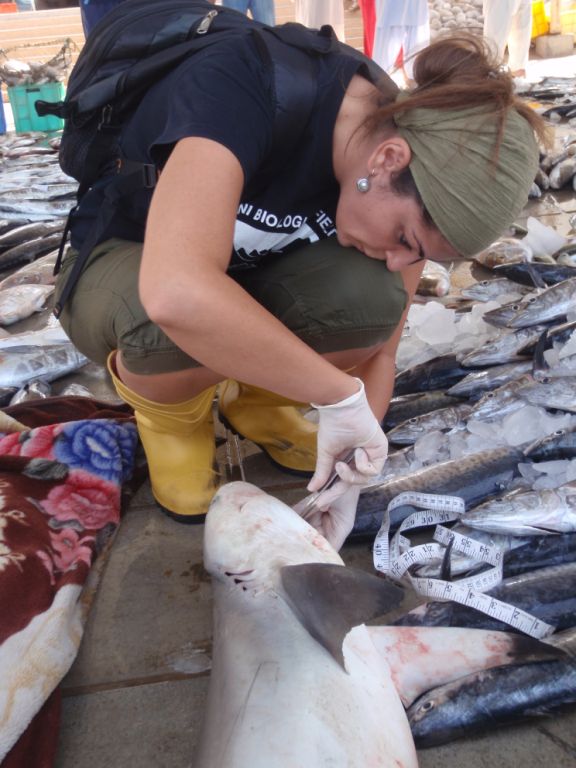
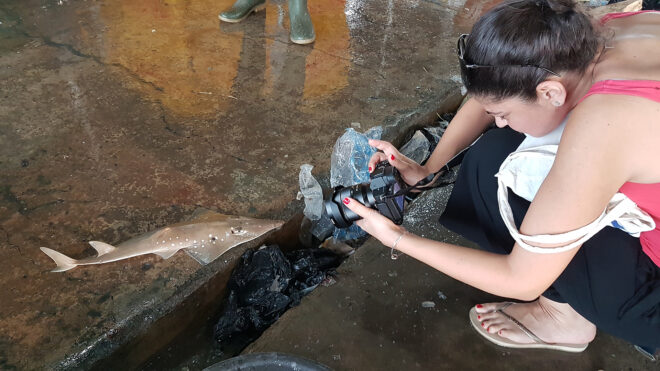
What is a normal days work for you? It really depends on the day! Some days are spent interviewing fishermen at the various fisheries cooperatives or landing sites across the country; some are spent identifying, sexing, measuring and collecting genetic samples at various landing sites; some are spent in the laboratory preparing field equipment, dissecting sharks or extracting DNA; and some are spent on the boat waiting for sharks to be tagged and released.
Green Prophet: Are sharks experiencing new threats in the Middle East? What are the major threats to sharks? I think sharks in the region are experiencing similar threats as in other parts of world. Targeted fisheries are the major threat especially for the international fin trade. However, they also face threats from habitat destruction and degradation.
What kind of findings have come from your research so far? I’ve confirmed 27 species of sharks from landings across the UAE and have determined trends in their distribution and abundance. My interviews with fishermen provided me a lot of information on the characteristics of the fishery, the type of gear used, trends in shark catch and the value of the various species.
I understand that you have overseen the dissection of sharks. What uses does dissection have for research and protecting shark populations? I actually did the dissections myself. I purchase two species of commercially important sharks from markets on a monthly basis to gain a better understanding of their biology, reproduction and feeding habits while collecting samples for parasitology, toxicology and growth studies.
The information provided will allow me to gain an insight on their life-history traits and provide information to undertake a stock assessment of these species. This information is crucial to develop management plans for their conservation while ensuring their long term sustainability.
Green Prophet: Are you hopeful for the future of sharks in the Middle East region? I think that there is increasing awareness of the threats that sharks face in this region. I am hopeful that with more research and a better understanding of the situation, scientists and resource managers can work together to protect the species that are most vulnerable while ensuring the sustainable catch of the remaining species.
Jordan takes another definitive step towards a renewable future with a little help from its Czech friends
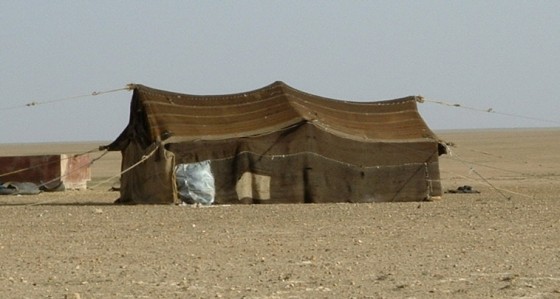
There will be no more stinky kerosene for the first solar-illuminatedBedouin tent in Jordan. Gas and kerosene lanterns have been replaced with a far more sustainable resource at the Rumana campsite in the Dana Biosphere Reserve. Donated by the Czech embassy in Jordan, the four solar units that will harness the sun – a cleaner, renewable energy resource – comprise just one initiative that the embassy has undertaken to help protect the local cultural and ecological heritage.
As part of the “Terra Madre” project, the Italian Slow Food Organization has plans to help locals grow 1,000 local gardens throughout Africa. The idea is to take back indigenous crops while also integrating more advanced and efficient growing techniques. This ambitious program will also help communities and individuals wrestle themselves from such industrial horrors as meat glue: the meat industry’s dirty secret.
The Superbus can carry well-to-do passengers in comfort and speed
With the “whish” of a passing Formula 1 race car, and an almost silent “whrr” of its rear mounted electric engine, the new Dutch engineered 23 passenger Superbus amazed spectators during a test run at Abu Dhabi’s futuristic Masdar City, reports The National. The 15 meter-long all electric vehicle appeared to be very maneuverable despite its length and its being able to reach speeds at over 200 kmh. Antonia Terzi, a former Formula 1 aerodynamics designer who was involved in designing the Superbus prototype told a reporter for The National: “It drives like a car. After a couple of laps you forget you have 15 metres behind you. It’s really, really responsive and it drives really, really nicely.”
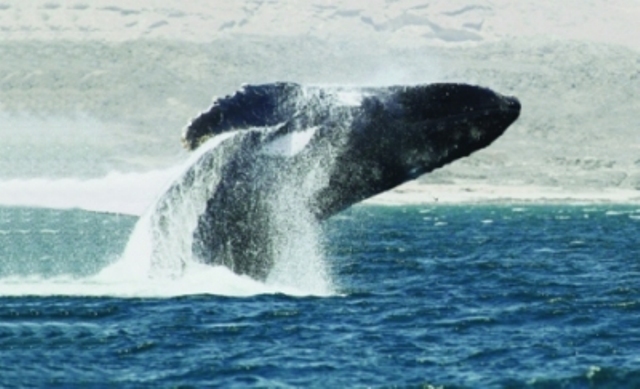
An Arabian humpback whale: newly discovered and already imperiled?
The Arabian and Persian Gulf waters off countries like Abu Dhabi, Iran, and Oman are home to a number of different types of marine animals. These include dolphins, at least 600 dugongs, several species of sharks, and sea turtles living in and around the Bu Tinah atolls. An even larger and more exotic marine mammal species, such as whales, may be sharing these waters as well. As reported recently in the English edition of the global Arab Network, a species of the Humpback whale, now known as the Arabian Sea Humpback Whale, have been located in the Arabian Gulf waters off Oman.
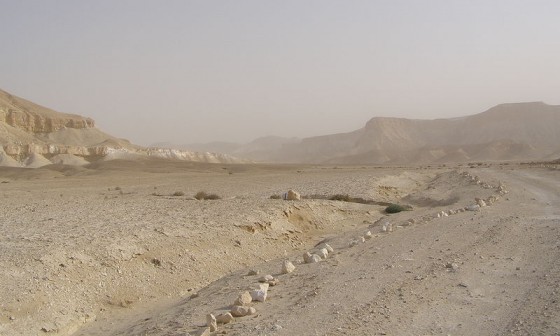
Within the next four months, Dimona Silica plans to build a factory in Nahal Zin Wadi in order to supply China with high-quality asphalt.
Since its inception, Dimona Silica Industries Ltd. has been plagued with a dodgy reputation. After its involvement with the 2004 Investment Promotions Center scandal, where it was found that then Minister of Industry, Trade and Labor Ehud Olmert (of Monster on the Mountain infamy) illegally offered a $10 million grant to help the company develop a proprietary asphalt mix called iBind, the company almost faltered.
An infusion of foreign investment has since saved them from obscurity, but at grave environmental cost. Founder Ephraim Fernblum handed over the company to his son-in-law Ronen Peled, who recently won a $6 million contract to line a Chinese highway with a rare mineral deposit found only in the Negev desert.
BrightSource vs. the desert tortoise. Is BSE too big to fail?
Shortly after Google announced its largest investment to date in BrightSource Energy’s gargantuan solar thermal project, the Californian company filed its first $250 million public offering on Earth Day. Forbes calls this an initial test of the market’s appetite for utility-scale solar energy. A handful of blue-chip investors have invested millions of dollars in BSE’s promise, and the company is in the red by nearly $2 billion. But BSE disclosed in its IPO that its success hinges on the 370MW Ivanpah Solar Energy Generating Station, the implementation of which is imperiled by the desert tortoise.
California’s gigantic aqueduct that snakes through the entire state to irrigate farms is probably the world’s best site for developing solar on bodies of water.
According to Todd Woody at the New York Times, who asks, Could the California Aqueduct serve as a solar farm? Israel’s Solaris Synergy estimates that its floating solar system could generate two megawatts in every mile along the 400 mile length of the California Aqueduct – which would mean a staggering 800 MW solar power station if the entire length was used. Their system is already in use on the utility scale in Israel.
Unsurprisingly, since water scarcity is at the forefront of the cause of most of the troubles in the Middle East, MENA nations dominated the 2011 Global Water Awards held in Berlin this week.
Almost half of the international winners were from the Middle East, but surprisingly, traditional fossil-fueled water projects dominated the awardees.
Advanced cleantech water companies that genuinely hold the promise of a sustainable water development, such as the many innovators that Israel’s Kinrot has incubated (GE Partnership With Kinrot Ventures Takes Clean Water Innovation Global) were not represented among the global winners. Nor were any of the many international solar companies now innovating sustainable desalination.
Eskişehir, a center of industrial production in Turkey, is the country’s most sustainable city, according to a recent survey.
When businesspeople from 29 different cities in Turkey were asked to rank their country’s provinces and cities in terms of sustainability, quality of life, social opportunities, and economic environment, the biggest cities in Turkey — Istanbul, Ankara, and Izmir — didn’t make the top 10.
“We can observe some world-cities in Turkey are not ranked in the top 10 for sustainability,” said Refik Erzan, Ph.D., from Boğaziçi University, at a press conference about the survey on Wednesday.
Stefanie Iris Weiss advocates for a greener shade of love and intimacy in her 2010 book, Eco-Sex: Go Green Between the Sheets and Make your Love Life Sustainable.
For the past few years, Earth Day has turned a racier shade of green thanks to the work of eco-sexuality advocates, such as Stefanie Iris Weiss, author of Eco-Sex: Go Green Between the Sheets and Make Your Love Life Sustainable (2010). A long-time adviser to the Green Love column, Ms. Weiss isn’t one to shy away from provocations, especially when the wellbeing of the planet and her inhabitants are at stake. From using safer forms of lubrication to advising tree-humpers on how to prevent pregnancy, Weiss dishes out her insights in delightfully green doses.
In our exclusive interview, this committed GINK (Green Inclined, No Kids) explains how her bottom line philosophy combines sexuality with ecology, and why even environmentalists are sometimes afraid to admit to hard truths with regards to the toughest question of all: How many babies should we be having on our overcrowded planet?
This green toilet by Noa Lerner will be a boon for third world countries that lack sanitary public waste facilities.
While other industrial designers merely tweak the appearance of the latest electronic gadget to make minor improvements to trivial point-of-sale appeal, Israel’s Noa Lerner, a Berlin-based industrial engineer, is developing a much more crucial necessity: a mobile public toilet for third world urban slum dwellers, with applications anywhere they are threatened by untreated wastes.
Lerner was struck by the existence of the problem on a trip to India, finding that even the centers of large cities had no public toilets. It is even worse in slums, where no sewage system exists.
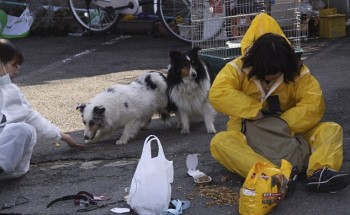
Abandoned dogs near Fukushima forced to roam in packs to find food
Despite the sad tragedy of what are now being called the “Fukushima Dead Zone Pets” all is not completely lost for these poor animals: a number of concerned Japanese citizens are willing to risk radiation exposure to themselves in order to save and care for abandoned stray animals in areas considered as high risk radiation exposure areas near the site of the damaged Fukushima power plant nuclear reactors.
As reported in the UK’s Daily Mail concerned people from Tokyo teamed up with residents of abandoned cities like Minami Soma, located near the Fukushima plant, to try to rescue abandoned dogs there, especially a number of Sheltie collies that a local dog breeder had alerted the media about.
Feeding Fukushima strays
Despite the numerous warning signs, and the fact that the animals themselves may be carrying radioactive articles in their fur, these are caring people. The particular group mentioned in the article and in another one in a Seattle Washington dog lover website, Dogspot, managed to entice 20 dogs, still waiting for their owners, to come to them for safety and treatment.
This only shows that people are willing to go the “extra mile” to save animals that would eventually die from being left behind in the panic that occurred after the nuclear reactors were damaged in the 9 magnitude earthquake and tsunami that followed.
Reports of animals locked in abandoned pet stores in Cairo and other cities, as well as abandoned dogs and cats forced to roam the streets in search of food, have been reported by ESMA, the Egyptian Society for Mercy to Animals.
Pets in large numbers were also abandoned in northern Israel during the 2006 Lebanon II war, as well as in Gaza, following the evacuation of Israeli settlers from there in August, 2005. But the ongoing tragedy of abandoning pets, on a daily basis, is still occurring and is unfortunately not receiving enough media attention as the case of the Japanese and Egyptian animal abandonment stories.
It’s a harsh world that we find ourselves living in these days. I hope we won’t reach the point where “stray humans” will share the same fate as animals now do. In some parts of the world, this appears to be already happening, however.






 An Arabian humpback whale: newly discovered and already imperiled?
 Within the next four months, Dimona Silica plans to build a factory in Nahal Zin Wadi in order to supply China with high-quality asphalt.