

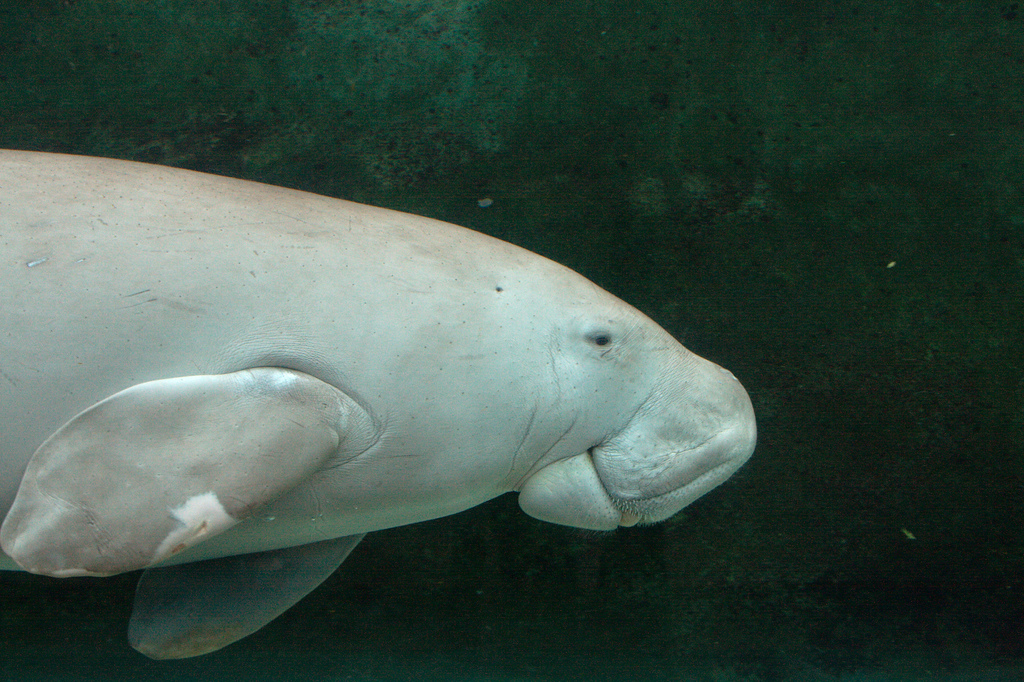
 The rare and beautiful dugong inspired “tails” about mermaids. This strange creature faces extinction in the Middle East. Image via Christian Haugen.
Can you believe that between six and seven thousand “mermaids” still live in the shallow, saline waters of the Persian Gulf? Better known as dugongs or sea cows, these slow moving, gentle herbivores inhabit sea grass filled estuaries and mangrove swampy areas off Saudi Arabia, the UAE states, Bahrain, and Qatar. They also live in the Red Sea. But they are under danger of extinction.
These aquatic mammals were once the subject of maritime tales dealing with mermaids, or half fish, half human creatures that lived in the sea and often called sailors to their death by encouraging them to jump overboard from their ships.
The dugong population in the Red Sea and in the Persian Gulf are estimated to be the second largest in the world, according to an article published a few years back by UN Environment Protection Agency’s Grida newsletter (no longer online, March 2020).

We need to protect these strange and beautiful mammals not at risk in the Persian Gulf and the Red Sea. Image via ThePatrick.
Recent construction projects in the Gulf’s coastal areas may have affected the relative safety that these creatures have been there for hundreds of years.

Man made damage harms dugongs and other Gulf Wildlife
The impact of oil production, war, and all the construction projects in and around the Persian Gulf has naturally had an adverse effect on marine and other wildlife in this region.
Previous Green Prophet articles have mentioned Dubai and Abu Dhabi real estate projects such as Dubai’s Palm Island and The World artificial islands, which have caused considerable damage to marine life in the areas where these projects have been constructed, and are presently being constructed.
The best example is the largest of these projects, The World, which is now causing serious damage to coral reefs, kelp, and the very sea grass that the dugong feed upon. As was noted in this article, the delicate eco-system of coral reefs, mangrove coastal areas and seagrass habitats, have been depleted by more than 35%.
The sea water salinity in the Gulf has also increased, affecting sea life. It was also noted that Island project promoters plan to import a number of dolphins from the Solomon Islands to add an extra attraction to the area, as well as creating a special “diver’s cave” where amateur scuba divers can hunt for “treasure” that the project promoters will put there for them.
In another article, a case study published in an American University educational website, one of the most constant threats posed to the dugongs of the Persian Gulf is that of water pollution; most especially water pollution as a result of oil spills.
With an enormous amount of the world’s oil supplies located in the Persian Gulf region, the transport of oil through the Persian Gulf is a fact of life. So too are oil spills. Oil in the water of the Persian Gulf destroys dugong habitats and is likely to have significant direct negative health effects on the dugong.
Efforts have been made to protect the dugong from being hunted or killed by fishermen when the mammals are trapped in fishing nets. Saudi Arabia and the UAE are signers to the CITES Agreement which is a world-wide resolution, adopted originally in 1963, to protect endangered animal species, of which the dugong and other similar species (manatee, etc) are now considered to be.
A video about saving the dugongs
Bahrain and Qatar are not signers to this agreement; but they have their own laws designed to protect the dugong. In 2006, a joint symposium was made by ten countries, including the UAE, Qatar, Bahrain, and Saudi Arabia to find ways to protect these animals in which one of the speaker, Catherine Muir of the Sea Sense organization in Tanzania, noted that:
“The main danger — in the whole region — is the net capture, because it is the reason for many accidents, and the cause of destruction of habitat sea-grass.”
These creatures, which grow up to 3 meters in length, are related to the elephant, and can live as long as 70 years, are a classic example of how humans are damaging and even destroying the wildlife of the Persian Gulf.
More environmental news from the Persian Gulf and Middle East:
Dubai’s The World Island Project Threatens Corals and Other Wildlife



[…] Actually, they are in a classification that is more closely related to elephants or marine dugongs (sea cows), found in the Arabian Gulf. […]
[…] Persian Gulf "Mermaids" Face Manmade Environmental Threats …Mar 4, 2010 … The rare and beautiful dugong inspired “tails” about mermaids. This strange creature faces extinction in the Middle East. Image via Christian … […]
[…] has been under pressure by developers, and this has also caused problems for marine wildlife, including one of the world’s largest concentrations of dugongs – a large herbivorous marine mammal that feeds off of underwater vegetation such as sea […]
[…] issues: Worst Wildfire in Israel’s Modern History Continues to Rage out of Control Persian Gulf “Mermaids” face Manmade environmental Threats Lebanon Environment Inaction May Affect Entire Region Helping Turkish Wildlife Cross the Roads […]
[…] Iran, and Oman are home to a number of different types of marine animals. These include dolphins, at least 600 dugongs, several species of sharks, and sea turtles living in and around the Bu Tinah atolls. An even […]
[…] “death ray” experiments: Dubai Marine Life at Risk After Devastating Shark Catch Persian Gulf Mermaids Face Man Made Environmental Threats Were Tesla’s Solar Innovations “Buried” by Big Oil? 25 Shark Species in Persian […]
[…] Dugongs, or sea cows, believed to be the source of mermaid legends, are threatened with extinction within 40 years, and an arsenal of measures, from replacing fishing nets that trap them to setting up marine reserves, are vital for their survival, a United Nations-backed forum has warned. “Man-made threats pose the greatest risk to the gentle sea cow,” the UN Environment Programme (UNEP) said, summing up a meeting this week in Abu Dhabi, United Arab Emirates. The dugong is the world’s only herbivorous mammal living in marine waters. […]
[…] the only large marine mammals found in sea, including bodies of water like the Gulf. At least 4,000 dugongs (large gentle marine herbivores, related to the manatee of sea cow) also live in the Gulf, as well as 40 different species of […]
[…] Bu Tinah islands, located 130 km west of the sheikdom’s capital, rare hawksbill sea turtles, dugongs, dolphins, and thousands of birds appear to be very happy on or around the island, according […]
[…] Persian Gulf “Mermaids” Face Manmade Environmental Threats […]