Sudan is starving and 25 million people face famine

Sudan
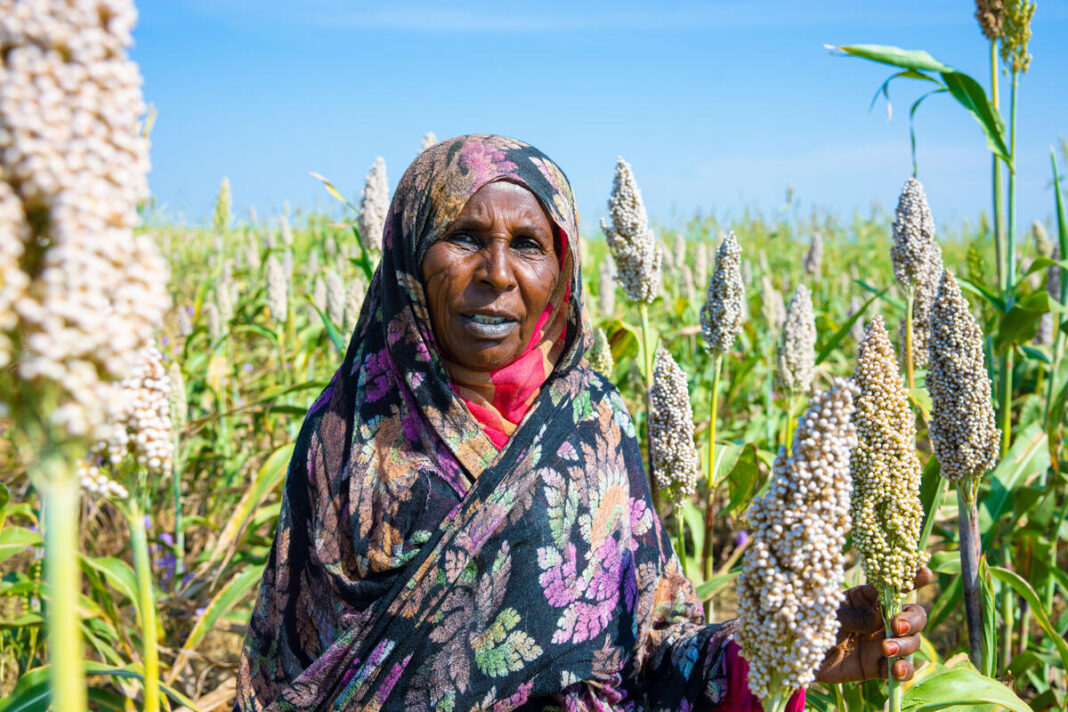
21 October 2024. Gadam Baliah village, Wasat Al Gedaref locality, Gedaref, Sudan. Hawa Ahmed, a resilient farmer from Gadam Baliah village, Gedaref, showcasing her crops’ progress.

Urgent action, in particular immediate and unimpeded humanitarian access, is required to address the widening famine in Sudan, where almost 25 million people face acute food insecurity.

According to the latest analysis from the Integrated Food Security Phase Classification (IPC), half of Sudan’s population – or 24.6 million people – are facing acute food insecurity levels. This is 3.5 million more people since June 2024.

The latest report by the IPC, a multi-partner initiative for improving food security and nutrition analysis and decision-making, is the worst in the country’s history. Widespread starvation and acute malnutrition have already resulted in tens of thousands of deaths in a country where almost two-thirds of the population depends on agriculture.

Production of key crops such as sorghum, millet and wheat during the first year of the conflict – the 2023/24 season – was down 46 percent from the previous year. This production loss could have fed approximately 18 million people for a year and represented an economic loss of between $1.3 and $1.7 billion.

Restricted humanitarian access is exacerbating the situation, while sustained violence and economic turmoil have disrupted markets, driving the price of staple goods to unaffordable levels.

This marks the fourth time that famine has been confirmed in a country over the past 15 years.

“We must take urgent action to address the famine in Sudan,” said Beth Bechdol, the Deputy Director-General of the Food and Agriculture Organization of the United Nations told a UN Security Council meeting in New York.

“If we fail to act now, collectively, and at scale, millions of lives are even further at risk, and (…) so is the stability of many nations in the region,” she added.

According to Bechdol, the following actions deserve prioritizing and require the Security Council’s support:

1) political leverage to end hostilities and bring relief to the people of Sudan;

2) immediate and unimpeded humanitarian access, as well as safe reopening of commercial supply routes to address current shortfalls in key hunger hotspots, as stated recently by FAO and its UN partner agencies;

3) the delivery of multi-sectoral humanitarian assistance, especially emergency agricultural support which is key to ensuring local food production, building resilience and preventing further humanitarian catastrophe.

The source of Sudan’s conflicts?

2020 Pew Research Center data estimates that 91 percent of the population is Muslim, 5.4 percent Christian, 2.8 percent follow Indigenous religions, and the remainder follow other religions or are unaffiliated. Some religious advocacy groups estimate non-Muslims make up more than 13 percent of the population.

Sudan ended over a quarter-century of Islamist-military rule with the 2019 overthrow of President Omar al-Bashir, whose rule was based on Islamism, Arab supremacy, and the ruthless application of military power, according to the Jameston Foundation: A joint civilian-military government was formed to lead the transition to a civilian-led democracy. However, an October 2021 coup led by Sudan’s military and security forces ended all progress toward civilian rule, severing at the same time most of Sudan’s economic and financial ties to the West.


TRENDING

The Christ’s thorn (sidr tree) is also a well-known folk medicine

Christ’s thorn jujube (Ziziphus spina-christi) also known as the sidr tree is a real, identifiable tree native to the Middle East, and it appears—directly or indirectly—in Islam, Judaism, and later Christian tradition. The connections between the three faiths are not theological agreements but overlapping uses, names, and symbolic associations rooted in the same landscape.

The Lote Tree of the Utmost Boundary, explained

Knowing about the concept of the Lote Tree of the Utmost Boundary helps explain a core idea in Islam.

How does one start prepping?

Faced with an extreme winter storm this year, Americans wonder how to be prepared for catastrophe. Miriam has lived through wars in the Middle East - so she's prepared on giving you a guide to prepping.

Female Genital Mutilation still happens — quietly, at home, and across borders in Canada

A service provider explains that women may choose midwives from within their community to keep their status private. Another line cuts to the core: “There’s a lack of understanding… especially psychologically.”

Sustainable Architect Ronak Roshan on the Politics Behind the Houston Ismaili Center

Roshan’s reflection situates the Houston Ismaili Center within a broader discussion about architecture as diplomacy — where aesthetics, faith, and geopolitics intersect. Her words challenge readers to question whether “green” design and grand symbolism can coexist without transparency and accountability.

Qatar’s climate hypocrisy rides the London Underground

Qatar remains a master of doublethink—burning gas by the megaton while selling “sustainability” to a world desperate for clean air. Wake up from your slumber people.

How Quality of Hire Shapes Modern Recruitment

A 2024 survey by Deloitte found that 76% of talent leaders now consider long-term retention and workforce contribution among their most important hiring success metrics—far surpassing time-to-fill or cost-per-hire. As the expectations for new hires deepen, companies must also confront the inherent challenges in redefining and accurately measuring hiring quality.

8 Team-Building Exercises to Start the Week Off 

Team building to change the world! The best renewable energy companies are ones that function.

Thank you, LinkedIn — and what your Jobs on the Rise report means for sustainable careers

While “green jobs” aren’t always labeled as such, many of the fastest-growing roles are directly enabling the energy transition, climate resilience, and lower-carbon systems: Number one on their list is Artificial Intelligence engineers. But what does that mean? Vibe coding Claude? 

Somali pirates steal oil tankers

The pirates often stage their heists out of Somalia, a lawless country, with a weak central government that is grappling with a violent Islamist insurgency. Using speedboats that swarm the targets, the machine-gun-toting pirates take control of merchant ships and then hold the vessels, crew and cargo for ransom.

Leopoldo Alejandro Betancourt López Turned Ocean Plastic Into Profitable Sunglasses

Few fashion accessories carry the environmental burden of sunglasses. Most frames are constructed from petroleum-based plastics and acrylic polymers that linger in landfills for centuries, shedding microplastics into soil and waterways long after they've been discarded. Leopoldo Alejandro Betancourt López, president of the Spanish eyewear brand Hawkers, saw this problem differently than most industry executives.

Why Dr. Tony Jacob Sees Texas Business Egos as Warning Signs

Everything's bigger in Texas. Except business egos.  Dr. Tony Jacob figured...

Israel and America Sign Renewable Energy Cooperation Deal

Other announcements made at the conference include the Timna Renewable Energy Park, which will be a center for R&D, and the AORA Solar Thermal Module at Kibbutz Samar, the world's first commercial hybrid solar gas-turbine power plant that is already nearing completion. Solel Solar Systems announced it was beginning construction of a 50 MW solar field in Lebrija, Spain, and Brightsource Energy made a pre-conference announcement that it had inked the world's largest solar deal to date with Southern California Edison (SCE).

Related Articles

Popular Categories