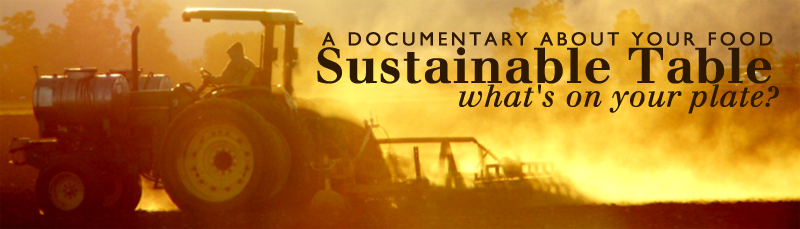
Sustainable Table Film Shows What’s On Your Plate

sustainable plate, what's on your plate

Miriam has been covering a series of sustainable meal recipes from the Middle East region, from countries like Saudi Arabia, Jordan and Iran to help people reconnect with their local food (click the countries to get some great local recipes).

We know that food industry is shaping the future of our bodies and our planet, and not in the best way. When you last tucked into dinner, did you pay any attention to where the ingredients came from? What’s on your plate? Where does it come from? The documentary Sustainable Table: What’s On Your Plate looks into the food we eat. While the film covers what’s going on in America the lesson can be applied to our global village, patterning itself on the West. 

For Sustainable Table: What’s On Your Plate,  director Mischa Hedges traveled along America’s west coast to learn more about our food system, and his findings apply globally.

Modern agriculture is waging a war against the planet, attacking nature with pesticides, herbicides, fertilizers, monoculture and genetically modified organisms. Learn what you can do to help stop it.

The film serves up these unsavory stats:

  • 7 percent of farms now sell 75% of our food
  • Agricultural runoff is a primary river pollutant, poisoning groundwater and killing entire ecosystems
  • Epidemic obesity, diabetes, and heart disease are directly linked to changes in food production
  • Over the last half century, agricultural exploitation and pollution have caused massive ecological degradation; 60% of earth’s ecosystems are sustained only through human intervention

Modern methods of commercial food production don’t consider environmental or human health costs when calculating bottom line. Monoculture is the practice of continually growing on the same land a single, high-yield crop: corn, soybeans and wheat are common monoculture crops. Sure it’s efficient and a better bang for your farming buck, but over the past century, massive monoculture has:

  • Reduced the diversity of soil nutrients
  • Destroyed biodiversity
  • Increased dependency on chemical pesticides and fertilizers
  • Increased reliance on specialized farm equipment dependent on fossil fuels

Polyculture (rotation of livestock and crops) evolved over centuries to meet a local community’s complete food needs. It can naturally replenish what’s consumed in the growing process by re- using byproducts of animal husbandry. When manure is direct-deposited onto fields by livestock, or purposely gathered and spread by farmers, the enriched soils help fertilize crops which are then consumed by humans and animals alike.  This eat/poop process returns critical phosphorus returned to the soil, a natural continuum.

Modern agriculture treats animals as commodities rather than living beings, exposing livestock to mental and physical anguish, dosing them with growth hormones and antibiotics and raising them in overcrowded conditions. Large scale animal breeding facilities (called concentrated animal feeding operations – CAFOs) generate foul emissions, which are linked to heart disease, neurological problems and asthma in nearby human populations. Animal waste runoff from these facilities is a leading contaminant of drinking water.

CAFOs are promoted as the best route to large-scale food production,  but their “efficiency” comes by replacing pasture-grazing with meal made from government-subsidized crops, completely altering the animals’ natural diets, with negative consequences for both animal and human health.

According to health website Mercola.com, farm subsidies underpin our unhealthy modern diet by supporting high-fructose corn syrup, fast food, animal factories, and monoculture.  Non-profit watchdog U.S. PIRG issued a stunning report translating federal subsidies of junk food versus fresh produce into easily understood terms: if you received the same annual subsidy a s Big Food Business, you’d get $7.36 to spend on junk food and 11 cents for fresh produce.

We vote every day when we choose our food.  Will you vote for the system that is systematically destroying your health, animal welfare and the planet? Or will you opt for sustainable change?

What can you do to help?  This film tries to find some of the answers.

Hot this week

How Renewable Energy is Revolutionizing the Way We Power Our World

Solar has become the star of the transition thanks to modular hardware and straightforward installation. It fits dense cities and remote towns alike. Many companies are turning to rooftop arrays and carport systems - and exploring commercial solar installation as a practical way to lock in future savings.

How does one start prepping?

Faced with an extreme winter storm this year, Americans wonder how to be prepared for catastrophe. Miriam has lived through wars in the Middle East - so she's prepared on giving you a guide to prepping.

Fishermen sue tire manufacturers on behalf of the salmon

A federal trial in San Francisco has brought US tire manufacturers, fishing groups, and environmental scientists into court over a chemical most drivers have never heard of — but which scientists say may be silently reshaping aquatic ecosystems.

Listening to Water: Tarek Atoui’s Next Work for Tate Modern

Born in Beirut, Lebanon in 1980 and now living in Paris, Atoui has spent years building instruments that don’t sit comfortably in concert halls. Many of them involve water, glass, and ceramics — materials that react to sound instead of simply producing it.

Leading Through a Dual-Energy Transition: Balancing Decarbonisation with Energy Security

Experience in one area of the energy industry isn't enough to guarantee readiness across all the others. That's where a structured program like an MBA in energy can come in. Today's advanced curricula explore energy economics, finance, policy, and strategic management alongside the technical subjects. And when pursuing an energy MBA online, professionals can skill up and retrain without having to step out of the labor market -- an important perk at a time when skilled professionals are already in short supply.

Topics

How Renewable Energy is Revolutionizing the Way We Power Our World

Solar has become the star of the transition thanks to modular hardware and straightforward installation. It fits dense cities and remote towns alike. Many companies are turning to rooftop arrays and carport systems - and exploring commercial solar installation as a practical way to lock in future savings.

How does one start prepping?

Faced with an extreme winter storm this year, Americans wonder how to be prepared for catastrophe. Miriam has lived through wars in the Middle East - so she's prepared on giving you a guide to prepping.

Fishermen sue tire manufacturers on behalf of the salmon

A federal trial in San Francisco has brought US tire manufacturers, fishing groups, and environmental scientists into court over a chemical most drivers have never heard of — but which scientists say may be silently reshaping aquatic ecosystems.

Listening to Water: Tarek Atoui’s Next Work for Tate Modern

Born in Beirut, Lebanon in 1980 and now living in Paris, Atoui has spent years building instruments that don’t sit comfortably in concert halls. Many of them involve water, glass, and ceramics — materials that react to sound instead of simply producing it.

Leading Through a Dual-Energy Transition: Balancing Decarbonisation with Energy Security

Experience in one area of the energy industry isn't enough to guarantee readiness across all the others. That's where a structured program like an MBA in energy can come in. Today's advanced curricula explore energy economics, finance, policy, and strategic management alongside the technical subjects. And when pursuing an energy MBA online, professionals can skill up and retrain without having to step out of the labor market -- an important perk at a time when skilled professionals are already in short supply.

From Green Energy to Healthy Societies: Why old systems thinking is becoming relevant again

Across the Middle East and North Africa, large investments are being made in green hydrogen, renewable energy, water infrastructure and sustainability. Most of these efforts are discussed in the context of climate change, decarbonization and economic diversification. That framing is important, but it may not capture their full value.

We saw peace – an interreligious encounter deep in our eyes

They came from Israel, Palestine, Jordan, Iraq, Yemen, Morocco, Tunisia, Lebanon, Egypt… There are Sunni Muslims, Shiite Muslims, Jews (Orthodox and Reform), Orthodox Christians, Coptic Christians, Protestant Christians, Druze, Baha'is, a Scientologist.

Can biochar reduce ‘Forever Chemicals’ in food if it’s used in farms?

Biochar is produced by heating organic material in a low-oxygen environment so it does not burn. This process, known as pyrolysis, transforms plant matter into a stable, carbon-rich material.

Related Articles

Popular Categories