

Saudi’s Waste of Ice Age Water Depicted in 4 NASA Images

water waste, NASA, water conservation, pivot irrigation, saudi arabia, agriculture, land grabsWithin 50 years, water trapped hundreds of thousands of years ago will be depleted by Saudi desert farms using pivot irrigation.

Water is a non-renewable resource in the Saudi desert, which only receives one inch of rain a year, so it makes sense to use existing resources very, very carefully, right? For ancient desert dwellers, this concept was a no-brainer, but for modern society – not so much.

Concerns about creating food security for Saudi Arabia’s population has led to an insane agricultural program depicted in NASA satellite images collected between 1987 and 2012. These eye-opening pictures demonstrate how the fields have grown using finite water sources trapped during the last Ice Age that hydrologists estimate will be gone within 50 years! 
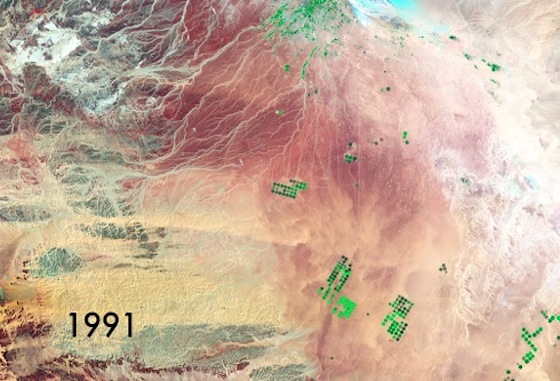
water waste, NASA, water conservation, agriculture, land grabs, saudi arabia

Each patch in these Landsat images represents a field of wheat (along with other crops) that is approximately 1 kilometer or 0.62 miles wide. A bright green block is healthy, according to NASA, while the orange-hued segments aren’t faring so well beneath the crippling desert sun.

The crops are irrigated using a technique called center-pivot irrigation. Saudis drill deep holes beneath the desert sands to tap into fossilized water captured hundreds of thousands of years ago.
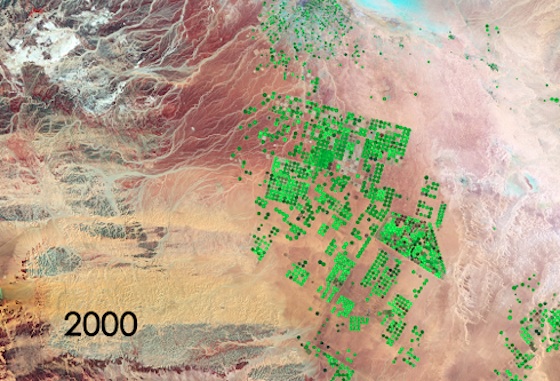
water waste, NASA, water conservation, agriculture, land grabs, saudi arabia

The water is then pumped through a circular sprinkling system that sprays the crops.

NASA, which manages the Landsat imaging program with the U.S. Department of Interior, explains how the images were captured and what they represent:

The images were created using reflected light from the short wave-infrared, near-infrared, and green portions of the electromagnetic spectrum (bands 7, 4, and 2 from Landsat 4 and 5 TM and Landsat 7 ETM+ sensors). Using this combination of wavelengths, healthy vegetation appears bright green while dry vegetation appears orange. Barren soil is a dark pink, and urban areas, like the town of Tubarjal at the top of each image, have a purple hue.

water waste, NASA, water conservation, agriculture, land grabs, saudi arabia desert

Using their extraordinary fossil wealth, Saudi has also nabbed up land in other countries, including water and food scarce Ethiopia, in order to secure food supplies for their own population.

I guess it’s hard to give up the good life, but it won’t be good indefinitely.

:: Grist, NASA

More News from Saudi Arabia:
Saudi Star Among Firms Behind Thousands of Forced Relocations in Ethiopia
Aflaj: Ancient Channels Keep Water Flowing in the Desert
Morocco’s Berbers had Water Management Sorted

Tafline Laylin
Tafline Laylinhttp://www.greenprophet.com
As a tour leader who led “eco-friendly” camping trips throughout North America, Tafline soon realized that she was instead leaving behind a trail of gas fumes, plastic bottles and Pringles. In fact, wherever she traveled – whether it was Viet Nam or South Africa or England – it became clear how inefficiently the mandate to re-think our consumer culture is reaching the general public. Born in Iran, raised in South Africa and the United States, she currently splits her time between Africa and the Middle East. Tafline can be reached at tafline (at) greenprophet (dot) com.
3 COMMENTS

LEAVE A REPLY

Please enter your comment!
Please enter your name here

TRENDING

Farm To Table Israel Connects People To The Land

Farm To Table Israel is transforming the traditional dining experience into a hands-on journey.

What a martian ice age left behind tells us about our future

We have heard that peak climate change might be...

Iran’s holiest city about to run dry as terror chosen over water management

Iran’s second-largest city, Mashhad, is facing an acute water emergency after dam reservoirs feeding the city fell below three percent capacity, according to Iranian state and local media. Officials warn that without rainfall or improved inflows from neighboring Afghanistan, the city’s supply could soon collapse.

Lizard tail stew, dhub mansaf, is a favored folk dish in Saudi Arabia

By exploring forgotten folk dishes like lizard stew, Green Prophet continues to connect the dots between culture, ecology, and the future of sustainable living in the Middle East.

Perseverance Rover Uncovers Ancient Martian Chemistry — And Raises the Question: Could This Hint at Past Life?

On Earth, similar mineral–organic interactions can be biological or abiotic. In Jezero Crater, the long geological timescales suggest the reduced vivianite and sulfides may have formed without biology — but organic compounds could still have driven the chemistry.

Qatar’s climate hypocrisy rides the London Underground

Qatar remains a master of doublethink—burning gas by the megaton while selling “sustainability” to a world desperate for clean air. Wake up from your slumber people.

How Quality of Hire Shapes Modern Recruitment

A 2024 survey by Deloitte found that 76% of talent leaders now consider long-term retention and workforce contribution among their most important hiring success metrics—far surpassing time-to-fill or cost-per-hire. As the expectations for new hires deepen, companies must also confront the inherent challenges in redefining and accurately measuring hiring quality.

8 Team-Building Exercises to Start the Week Off 

Team building to change the world! The best renewable energy companies are ones that function.

Thank you, LinkedIn — and what your Jobs on the Rise report means for sustainable careers

While “green jobs” aren’t always labeled as such, many of the fastest-growing roles are directly enabling the energy transition, climate resilience, and lower-carbon systems: Number one on their list is Artificial Intelligence engineers. But what does that mean? Vibe coding Claude? 

Somali pirates steal oil tankers

The pirates often stage their heists out of Somalia, a lawless country, with a weak central government that is grappling with a violent Islamist insurgency. Using speedboats that swarm the targets, the machine-gun-toting pirates take control of merchant ships and then hold the vessels, crew and cargo for ransom.

Leopoldo Alejandro Betancourt López Turned Ocean Plastic Into Profitable Sunglasses

Few fashion accessories carry the environmental burden of sunglasses. Most frames are constructed from petroleum-based plastics and acrylic polymers that linger in landfills for centuries, shedding microplastics into soil and waterways long after they've been discarded. Leopoldo Alejandro Betancourt López, president of the Spanish eyewear brand Hawkers, saw this problem differently than most industry executives.

Why Dr. Tony Jacob Sees Texas Business Egos as Warning Signs

Everything's bigger in Texas. Except business egos.  Dr. Tony Jacob figured...

Israel and America Sign Renewable Energy Cooperation Deal

Other announcements made at the conference include the Timna Renewable Energy Park, which will be a center for R&D, and the AORA Solar Thermal Module at Kibbutz Samar, the world's first commercial hybrid solar gas-turbine power plant that is already nearing completion. Solel Solar Systems announced it was beginning construction of a 50 MW solar field in Lebrija, Spain, and Brightsource Energy made a pre-conference announcement that it had inked the world's largest solar deal to date with Southern California Edison (SCE).

Related Articles

Popular Categories