
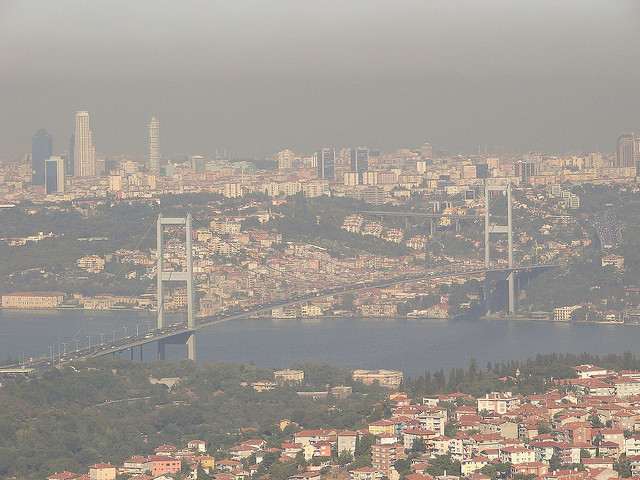

 Greenhouse gas emissions from Turkey don’t just pose an abstract, future threat to the country — the same gases that contribute to climate change periodically envelop Istanbul in smog.
Turkey’s greenhouse gas (GHG) emissions have increased by a whopping 98 percent in the last two decades, from 187 million tons of CO2 equivalent in 1990 to 370 million in 2009. That’s not as bad as India or China, where GHG emissions increased by 152 and 186 percent, respectively, in the same time period. But it’s a lot worse than the United States, where the increase was only 6 percent — or every country in the European Union, for that matter, where greenhouse gas emissions have all decreased since 1990.
What’s more, the Turkish government has resisted any binding solution to its skyrocketing GHG-emission rate. That, at least, is the conclusion of a new report by Bahçeşehir University Center for Economic and Social Research (BETAM) Research Fellow Barış Gençer Baykan.
Superficial international commitments
Though Turkey’s leaders ostensibly want the country to join the European Union, the government’s GHG emissions policy — or lack thereof — may be the clearest signal yet that Turkey’s government is not serious about bringing Turkey in line with EU standards.
Turkey ratified the Kyoto Protocol two years ago. Not only was Turkey one of the last countries to do so, its ratification was an empty gesture. Turkey is not bound by any of the pre-2012 Kyoto targets because it was not a member of the United Nations Framework Convention on Climate Change (UNFCC) when the protocol was first adopted.
And after the failure of recent talks in Bonn, Germany, to produce a legally binding successor to the 2008-2012 Kyoto Protocol emissions targets, it doesn’t look like external limits on Turkey’s GHG emissions will be imposed any time soon.
On the domestic front: lip service and inaction
Left to its own devices, it doesn’t seem likely that Turkey’s government will set emissions-reduction targets or impose the policies necessary to achieve them.
Baykan’s report pointed out that the biggest contributor to Turkey’s rising GHG emissions over the past twenty years has been the energy sector. The irresponsible construction of dirty-fuel power plants in various parts of the country has already spawned a grassroots protest movement throughout Turkey. In the Turkish Ministry of Energy’s strategic plan for energy independence, released last month, the ministry focused on increasing the number of domestic coal- and gas-fired power plants.
While some cleaner power plants are projected to come online in Turkey in the next few years, solely thanks to private investors, the government doesn’t offer the financial incentives necessary to jumpstart a widespread renewable energy industry in the country.
The government’s most recent opportunity to offer such incentives or set GHG emissions targets came in June, when the Ministry of Environment and Forestry released its 2011 Climate Change Action Plan. Like its predecessor, the document affirms the need to combat climate change, but shies from outlining any specific strategies for doing so.
Climate change policy not anti-competitive
In his report, Baykan found that government resistance to effective climate change policy appears to be rooted in economics — bad economics. “Leaders have said that reducing greenhouse gas emissions will hinder competitiveness,” he wrote in the report (in Turkish).
But, he pointed out, “An energy system based on fossil fuels and the unsustainable use of natural resources will only increase the cost of the fight against climate change, and our eventual adaptation to it.”
Read more about Turkish climate change policy:
Turkish Government Renews Efforts to Reduce Dependence on Foreign Energy
World’s First Integrated Renewables Combined Cycle Power Plant To Be Built In Turkey
Turkey’s Dams Are Violating Human Rights, UN Report Says
“Anatolia Won’t Be Blackened” Declare Turkish Anti-Fossil Fuel Groups
Image via orangejack




Fantastic blog! Do you have any hints for aspiring
writers? I’m planning to start my own blog soon but I’m
a little lost on everything. Would you advise starting with a free platform like WordPress or go for a paid option? There are so many
options out there that I’m totally confused .. Any ideas?
Thanks a lot!
This article provides clear idea in favor of the new people of blogging, that actually
how to do running a blog.
And who could fault the little boy for his sobering, direct answer.
” This was a 20 something young lad who was having fun doing something that he loves. Well, I don’t sit right down, first I go through my ritual.
Is it possible to encourage individual responsibility to use our natural energy resources. It would make such a difference to air quality and quality of lives.