Renewable-Energy Cars Heat Up in Turkey

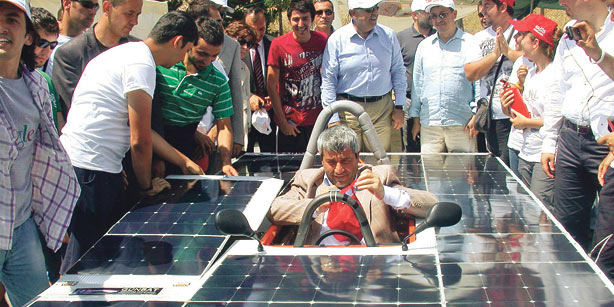
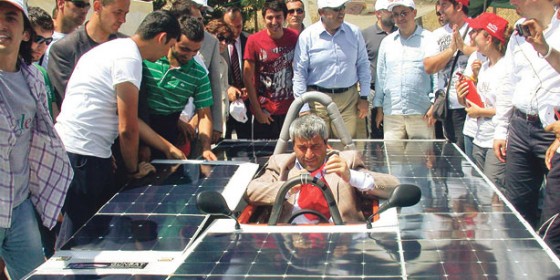
Science, Industry and Technology Minister Nihat Ergün test-drives a solar-powered car at a solar vehicle competition in the Turkish city of Izmir.

A strange array of vehicles were seen speeding around Izmir, Turkey last week, as the Scientific and Technological Research Council of Turkey (TÜBİTAK) hosted its first Alternative Energy Vehicle Races in the sunny Aegean coastal city. Thirty-eight teams entered the solar car races, while 20 teams brought vehicles to the hydrogen car competition.

The event inspired Nihat Ergün, of Turkey’s Ministry for Science, Industry and Technology, to declare that the government will up its investments in renewable vehicles in coming years.

Vague promises from the government

Though Ergün expressed enthusiasm for developing renewable energies at the TÜBİTAK races, the government’s material support for these technologies has been lackluster so far.

Ergün’s ministry recently published a Strategy Document for Turkey’s industrial sector between 2011 and 2014. While the paper sets some concrete goals for that time period, such as the development of Turkey’s first automotive brand, it stays vague on renewable energy targets despite frequently mentioning the need for a cleaner energy economy.

The document mentions old laws that have been passed to support renewable energy in Turkey, but does not point out that these laws have so far only resulted in subsidies that are too low to make solar and wind power competitive in the wider energy marketplace.

Recent reshufflings of the government ministries, though, could improve the prospects for renewable energy in Turkey. In June, Prime Minister Recep Tayyip Erdoğan announced that the former Ministry of Industry and Trade would lose “Trade” and add “Science and Technology” to its name.

As a result of this change, Ergün said in Izmir, his ministry will be able to focus on research and development projects more than it used to.

Promising activity from international bodies, private sector

While the government slowly begins to appreciate Turkey’s abundant renewable resources and technological potential, private companies and international organizations are already taking advantage of them.

The United Nations’ International Centre for Hydrogen Energy Technologies, for example, has already been holding competitions for hydrogen vehicles for several years now. Solar power is widely popular at the grassroots level, as evinced by the omnipresence of solar water heaters and small PV arrays on Turkish rooftops. And Turkish investor MetCap Developments recently contracted a renewable integrated combined cycle power plant from General Electric, the world’s first application of this unprecedentedly efficient power-producing technology.

The impressive turnout by university teams at the TÜBİTAK races suggests that Turkey’s next generation of scientists and engineers will be actively engaged in bringing their country into a cleaner energy future. Let’s hope the government follows their lead.

:: Today’s Zaman

Read more about renewable energy in Turkey:

GP Exclusive Interview: Turkey Beginning To Lay Infrastructure For Hydrogen Economy

World’s First Integrated Renewables Combined Cycle Plant To Be Built in Turkey

Europe’s Biggest Solar Farm To Be Built in Turkey

Image via Today’s Zaman

Julia Harte
Julia Hartehttp://www.greenprophet.com
Julia spent her childhood summers in a remote research station in the Rocky Mountains of Colorado, helping her father with a 25-year-old experiment in which he simulated global warming over a patch of alpine meadow. When not measuring plant species diversity or carbon flux in the soil, she could be found scampering around the forests and finding snowbanks to slide down. Now she is a freelance journalist living in Istanbul, where her passion for the environment intersects with her interest in Turkish politics and grassroots culture. She also writes about Turkish climate and energy policy for Solve Climate News.

Hot this week

How Renewable Energy is Revolutionizing the Way We Power Our World

Solar has become the star of the transition thanks to modular hardware and straightforward installation. It fits dense cities and remote towns alike. Many companies are turning to rooftop arrays and carport systems - and exploring commercial solar installation as a practical way to lock in future savings.

How does one start prepping?

Faced with an extreme winter storm this year, Americans wonder how to be prepared for catastrophe. Miriam has lived through wars in the Middle East - so she's prepared on giving you a guide to prepping.

Fishermen sue tire manufacturers on behalf of the salmon

A federal trial in San Francisco has brought US tire manufacturers, fishing groups, and environmental scientists into court over a chemical most drivers have never heard of — but which scientists say may be silently reshaping aquatic ecosystems.

Listening to Water: Tarek Atoui’s Next Work for Tate Modern

Born in Beirut, Lebanon in 1980 and now living in Paris, Atoui has spent years building instruments that don’t sit comfortably in concert halls. Many of them involve water, glass, and ceramics — materials that react to sound instead of simply producing it.

Leading Through a Dual-Energy Transition: Balancing Decarbonisation with Energy Security

Experience in one area of the energy industry isn't enough to guarantee readiness across all the others. That's where a structured program like an MBA in energy can come in. Today's advanced curricula explore energy economics, finance, policy, and strategic management alongside the technical subjects. And when pursuing an energy MBA online, professionals can skill up and retrain without having to step out of the labor market -- an important perk at a time when skilled professionals are already in short supply.

Topics

How Renewable Energy is Revolutionizing the Way We Power Our World

Solar has become the star of the transition thanks to modular hardware and straightforward installation. It fits dense cities and remote towns alike. Many companies are turning to rooftop arrays and carport systems - and exploring commercial solar installation as a practical way to lock in future savings.

How does one start prepping?

Faced with an extreme winter storm this year, Americans wonder how to be prepared for catastrophe. Miriam has lived through wars in the Middle East - so she's prepared on giving you a guide to prepping.

Fishermen sue tire manufacturers on behalf of the salmon

A federal trial in San Francisco has brought US tire manufacturers, fishing groups, and environmental scientists into court over a chemical most drivers have never heard of — but which scientists say may be silently reshaping aquatic ecosystems.

Listening to Water: Tarek Atoui’s Next Work for Tate Modern

Born in Beirut, Lebanon in 1980 and now living in Paris, Atoui has spent years building instruments that don’t sit comfortably in concert halls. Many of them involve water, glass, and ceramics — materials that react to sound instead of simply producing it.

Leading Through a Dual-Energy Transition: Balancing Decarbonisation with Energy Security

Experience in one area of the energy industry isn't enough to guarantee readiness across all the others. That's where a structured program like an MBA in energy can come in. Today's advanced curricula explore energy economics, finance, policy, and strategic management alongside the technical subjects. And when pursuing an energy MBA online, professionals can skill up and retrain without having to step out of the labor market -- an important perk at a time when skilled professionals are already in short supply.

From Green Energy to Healthy Societies: Why old systems thinking is becoming relevant again

Across the Middle East and North Africa, large investments are being made in green hydrogen, renewable energy, water infrastructure and sustainability. Most of these efforts are discussed in the context of climate change, decarbonization and economic diversification. That framing is important, but it may not capture their full value.

We saw peace – an interreligious encounter deep in our eyes

They came from Israel, Palestine, Jordan, Iraq, Yemen, Morocco, Tunisia, Lebanon, Egypt… There are Sunni Muslims, Shiite Muslims, Jews (Orthodox and Reform), Orthodox Christians, Coptic Christians, Protestant Christians, Druze, Baha'is, a Scientologist.

Can biochar reduce ‘Forever Chemicals’ in food if it’s used in farms?

Biochar is produced by heating organic material in a low-oxygen environment so it does not burn. This process, known as pyrolysis, transforms plant matter into a stable, carbon-rich material.

Related Articles

Popular Categories