


Bill McKibben talks about fossil fuels, a “slightly earlier time,” and 350.org’s goal to ensure a future for the world’s youth.
Bill McKibben needs very little introduction, but I’ll give one anyway. Not only is he considered one of America’s leading environmentalists, who has written a small sack full of books and contributes to numerous science magazines including Orion, Grist (on whose board he serves), and Mother Jones, but he is also captain of the 350.org ship.
This team of dynamic organizers has engaged the largest peaceful struggle against dogged carboneers the world has ever seen.
We first interviewed 350’s Phil Aroneanu, who gave us an in-depth description of what it means to amass a “green” movement in the Middle East (in 2020 we started to rebrand the region with a new name, the western East) and the wider implications of our willingness to engage.
His is an encouraging and passionate call to action that will hopefully inspire many readers. To Bill we looked for a more sobering account of global warming, and for a few pearls of wisdom that will help guide us away from our carbon addiction.
When you wrote your first book, “The End of Nature,” twenty years ago, did you imagine that climate change would reach such a dangerous climax? Or did you hope that the science would set us straight?
Well, I was 27 at the time, so I thought: people will read my book and get to work and solve the problem. A little naive! I think we have all underestimated the determination of the fossil fuel industry to fight any real change, even if it means courting real danger for the whole planet.
What is the most toxic thing we do that we should stop immediately if there is to be any hope of stabilizing our planet’s climate?
Burning coal is probably the single most unsustainable thing we do. And we will keep doing it until we agree to impose a price on carbon for the damage it does in the atmosphere. At the moment, the fossil fuel industry is allowed to use the atmosphere as an open sewer–for free. That has to stop.
Do you think that projects like Masdar City in Abu Dhabi – which aims to be (a very expensive) zero-carbon, zero-waste initiative – are appropriate solutions to our problems?
I think it’s a powerful demonstration of what is possible–and the fact that it is happening in Abu Dhabi amidst the oil rigs makes it an especially powerful challenge to the rest of the world.
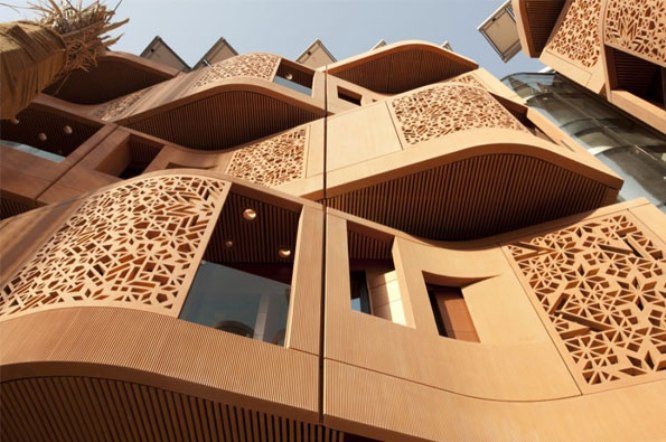
But of course most of the world–even most of Abu Dhabi–won’t look like Masdar City; the technology developed there will need to be applied in more real-life situations.
You have proposed that in order to build resilience in the coming decades, it is necessary to localize communities, pick up a pitchfork and some seeds, and move away from carbon-dependent agriculture. How can we apply this model in the Middle East where such a small percentage of our land is arable?
In the future we’ll need to pay more attention to what is and isn’t possible in our particular areas, instead of pretending we can do the same thing everywhere. (This is already starting to happen–the Saudis abandoning their dairy industry, for instance).
In the harsh terrain of the mideast, people will need to make careful use of every bit of fertile soil and every drop of water–that is, to go back to the careful habits of a slightly earlier time.
On the continuum of regions likely to suffer most as a result of climate change, where does the Middle East stand?
Any place that is already living close to the margins is in the greatest danger. And of course the Middle East is close to the margin in terms of available water. That will be the hardest threat.
The New York Times recently published an article about Kansas City climate skeptics embracing clean energy. This demonstrates to me that the country’s lack of energy independence will best motivate the US to adopt alternative sources of energy. But in the Middle East, we practically have more oil than water. In your opinion, how does this deepen the challenge of quitting our carbon habit?
It makes it very hard–the need to move away from the thing that underpins the local economy. That there are even people like you taking up these questions in the Middle East is remarkable and wonderful.
350.org has amassed one of the largest bodies of proactive, dissident voices – ever – and yet our leaders consistently fail to mobilize to create a safer model. What are the consequences of this inaction? And what is it finally going to take to convince powerful profiteers that what we’re up against is serious?
Every year we go deeper into the globally warmed future–the summer of 2010 across the northern hemisphere was, I’m afraid, a foretaste of what’s coming in the early stages of climate change, especially the drought across Russia and the floods of Pakistan. I wish that would be enough to wake up the profiteers, but I fear only an engaged and active citizenry can do that, which is what all of us at 350.org keep trying to build. It’s mostly the voices of the young around the world that speak for 350.org, and they say the same thing: we want a future.
Bill, thank you very much for taking time out of your busy schedule to answer our questions. Your seemingly boundless determination to generate awareness and engage people around the world is an enormous inspiration.
More on Bill McKibben and 350.org:
350.org’s Phil Aroneanu On How To Build An Environmental Movement In The Middle East



Too true 🙂
Not half as wonderful as Mr. McKibben and our readers… like you!
We are ALL wonderful.
He said:”…That there are even people like you taking up these questions in the Middle East is remarkable and wonderful.”
And I say, “Yes you are!”