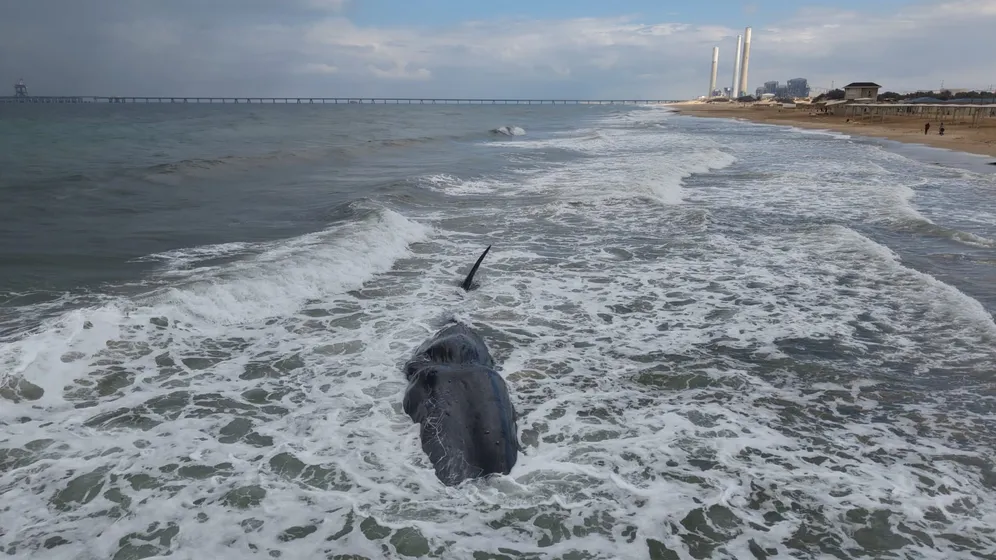
A large sperm whale has washed ashore on Zikim Beach in southern Israel, marking only the eighth documented case of its kind along the country’s Mediterranean coast since monitoring began.
The carcass was reported Tuesday morning within the Shikma Marine Nature Reserve near the Gaza-adjacent shoreline. Israeli marine authorities confirmed the animal as a sperm whale (Physeter macrocephalus), the world’s largest toothed predator.
According to Hebrew-language press reports, marine inspector Evyatar Ben-Avi of the Israel Nature and Parks Authority received the initial alert. Researchers from Israel’s Dolphin and Sea Center were dispatched to assess the site.
“Since research began in Israel, eight sperm whale carcasses have been recorded along the country’s coasts (including the one discovered this morning),” said Dr. Mia Elser of the NGO.
The Mediterranean population of sperm whales is considered genetically distinct and far smaller than its Atlantic relatives. The International Union for Conservation of Nature (IUCN) classified the Mediterranean group as Endangered in 2021, with estimates suggesting only 250 to 2,500 individuals remain, and declining. Recent videos and photographs from Gaza, also near to the sperm whale sighting, has shown that Palestinians are catching dolphins, sharks and endangered sea turtles for food.
“The Mediterranean sperm whale population is genetically isolated from Atlantic whales. It even has its own characteristic clicking pattern,” said Dr. Aviad Scheinin, director of the Dolphin and Sea Center at the Morris Kahn Marine Research Station to local media.
Scientists say deep-diving sperm whales face a unique set of threats in the region: drifting swordfish and tuna nets that entangle whales as bycatch, seismic surveys for offshore gas exploration that disrupt their acoustic navigation, constant conflict and plastic waste that accumulates in the deep-sea food chain.
For readers of Green Prophet, the image is sadly familiar: a giant of the deep arriving silently at shore, carrying the invisible pressures of modern seas. Each stranding is both a biological record and an ecological warning, from a population already on the edge.
Listen to the first ever recorded humpback whale voice here.