
The extreme weather threatening the US and parts of Europe has already downed electricity for thousands of people and made it hard to access supplies. Be smart; be prepared. Build a family emergency kit to get you and your household through at least 72 hours without normal services, as comfortably and safely as possible.
Make a list of things each family member regularly uses and can’t do without. For instance, a baby will need diapers, many changes of clothes, moist towelettes and specific food. Anyone depending on medications should have seven days’ supply stored away. Feminine hygiene products, entertainment items, pet supplies – each person or pet has unique needs.
Discuss it with your family. They’ll remind you of things you may not have thought of. Make sure you have these things, then store them in an accessible place.
If you can, make up an individual box or package for each person, and put it where they can easily find it.
Now let’s look at an all-purpose list of indispensable supplies. Below is the Red Cross list, with our comments in parenthesis:
- Water: one gallon per person, per day: 3-day supply for evacuation, 2-week supply for home. (We bought water purification tablets and used them to store tap water in tightly closed buckets. But plain non-perfumed bleach will also serve to sanitize water. Find instructions here.
- Food: non-perishable, easy-to-prepare items: 3-day supply for evacuation, 2-week supply for home. (Store foods that your family likes. And a manual can opener)
- Flashlight (or two)
- Battery-powered or hand-crank radio
- Extra batteries for flashlight and radio
- First aid kit (Things to have in the first-aid kit )
- Medications (7-day supply) and medical items
- Multi-purpose tool
- Sanitation and personal hygiene items (toilet paper, feminine hygiene products. Baby wipes can be used in a pinch for personal hygiene when no running water available. Also, shops that sell adult diapers often sell full-body moist towels; worth having for hygiene and comfort.)
- Copies of personal documents: medication list and pertinent medical information, proof of address, deed/lease to home, passports, birth certificates, insurance policies (plus marriage/divorce documents, bank account information). Put these documents in sealed, waterproof bags and keep them in a getaway suitcase in case of evacuation. Here is FEMA’s guide to safeguarding critical documents and valuables.
- Cell phone with chargers (and a portable power bank)
- Family and emergency contact information (put these names and numbers on everyone’s phones. Plus keep a paper copy taped to the refrigerator.)
- Extra cash
- Emergency blankets or sleeping bags
- Map(s) of the area
Depending on the types of disasters that are common where you live, also consider adding these things to your kit:
- Whistle (to call for help)
- N95 or surgical masks
- Matches
- Rain gear
- Towels
Work gloves - Tools/supplies for securing your home
- Extra clothing, hat and sturdy shoes
- Plastic sheeting
- Duct tape
- Scissors
- Household liquid bleach
- Entertainment (and comfort) items
- Two-way radios
- Extra set of car keys and house keys (give a set to a trusted neighbor or friend)
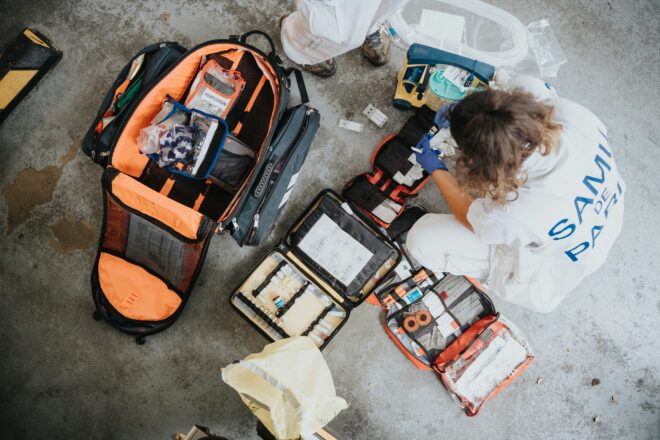
We add:
- Moist antiseptic towels to sanitize areas.
- A portable solar-powered or hand-crank lantern, to avoid tripping in the dark.
- Several long-burning candles for comforting light; assuming that it’s safe to have fire burning.
- Two or three cigarette lighters. A cigarette lighter supplies fire many more times than a box of matches.
If the suppy list seems too long to deal with, the Red Cross sells emergency kits of all sizes on their site. But we recommend building your own kit that suits your particular needs.
Other notes:
Wash and dry all the laundry in the hamper, and don’t let more accumulate. If the power goes down or water stops running in the pipes, you’ll at least have clean changes of clothes. This is important not only for hygiene but for mental health: having to live in dirty clothes makes stress worse.
If it seems likely that running water might stop, improvise a toilet made from a tall, sturdy metal bucket, strong plastic bags to line it, and a tight lid. You can also order a portable toilet online.
If you wonder where to store the emergency supplies, stash the boxes or suitcases in unused spaces. Under a table. Under beds; under the sofa. On top of closets, or under a sink. In the space under the stairs. Out on the patio; in the garage – always assuming it’s safe to go outside. Put decorative items away and use the space for emergency storage. It might feel crowded, but you’ll restore order after the emergency.
The important thing is to stay safe and be prepared.