

MIT aerospace engineers have discovered that rising greenhouse gas emissions are altering the near-Earth space environment in ways that will gradually reduce the number of satellites that can safely operate in this region.
In a study published today in Nature Sustainability, the researchers reveal that carbon dioxide and other greenhouse gases are causing the upper atmosphere to shrink. The thermosphere, a layer where the International Space Station and most satellites orbit, is of particular concern. When the thermosphere contracts, its density decreases, which reduces atmospheric drag—the force that typically pulls old satellites and space debris down to lower altitudes where they burn up upon re-entry.
With less drag, satellites and debris will remain in orbit longer, creating an overcrowded environment in critical regions and heightening the risk of collisions.
The team ran simulations to assess how carbon emissions impact the upper atmosphere and orbital dynamics, estimating the “satellite carrying capacity” of low Earth orbit. Their findings predict that by 2100, the capacity of popular orbital regions could decline by 50-66 percent due to the effects of greenhouse gases.
“Our behavior with greenhouse gases over the past century is affecting how we will operate satellites over the next century,” says Richard Linares, an associate professor in MIT’s Department of Aeronautics and Astronautics (AeroAstro).
Related: all about space junk
“The upper atmosphere is in a fragile state as climate change disrupts the status quo,” adds lead author William Parker, a graduate student in AeroAstro. “At the same time, satellite launches have surged, particularly for broadband internet from space. If we don’t manage this activity and reduce emissions, space could become too crowded, leading to more collisions and debris.”
The study also includes co-author Matthew Brown from the University of Birmingham.

The thermosphere naturally contracts and expands in response to the sun’s 11-year activity cycle. During periods of low solar activity, the Earth’s outer atmosphere cools and contracts before expanding again during solar maximum.
In the 1990s, scientists wondered how greenhouse gases might affect the thermosphere. Early models suggested that while these gases trap heat in the lower atmosphere, they radiate heat at higher altitudes, cooling the thermosphere. This cooling, they predicted, would cause the thermosphere to shrink, reducing atmospheric density at high altitudes.
In recent years, scientists have measured changes in drag on satellites, providing evidence that the thermosphere is contracting in response to factors beyond the sun’s natural cycle.
“The sky is literally falling, but at a rate that spans decades,” says Parker. “We can see this by how drag on satellites is changing.”
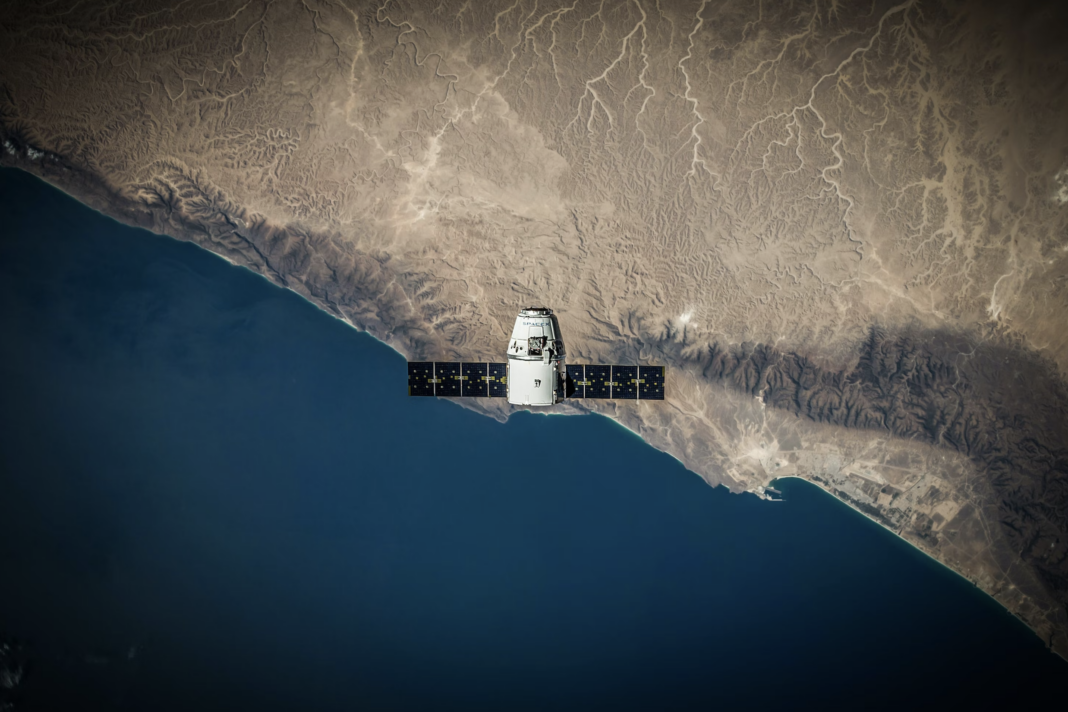
The MIT team explored how these changes might affect the number of satellites that can safely operate in Earth’s orbit. There are currently over 10,000 satellites in low Earth orbit—an area extending up to 1,200 miles (2,000 kilometers) above the Earth’s surface. These satellites provide vital services like internet, communications, navigation, weather forecasting, and banking. With the recent explosion in satellite launches, operators now perform regular collision-avoidance maneuvers to maintain safety. When collisions occur, debris can linger in orbit for decades or longer, heightening the risk of further collisions.
“More satellites have been launched in the last five years than in the preceding 60 years combined,” Parker says. “One of the key things we’re trying to understand is whether the path we’re on today is sustainable.”
In their study, the researchers simulated different greenhouse gas emissions scenarios over the next century to evaluate their impacts on atmospheric density and drag. For each altitude range, they modeled orbital dynamics and the risk of satellite collisions based on the number of objects present. This approach helped identify the “carrying capacity” of low Earth orbit, a term typically used in ecology to describe how many individuals an ecosystem can support.
“We’re translating the concept of carrying capacity to this space sustainability problem to understand how many satellites low Earth orbit can sustain,” Parker explains.
The team compared several emissions scenarios: one in which greenhouse gas concentrations remain at 2000 levels, and others based on future projections from the IPCC’s Shared Socioeconomic Pathways (SSPs). They found that increasing emissions would significantly reduce the capacity of low Earth orbit.
By the end of the century, the team predicts that the number of satellites safely accommodated in altitudes between 200 and 1,000 kilometers could decline by 50-66 percent compared to a scenario where emissions remain at 2000 levels. If satellite capacity is exceeded in any region, the researchers anticipate a “runaway instability,” where a cascade of collisions would generate so much debris that satellites could no longer operate there.
Although these predictions extend to 2100, some regions are already nearing capacity, especially those occupied by recent “megaconstellations” like SpaceX’s Starlink, which consists of thousands of small internet satellites.
“The megaconstellation is a new trend, and we’re showing that because of climate change, we’re going to have a reduced capacity in orbit,” Linares says. “In local regions, we’re already approaching this capacity.”
“We rely on the atmosphere to clean up our debris,” Parker adds. “If the atmosphere is changing, the debris environment will change as well. Our study shows that the long-term outlook for orbital debris depends critically on curbing greenhouse gas emissions.”
This research is supported, in part, by the U.S. National Science Foundation, the U.S. Air Force, and the U.K. Natural Environment Research Council.”