

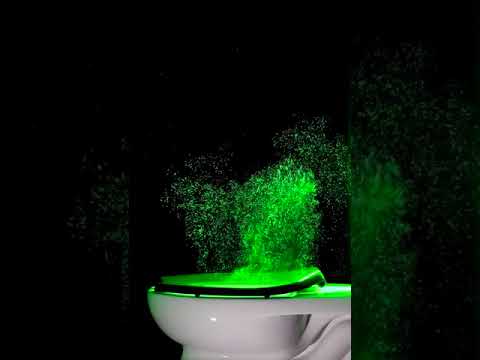
We know that lidless toilets spread poop droplets and it’s worse than you think. More research is in: bioaerosol emissions (the spray that comes from the toilet) during toilet flushing are an often-overlooked source of potential health risks in shared public facilities.
A new study published in the journal Risk Analysis found that bioaerosol concentrations of two bacteria — Escherichia coli (E. coli) and Staphylococcus aureus (S. aureus) — exceeded acceptable levels established by the Centers for Disease Control (CDC) after toilet flushing. Inhaling these biological particles can produce symptoms like abdominal cramps, nausea, diarrhea, and vomiting.
The research was conducted in two restrooms located in an office building in China. One contained a squat toilet and the other a bidet toilet. Scientists measured the emissions of bioaerosols containing S. aureus and E. coli under various flushing conditions and ventilation scenarios in both restrooms.
An analysis of the results showed that, compared to bidet toilets, squat toilets generated 42 to 62 percent higher concentrations of S. aureus bioaerosols and 16 to 27 percent higher concentrations of E. coli bioaerosols.
Related: why do wombats have cubed poop

In addition, bioaerosol concentrations were 25 to 43 percent staph and 16 to 27 percent E. coli lower after the first flush of an empty toilet compared to those observed after a second flush (when feces were present).
Importantly, the researchers found that active ventilation with an exhaust fan reduced the risk by 10 times.
Related: come inside and meet a squat toilet

The lidless toilet setup in the lab. A green laser catches droplets of toilet matter as it flies in the air
“Our findings underscore the substantial health risks posed by bioaerosol exposure in public washrooms,” says lead author Wajid Ali, a PhD student in environmental studies at China University of Geosciences. “Enhancing ventilation systems by optimizing exhaust fan efficiency and air exchange rates can effectively reduce bioaerosol concentrations and exposure risks for the public.”
He adds that the findings for squat toilets (common in the Middle East and Asia) apply for seated toilets as well. For public health policymakers, the results of the study provide evidence-based recommendations to define safe bioaerosol exposure limits and promote hygiene practices in public washrooms, ensuring healthier and safer indoor environments. The take home message? Keep the air well ventilated in the rest room for public health and safety and when you can, put down the lid before you flush –– especially #2.


 and Staphylococcus aureus (S. aureus) -- exceeded acceptable levels established by the Centers for Disease Control (CDC) after toilet flushing. Inhaling these biological particles can produce symptoms like abdominal cramps, nausea, diarrhea, and vomiting. )