Meet the Marsh Arabs of Iraq at Dubai Design Week

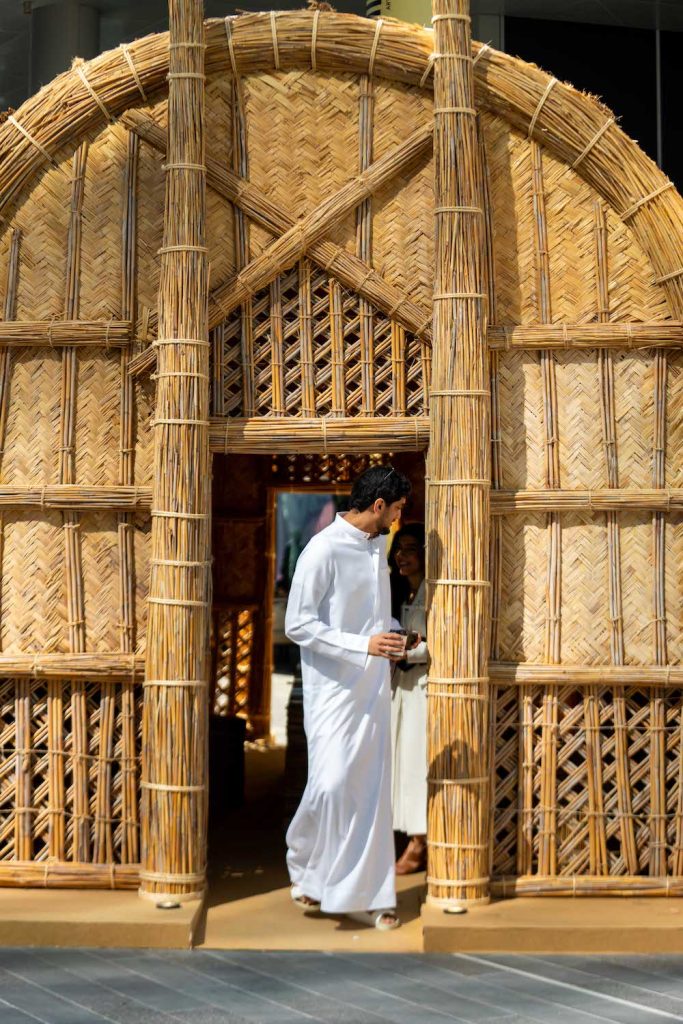
Mudhif, from the Arab Marsh people built at Dubai Design Week

We got so much international attention when we wrote about the Iraqi mudhouse called a mudhif built with US veterans and Iraqi refugees in the US. You can read the story here. Vernacular architecture is that built without a plan by local people is taking the world by storm as people consciously and subconsciously are drawn to simpler times when design was functional and from materials that nature made.

Mudhif

Mudhif, from the Arab Marsh people built at Dubai Design Week

The proof is in the pudding at Dubai Design Week where a designer from Kuwait, with Mesopotamian origins, recreates an Iraqi or Mesopotamian mudhouse. Don’t you feel like you’d like to step inside?

Mudhif, from the Arab Marsh people built at Dubai Design Week

Mudhif, from the Arab Marsh people built at Dubai Design Week

In the US they were constructed of phragmites, an invasive reed grass, and built on the grounds of the Schuylkill Center for Environmental Education in Northwest Philadelphia.

Ola Znad, the designer, turns the traditional gathering place for Marsh Arab communities into a multi-sensory experience. The buildings were designed, of course, for centuries before without any one person taking claim. She says they were crafted in Iraq from locally sourced reeds and mud: the materials that have supported Marsh Arab communities for generations.

According to the paper The Ecology of the Mudhif, the mudhif was built and used, by the Marsh Arabs of the region, until 1993 when Saddam Hussein began to drain and dam the marshes, in an attempt to destroy the life and culture of those Arabs. But after his defeat 10 years later in 2003, the Arabs dug up his dykes, canals and damns, re-flooded the marshes and began to resume their ancient way of life.

Inherently nomadic, the author muses: “the prejudice against a fixed life is strong, only the lowest of the tribe will condescend to remain stationary; but change is in progress.”
Related: What is Vernacular Architecture

The paper notes that mudhifs were built by the culture which not only developed the world’s first cities, with their great mud-brick ziggurats and temples; it also invented writing, for the keeping of temple records. And of course, for sustenance, the cities had to be surrounded by agricultural villages hence, in the marshes, buildings constructed entirely of reeds. Is this why our pull toward them is strong?

Related: read about the origins of writing in Iraq

By portraying the Mudhif as an open and inclusive space, Znad says she “reflects the traditional architecture of the Marsh Arabs and emphasizes the contemporary need for sustainable design.”

This is true in every culture everywhere especially the UAE which has designed itself out of the desert from scratch over the last 50 years. It may be why cardboard was also featured this year. We are all going back to the basics.

Enjoy the photos and if you are at the Dubai Design Week this week drop us a line.


Karin Kloosterman
Karin Kloostermanhttp://www.greenprophet.com
Karin Kloosterman is an award-winning journalist, innovation strategist, and founder of Green Prophet, one of the Middle East’s pioneering sustainability platforms. She has ranked in the Top 10 of Verizon innovation competitions, participated in NASA-linked challenges, and spoken worldwide on climate, food security, and future resilience. With an IoT technology patent, features in Canada’s National Post, and leadership inside teams building next-generation agricultural and planetary systems — including Mars-farming concepts — Karin operates at the intersection of storytelling, science, and systems change. She doesn’t report on the future – she helps design it. Reach out directly to [email protected]

Hot this week

How Renewable Energy is Revolutionizing the Way We Power Our World

Solar has become the star of the transition thanks to modular hardware and straightforward installation. It fits dense cities and remote towns alike. Many companies are turning to rooftop arrays and carport systems - and exploring commercial solar installation as a practical way to lock in future savings.

How does one start prepping?

Faced with an extreme winter storm this year, Americans wonder how to be prepared for catastrophe. Miriam has lived through wars in the Middle East - so she's prepared on giving you a guide to prepping.

Fishermen sue tire manufacturers on behalf of the salmon

A federal trial in San Francisco has brought US tire manufacturers, fishing groups, and environmental scientists into court over a chemical most drivers have never heard of — but which scientists say may be silently reshaping aquatic ecosystems.

Listening to Water: Tarek Atoui’s Next Work for Tate Modern

Born in Beirut, Lebanon in 1980 and now living in Paris, Atoui has spent years building instruments that don’t sit comfortably in concert halls. Many of them involve water, glass, and ceramics — materials that react to sound instead of simply producing it.

Leading Through a Dual-Energy Transition: Balancing Decarbonisation with Energy Security

Experience in one area of the energy industry isn't enough to guarantee readiness across all the others. That's where a structured program like an MBA in energy can come in. Today's advanced curricula explore energy economics, finance, policy, and strategic management alongside the technical subjects. And when pursuing an energy MBA online, professionals can skill up and retrain without having to step out of the labor market -- an important perk at a time when skilled professionals are already in short supply.

Topics

How Renewable Energy is Revolutionizing the Way We Power Our World

Solar has become the star of the transition thanks to modular hardware and straightforward installation. It fits dense cities and remote towns alike. Many companies are turning to rooftop arrays and carport systems - and exploring commercial solar installation as a practical way to lock in future savings.

How does one start prepping?

Faced with an extreme winter storm this year, Americans wonder how to be prepared for catastrophe. Miriam has lived through wars in the Middle East - so she's prepared on giving you a guide to prepping.

Fishermen sue tire manufacturers on behalf of the salmon

A federal trial in San Francisco has brought US tire manufacturers, fishing groups, and environmental scientists into court over a chemical most drivers have never heard of — but which scientists say may be silently reshaping aquatic ecosystems.

Listening to Water: Tarek Atoui’s Next Work for Tate Modern

Born in Beirut, Lebanon in 1980 and now living in Paris, Atoui has spent years building instruments that don’t sit comfortably in concert halls. Many of them involve water, glass, and ceramics — materials that react to sound instead of simply producing it.

Leading Through a Dual-Energy Transition: Balancing Decarbonisation with Energy Security

Experience in one area of the energy industry isn't enough to guarantee readiness across all the others. That's where a structured program like an MBA in energy can come in. Today's advanced curricula explore energy economics, finance, policy, and strategic management alongside the technical subjects. And when pursuing an energy MBA online, professionals can skill up and retrain without having to step out of the labor market -- an important perk at a time when skilled professionals are already in short supply.

From Green Energy to Healthy Societies: Why old systems thinking is becoming relevant again

Across the Middle East and North Africa, large investments are being made in green hydrogen, renewable energy, water infrastructure and sustainability. Most of these efforts are discussed in the context of climate change, decarbonization and economic diversification. That framing is important, but it may not capture their full value.

We saw peace – an interreligious encounter deep in our eyes

They came from Israel, Palestine, Jordan, Iraq, Yemen, Morocco, Tunisia, Lebanon, Egypt… There are Sunni Muslims, Shiite Muslims, Jews (Orthodox and Reform), Orthodox Christians, Coptic Christians, Protestant Christians, Druze, Baha'is, a Scientologist.

Can biochar reduce ‘Forever Chemicals’ in food if it’s used in farms?

Biochar is produced by heating organic material in a low-oxygen environment so it does not burn. This process, known as pyrolysis, transforms plant matter into a stable, carbon-rich material.

Related Articles

Popular Categories