These ancients built graveyards for travellers

ancient burial highways
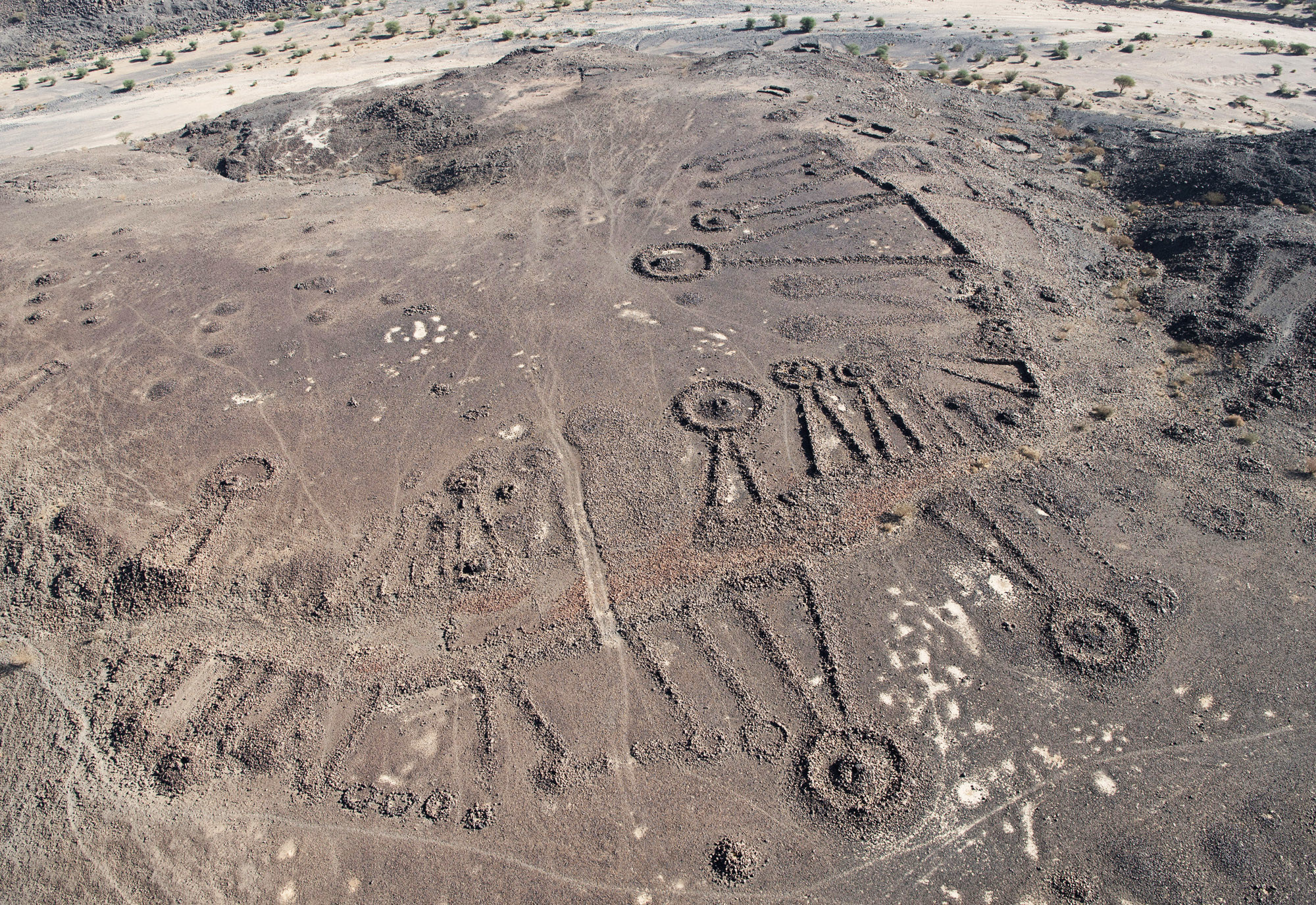
A dense ‘funerary avenue’ flanked by Bronze Age tombs, leading out of al Wadi Oasis near Khaybar in north-west Saudi Arabia.

As the Saudi Arabian regime opens its doors to the west more progress can be made on understanding ancient archeology in the Arabian areas. A recent finding this year is a deeper understanding into the strange burial highways, a series of pendant tomb graves along travelling routes, called funerary avenues. They are located in the same area as Saudi Arabian’s giant mirrored music hall called Maraya

Why did the ancients, our ancient ancestors mark major byways with thousands of burial monuments? Why are they shaped like pendants and what stories do they tell?

Archaeologists from the University of Western Australia (UWA) working in Saudi Arabia under the Royal Commission for AlUla (RCU) have determined that the people who lived in ancient north-west Arabia (and not aliens!) built these long-distance ‘funerary avenues’.

These routes are major pathways flanked by thousands of burial monuments that linked oases and pastures, reflecting a high degree of social and economic connection between the region’s populations in the 3rd millennium BCE.

Saudi Arabia, burial mounds and highway
A dense ‘funerary avenue’ flanked by Bronze Age tombs, leading out of al ‘Ayn Oasis near Khaybar in north-west Saudi Arabia.

Publication of the findings appear in the journal The Holocene sheds light on the lives of the ancient inhabitants of Arabia.

What do these strange pendant tombs mean?

The existence of the funerary avenues suggests that complex social horizons existed 4,500 years ago across a huge swathe of the Arabian Peninsula, the researchers report. They also document that there are big hidden stories to be uncovered about the ancient kingdoms and earlier societies of north Arabia.

In the recent study, the team used satellite imagery analysis, aerial photography, ground survey and excavation to locate and analyse funerary avenues over an area of at least 160,000 square km in north-west Arabia. They recorded more than 17,800 ‘pendant’ tombs in their primary study areas of AlUla and Khaybar counties, of which around 11,000 formed part of funerary avenues.

burial cairn up close
A 3rd millennium BCE infilled ringed cairn from the Khaybar Oasis in north-west Saudi Arabia.

Whether on basalt plains or mountain passes, the densest concentrations of funerary structures on these avenues are located near permanent water sources. The direction of the avenues suggests that many were used to travel between major oases, including those of Khaybar, AlUla and Tayma. Other avenues fade into the landscapes surrounding oases, suggesting they were used to move herds of domestic animals into nearby pastures during periods of rain.

The Australian team’s work is part of collective that includes 13 archaeological and conservation project teams from around the world collaborating with Saudi experts in AlUla and neighbouring Khaybar counties in Saudi Arabia.

“The more we learn about the ancient inhabitants of north-west Arabia, the more we are inspired by the way our mission reflects their mindset: they lived in harmony with nature, honoured their predecessors, and reached out to the wider world,” says Amr AlMadani, the CEO of RCU. 

Oenda
A 3rd millennium BC pendant burial on the southern edge of the Khaybar Oasis in north-west Saudi Arabia.

In other ancient news from Saudi Arabia:

  • In August in the journal Arabian Archaeology and Epigraphy the team dated the pendant-shaped tombs of the Khaybar Oasis to the 3rd millennium BCE – the first published radiocarbon evidence dating the tombs. Archaeological exploration of the mysteries of Khaybar is still in its infancy.
  • The monumental structures known as mustatils are much older than previously believed, dating as far back as 5,200 BCE, and appear to have had a ritual function. What that is, time will tell.
  • The Australian team discovered the remains of the oldest known domesticated dog in Arabia.

The Royal Commission for AlUla (RCU) was established by royal decree in July 2017 to preserve and develop AlUla, a region of outstanding natural and cultural significance in north-west Saudi Arabia. RCU’s long-term plan outlines a responsible, sustainable, and sensitive approach to urban and economic development, that preserves the area’s natural and historic heritage, while establishing AlUla as a desirable location to live, work, and visit. This encompasses a broad range of initiatives across archaeology, tourism, culture, education, and the arts, reflecting a commitment to meeting the economic diversification, local community empowerment, and heritage preservation priorities of the Kingdom of Saudi Arabia’s Vision 2030 programme.

Karin Kloosterman
Karin Kloostermanhttp://www.greenprophet.com
Karin Kloosterman is an award-winning journalist, innovation strategist, and founder of Green Prophet, one of the Middle East’s pioneering sustainability platforms. She has ranked in the Top 10 of Verizon innovation competitions, participated in NASA-linked challenges, and spoken worldwide on climate, food security, and future resilience. With an IoT technology patent, features in Canada’s National Post, and leadership inside teams building next-generation agricultural and planetary systems — including Mars-farming concepts — Karin operates at the intersection of storytelling, science, and systems change. She doesn’t report on the future – she helps design it. Reach out directly to [email protected]

Hot this week

How Renewable Energy is Revolutionizing the Way We Power Our World

Solar has become the star of the transition thanks to modular hardware and straightforward installation. It fits dense cities and remote towns alike. Many companies are turning to rooftop arrays and carport systems - and exploring commercial solar installation as a practical way to lock in future savings.

How does one start prepping?

Faced with an extreme winter storm this year, Americans wonder how to be prepared for catastrophe. Miriam has lived through wars in the Middle East - so she's prepared on giving you a guide to prepping.

Fishermen sue tire manufacturers on behalf of the salmon

A federal trial in San Francisco has brought US tire manufacturers, fishing groups, and environmental scientists into court over a chemical most drivers have never heard of — but which scientists say may be silently reshaping aquatic ecosystems.

Listening to Water: Tarek Atoui’s Next Work for Tate Modern

Born in Beirut, Lebanon in 1980 and now living in Paris, Atoui has spent years building instruments that don’t sit comfortably in concert halls. Many of them involve water, glass, and ceramics — materials that react to sound instead of simply producing it.

Leading Through a Dual-Energy Transition: Balancing Decarbonisation with Energy Security

Experience in one area of the energy industry isn't enough to guarantee readiness across all the others. That's where a structured program like an MBA in energy can come in. Today's advanced curricula explore energy economics, finance, policy, and strategic management alongside the technical subjects. And when pursuing an energy MBA online, professionals can skill up and retrain without having to step out of the labor market -- an important perk at a time when skilled professionals are already in short supply.

Topics

How Renewable Energy is Revolutionizing the Way We Power Our World

Solar has become the star of the transition thanks to modular hardware and straightforward installation. It fits dense cities and remote towns alike. Many companies are turning to rooftop arrays and carport systems - and exploring commercial solar installation as a practical way to lock in future savings.

How does one start prepping?

Faced with an extreme winter storm this year, Americans wonder how to be prepared for catastrophe. Miriam has lived through wars in the Middle East - so she's prepared on giving you a guide to prepping.

Fishermen sue tire manufacturers on behalf of the salmon

A federal trial in San Francisco has brought US tire manufacturers, fishing groups, and environmental scientists into court over a chemical most drivers have never heard of — but which scientists say may be silently reshaping aquatic ecosystems.

Listening to Water: Tarek Atoui’s Next Work for Tate Modern

Born in Beirut, Lebanon in 1980 and now living in Paris, Atoui has spent years building instruments that don’t sit comfortably in concert halls. Many of them involve water, glass, and ceramics — materials that react to sound instead of simply producing it.

Leading Through a Dual-Energy Transition: Balancing Decarbonisation with Energy Security

Experience in one area of the energy industry isn't enough to guarantee readiness across all the others. That's where a structured program like an MBA in energy can come in. Today's advanced curricula explore energy economics, finance, policy, and strategic management alongside the technical subjects. And when pursuing an energy MBA online, professionals can skill up and retrain without having to step out of the labor market -- an important perk at a time when skilled professionals are already in short supply.

From Green Energy to Healthy Societies: Why old systems thinking is becoming relevant again

Across the Middle East and North Africa, large investments are being made in green hydrogen, renewable energy, water infrastructure and sustainability. Most of these efforts are discussed in the context of climate change, decarbonization and economic diversification. That framing is important, but it may not capture their full value.

We saw peace – an interreligious encounter deep in our eyes

They came from Israel, Palestine, Jordan, Iraq, Yemen, Morocco, Tunisia, Lebanon, Egypt… There are Sunni Muslims, Shiite Muslims, Jews (Orthodox and Reform), Orthodox Christians, Coptic Christians, Protestant Christians, Druze, Baha'is, a Scientologist.

Can biochar reduce ‘Forever Chemicals’ in food if it’s used in farms?

Biochar is produced by heating organic material in a low-oxygen environment so it does not burn. This process, known as pyrolysis, transforms plant matter into a stable, carbon-rich material.

Related Articles

Popular Categories