Solar power for 10 mosques

mosques going solar, green

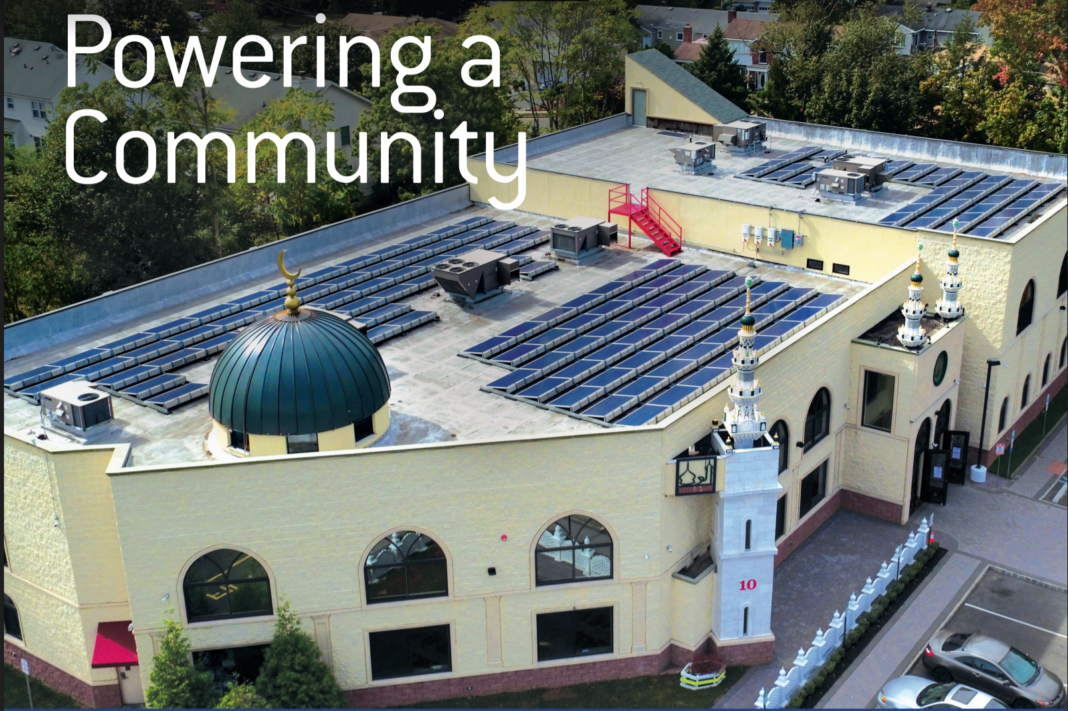
Muslims are also environmentalists and a group of them from a few NGOs want to help 10 mosques in the world go green.

As part of the activities of the Ummah for Earth alliance during the UN Climate Change Summit (COP26) Greenpeace Middle East and North Africa announced a new initiative aimed at reducing the carbon footprint of mosques and other community buildings around the world. Faith can play a role in mitigating the effects of the climate crisis, and it has potential to inspire an alternative future, completely free of fossil fuels. 

The Green Mosques initiative aims to build on the examples already set by various mosques around the world, including The Glasgow Central Mosque in Scotland, where solar power systems are currently being installed thanks to generous support from Islamic Relief – an Ummah for Earth alliance member, as well as the Istiqlal Mosque in Jakarta, Indonesia, which made a move to partial solar energy production last year. 
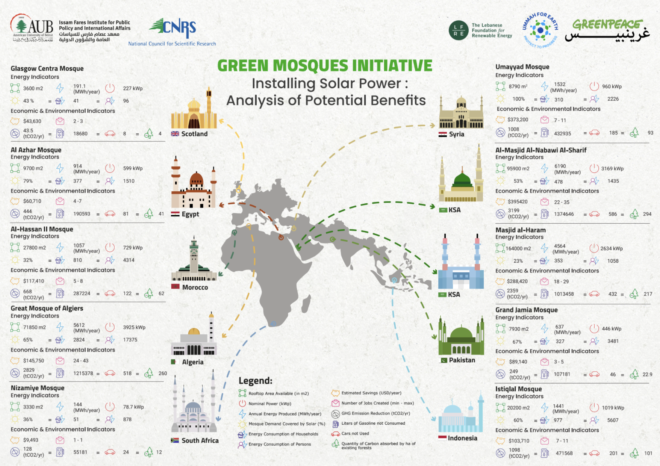
eco mosques infogram

The initiative is being launched with a detailed technical report that analyses the potential carbon savings that can be made by installing solar systems at ten key sites around the world, as well as the potential social, economic and environmental impact these systems can have within each community. 

The report was developed by a team from the Issam Fares Institute for Public Policy and International Affairs at the American University of Beirut, in collaboration with The Lebanese Foundation for Renewable Energy and the National Council for Scientific Research.

“This initiative is a testimony of the Ummah’s ambition to be part of the climate solution and a message to leaders representing the countries from the Muslim world in the ongoing climate negotiations, that they should be true to its ambition and push hard for a world free of fossil fuels,” Mouhad Awwad, Project Campaigner – Ummah for Earth at Greenpeace Middle East and North Africa said.

In total, the installation of the proposed solar power systems at the ten locations would generate approximately 22.3 gigawatt-hours of electricity, and reduce 12,025 tonnes of carbon dioxide emissions per year. The equivalent of a reduction in consumption of more than 5 million litres of gasoline, a reduction of 2203 light vehicles on the roads, or the preservation of 1107 hectares of forest.

Additionally, the proposed solar plan would create between 93 and 153 new jobs within the local communities around the mosques. 

The ten mosques aiming to go solar

Al Azhar Mosque – Cairo, Egypt

Al Haram Mosque – Mecca, Kingdom of Saudi Arabia

Al Hassan II Mosque – Casablanca, Morocco

Al Nabawi Mosque – Medina, Kingdom of Saudi Arabia

Glasgow Central Mosque – Glasgow, Scotland

Grand Jamia Mosque – Lahore, Pakistan

Great Mosque of Algiers – Algiers, Algeria

Istiqlal Mosque – Jakarta, Indonesia

Nizamiye Mosque – Johannesburg, South Africa

Umayyad Mosque – Damascus, Syria

The initiative will be followed by a global drive on Greenpeace’s social media channels and its Ummah for Earth allies, inviting people to take part from within their communities, by first working together to produce a cost-benefit analysis of installing solar systems at their local places of worship – along the lines of what was done in the report, with the ultimate aim of empowering them to physically implement the conversion to solar energy throughout the coming year. 


Karin Kloosterman
Karin Kloostermanhttp://www.greenprophet.com
Karin Kloosterman is an award-winning journalist, innovation strategist, and founder of Green Prophet, one of the Middle East’s pioneering sustainability platforms. She has ranked in the Top 10 of Verizon innovation competitions, participated in NASA-linked challenges, and spoken worldwide on climate, food security, and future resilience. With an IoT technology patent, features in Canada’s National Post, and leadership inside teams building next-generation agricultural and planetary systems — including Mars-farming concepts — Karin operates at the intersection of storytelling, science, and systems change. She doesn’t report on the future – she helps design it. Reach out directly to [email protected]

Hot this week

Why Health Systems Are Reaching a Turning Point

Health emerges from a continuous energy and material flow from water through food to human physiology. Technical energy systems support this cycle through water treatment, agriculture, and infrastructure.

Sustainability That Sells: How Profit and Purpose Come Together in the Hive

Whether you are a commercial grower, hobbyist beekeeper or retail equipment supplier, this system opens a new income stream with minimal environmental impact.

The Fitness App Revolution: Building the Future of Wellness Through Strategic Development

In an era where smartphones are ubiquitous and health consciousness is at an all-time high, the fitness industry has undergone a radical digital transformation. Fitness applications have moved far beyond simple pedometers, evolving into comprehensive wellness platforms that serve as personal trainers, nutritionists, and community hubs right in our pockets.

A Brief History of Basil From India to Italy

Beloved, fortunate, sweet, and royal; an herb with a long and storied history in Asia and across the world. Called by many names, basil has featured in previous Green Prophet articles, so enjoy another serving, a brief history of basil.

How Renewable Energy is Revolutionizing the Way We Power Our World

Solar has become the star of the transition thanks to modular hardware and straightforward installation. It fits dense cities and remote towns alike. Many companies are turning to rooftop arrays and carport systems - and exploring commercial solar installation as a practical way to lock in future savings.

Topics

Why Health Systems Are Reaching a Turning Point

Health emerges from a continuous energy and material flow from water through food to human physiology. Technical energy systems support this cycle through water treatment, agriculture, and infrastructure.

Sustainability That Sells: How Profit and Purpose Come Together in the Hive

Whether you are a commercial grower, hobbyist beekeeper or retail equipment supplier, this system opens a new income stream with minimal environmental impact.

The Fitness App Revolution: Building the Future of Wellness Through Strategic Development

In an era where smartphones are ubiquitous and health consciousness is at an all-time high, the fitness industry has undergone a radical digital transformation. Fitness applications have moved far beyond simple pedometers, evolving into comprehensive wellness platforms that serve as personal trainers, nutritionists, and community hubs right in our pockets.

A Brief History of Basil From India to Italy

Beloved, fortunate, sweet, and royal; an herb with a long and storied history in Asia and across the world. Called by many names, basil has featured in previous Green Prophet articles, so enjoy another serving, a brief history of basil.

How Renewable Energy is Revolutionizing the Way We Power Our World

Solar has become the star of the transition thanks to modular hardware and straightforward installation. It fits dense cities and remote towns alike. Many companies are turning to rooftop arrays and carport systems - and exploring commercial solar installation as a practical way to lock in future savings.

How does one start prepping?

Faced with an extreme winter storm this year, Americans wonder how to be prepared for catastrophe. Miriam has lived through wars in the Middle East - so she's prepared on giving you a guide to prepping.

Fishermen sue tire manufacturers on behalf of the salmon

A federal trial in San Francisco has brought US tire manufacturers, fishing groups, and environmental scientists into court over a chemical most drivers have never heard of — but which scientists say may be silently reshaping aquatic ecosystems.

Listening to Water: Tarek Atoui’s Next Work for Tate Modern

Born in Beirut, Lebanon in 1980 and now living in Paris, Atoui has spent years building instruments that don’t sit comfortably in concert halls. Many of them involve water, glass, and ceramics — materials that react to sound instead of simply producing it.

Related Articles

Popular Categories