Near-extinct gazelle brings Israelis and Palestinians to peace-making plan

gazelle
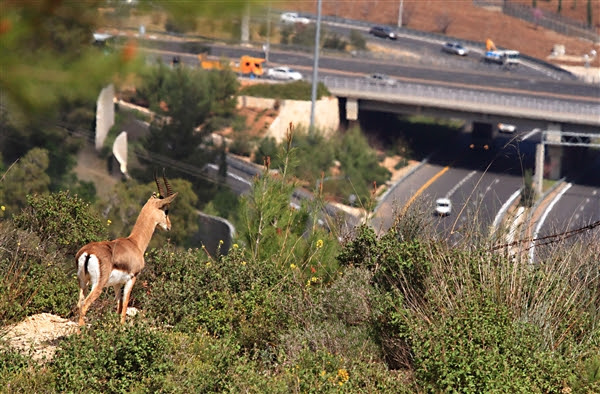
Why did the gazelle cross the road? In some parts of Israel underground or above ground bridges help the animals move like this wildlife bridge in Turkey, but it’s not enough. A new research project might bring them from the brink of extinction.

The endangered mountain gazelle Gazella gazella was once widespread throughout the Fertile Crescent in parts of present-day Israel, Palestinian Authority, Lebanon, Jordan, Syria, Turkey and Iraq. Most of its former distribution range overlaps with areas in the region that are now densely populated by people.

Archaeological remains also indicate that gazelles were the main prey hunted by people throughout the Pleistocene. Nevertheless, until the 19th century, the mountain gazelle survived this hunting pressure, and thrived.

It’s the same story everywhere: the rise in human population in this region from 1900 to 2016, together with the increased use of firearms and off-road vehicles for hunting, led to the extinction of gazelles from most of this area. Israel and the Palestinian Authority are currently the last strongholds of the mountain gazelle and are home to about 5,000 individuals.
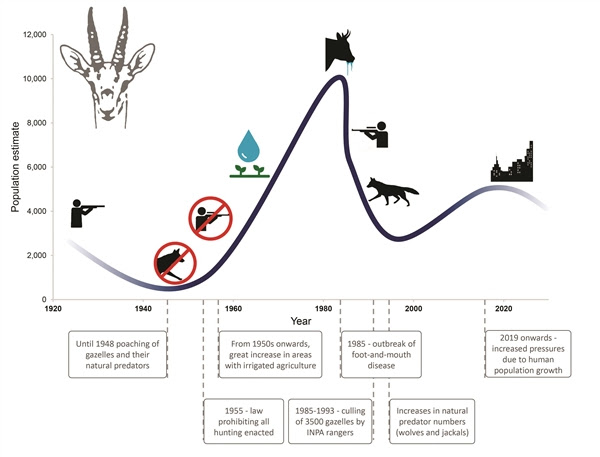
A new research effort led by Prof. Yoram Yom-Tov of Tel-Aviv University and Dr. Uri Roll of Ben-Gurion University of the Negev, together with Amir Balaban, Ezra Hadad, and Gilad Weil, reviews mountain gazelle dynamics in Israel from the beginning of the 20th century and provides an outlook for the conservation of the species. Their findings were published in Oryx—The International Journal of Conservation on Wednesday.

During the 1900s, Israel’s human population increased steadily by 2% per year. The human population density is currently c. 430 persons per km2 and is forecasted to continue to rise. This presents an array of threats to the mountain gazelle. These include: habitat change; fragmentation and isolation by roads, railways and fences, predation by an increasing population of natural predators and feral dogs, poaching, and collisions with road traffic. These threats often act in synergy, amplifying their effects.

In their article, they present an overview of how these factors threatened and continue to threaten the survival of this species. They also review the policy and management actions, both implemented and still required, to ensure the persistence of the mountain gazelle.

In addition, they analyze connectivity of gazelle populations in the landscape, highlighting highly fragmented populations, and suggesting potential interventions. To improve connectivity, they suggest construction of road over/under passes in strategic locations, translocation of individuals when needed, and better monitoring of potential genetic bottlenecks of the at-risk population.

Reducing feral dogs that roam the wild, no poaching

To reduce the effects of predation, they suggest reinstating the control of feral dogs, and improved management of anthropogenic waste. Furthermore, greater efforts should be made to eliminate poaching of gazelles, on the legislative, enforcement, and education fronts. More broadly, Israel’s human population is expected to double in the next thirty years – which will have grave implications on many local species and ecosystems, some of which are of global importance. Efforts should be made at the national level to limit this growth and stop further land conversions from natural habitats to other uses.

The mountain gazelle exemplifies an ungulate with both great vulnerability to anthropogenic pressures and a large breeding potential. As more and more regions are converted to human-dominated landscapes, pressures on wildlife will continue to increase, and lessons from the mountain gazelle could prove valuable elsewhere.


Karin Kloosterman
Karin Kloostermanhttp://www.greenprophet.com
Karin Kloosterman is an award-winning journalist, innovation strategist, and founder of Green Prophet, one of the Middle East’s pioneering sustainability platforms. She has ranked in the Top 10 of Verizon innovation competitions, participated in NASA-linked challenges, and spoken worldwide on climate, food security, and future resilience. With an IoT technology patent, features in Canada’s National Post, and leadership inside teams building next-generation agricultural and planetary systems — including Mars-farming concepts — Karin operates at the intersection of storytelling, science, and systems change. She doesn’t report on the future – she helps design it. Reach out directly to [email protected]

Hot this week

How Renewable Energy is Revolutionizing the Way We Power Our World

Solar has become the star of the transition thanks to modular hardware and straightforward installation. It fits dense cities and remote towns alike. Many companies are turning to rooftop arrays and carport systems - and exploring commercial solar installation as a practical way to lock in future savings.

How does one start prepping?

Faced with an extreme winter storm this year, Americans wonder how to be prepared for catastrophe. Miriam has lived through wars in the Middle East - so she's prepared on giving you a guide to prepping.

Fishermen sue tire manufacturers on behalf of the salmon

A federal trial in San Francisco has brought US tire manufacturers, fishing groups, and environmental scientists into court over a chemical most drivers have never heard of — but which scientists say may be silently reshaping aquatic ecosystems.

Listening to Water: Tarek Atoui’s Next Work for Tate Modern

Born in Beirut, Lebanon in 1980 and now living in Paris, Atoui has spent years building instruments that don’t sit comfortably in concert halls. Many of them involve water, glass, and ceramics — materials that react to sound instead of simply producing it.

Leading Through a Dual-Energy Transition: Balancing Decarbonisation with Energy Security

Experience in one area of the energy industry isn't enough to guarantee readiness across all the others. That's where a structured program like an MBA in energy can come in. Today's advanced curricula explore energy economics, finance, policy, and strategic management alongside the technical subjects. And when pursuing an energy MBA online, professionals can skill up and retrain without having to step out of the labor market -- an important perk at a time when skilled professionals are already in short supply.

Topics

How Renewable Energy is Revolutionizing the Way We Power Our World

Solar has become the star of the transition thanks to modular hardware and straightforward installation. It fits dense cities and remote towns alike. Many companies are turning to rooftop arrays and carport systems - and exploring commercial solar installation as a practical way to lock in future savings.

How does one start prepping?

Faced with an extreme winter storm this year, Americans wonder how to be prepared for catastrophe. Miriam has lived through wars in the Middle East - so she's prepared on giving you a guide to prepping.

Fishermen sue tire manufacturers on behalf of the salmon

A federal trial in San Francisco has brought US tire manufacturers, fishing groups, and environmental scientists into court over a chemical most drivers have never heard of — but which scientists say may be silently reshaping aquatic ecosystems.

Listening to Water: Tarek Atoui’s Next Work for Tate Modern

Born in Beirut, Lebanon in 1980 and now living in Paris, Atoui has spent years building instruments that don’t sit comfortably in concert halls. Many of them involve water, glass, and ceramics — materials that react to sound instead of simply producing it.

Leading Through a Dual-Energy Transition: Balancing Decarbonisation with Energy Security

Experience in one area of the energy industry isn't enough to guarantee readiness across all the others. That's where a structured program like an MBA in energy can come in. Today's advanced curricula explore energy economics, finance, policy, and strategic management alongside the technical subjects. And when pursuing an energy MBA online, professionals can skill up and retrain without having to step out of the labor market -- an important perk at a time when skilled professionals are already in short supply.

From Green Energy to Healthy Societies: Why old systems thinking is becoming relevant again

Across the Middle East and North Africa, large investments are being made in green hydrogen, renewable energy, water infrastructure and sustainability. Most of these efforts are discussed in the context of climate change, decarbonization and economic diversification. That framing is important, but it may not capture their full value.

We saw peace – an interreligious encounter deep in our eyes

They came from Israel, Palestine, Jordan, Iraq, Yemen, Morocco, Tunisia, Lebanon, Egypt… There are Sunni Muslims, Shiite Muslims, Jews (Orthodox and Reform), Orthodox Christians, Coptic Christians, Protestant Christians, Druze, Baha'is, a Scientologist.

Can biochar reduce ‘Forever Chemicals’ in food if it’s used in farms?

Biochar is produced by heating organic material in a low-oxygen environment so it does not burn. This process, known as pyrolysis, transforms plant matter into a stable, carbon-rich material.

Related Articles

Popular Categories