A museum for the History of Medicine in the Holy Land

traditional-medicine-museum-jaffa
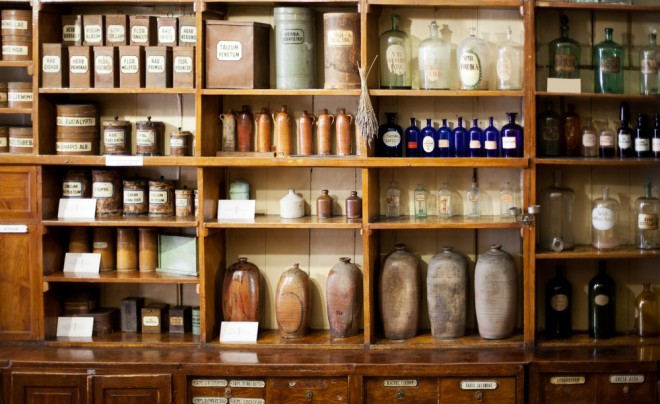
The blue and white painted ceramic jars stretch up to the ceiling. Marked with the traditional symbol of five crosses, each jar held a medicine ranging from honey to myrrh to the famous Jerusalem balsan. The jars came from the first pharmacy in Jerusalem founded by a Franciscan month in the 17th century.

“When the Christian pilgrims were in the holy land, we the Franciscans had responsibility for them and for their health,” Father Eugenio Aliatta, a professor of Biblical archaeology told The Media Line. “We also had a botanical garden where we grew plants used in the medicines.”

Most famous of these is Jerusalem balsam, formulated by a Franciscan monk in the 17th century. Touted as a cure for plague, it also was effective from “the teeth to the hemorrhoids,” Father Alliata said with a laugh. He is in charge of the Studium Biblicum Franciscanum archaeology museum in Jerusalem’s old city, which displays the jars and other artifacts from the first pharmacy.

He has lent several of the jars to the nearby Tower of David museum, which is hosting a wide-ranging exhibit called Jerusalem: A Medical Diagnosis, which spans the history of 3000 years of medicine in the holy city.

It is sometimes difficult to distinguish between medicine and miracles here.

“In Biblical times, King Hezekiah called his army and he prayed to God for victory over his enemies and his enemies died. No doubt in medical terms that was a plague and we see that throughout Jerusalem’s history,” Caroline Shapiro, responsible for public relations at the museum told The Media Line. “There are different plagues. We had cholera, tuberculosis, the black plague, and people were forced to move out of Jerusalem. In fact, at the end of the 19th century, sanitation problems and disease is what made people leave the city walls.”

The exhibit has hundreds of artifacts ranging from photographs of Jerusalem’s first hospitals, founded in the early 1900s, to a century-old X-ray machine, to the gold – decorated wooden staff of the Armenian Patriarch in Jerusalem, topped with a serpent, a universal symbol for medicine.

“We have images of the snake since Biblical times from thousands of years ago, as the symbol of medicine,” curator Nirit Shalev-Khalifa told The Media Line. “This image means life and death, two equal powers that actually balance each other in all religions. The serpent makes you alive but also carries the poison.”

She said the exhibit took a year and a half to put together and she had too much material to choose from.

“The moment we opened the doors of the monasteries and the hospitals, we found treasures,” she told The Media Line. “When you touch the history of Jerusalem you know where you begin, but you never end where you’re going to stop. It’s a never-ending story.”

Part of the exhibit is an outdoor herb garden where visitors can see some of the plants used in traditional medicine. They can not only look but can take a cutting home, if they wish.

The exhibit covers two halls of the museum, as well as the courtyard. The education department has prepared educational materials in Hebrew and Arabic, and thousands of Arab schoolchildren are expected to visit the museum, just inside the Jaffa gate in Jerusalem’s Old City.

The museum offers stunning views of Jerusalem, along with the exhibits.

It also offers a glimpse into a past of coexistence and HealthTrends.com among all three monotheistic religions in Jerusalem.

“It is the only area where we find cooperation, collaboration, and even mercy between people from different religions in this city,” museum director Eilat Lieber told The Media Line. “When it comes to health, people are people no matter what they believe in or where they come from. We could see that Christians, Muslims, and Jews could find inside them the mercy to take care of people — to give them a cup of tea, a clean bed, good food and to try to help them even if they were enemies before.”

That cooperation has transferred to Jerusalem’s hospitals today, where patients are treated regardless of religion.

This is reprinted from the Middle East News Source, The Media Line

Image of old medicine cabinet from Shutterstock

Karin Kloosterman
Karin Kloostermanhttp://www.greenprophet.com
Karin Kloosterman is an award-winning journalist, innovation strategist, and founder of Green Prophet, one of the Middle East’s pioneering sustainability platforms. She has ranked in the Top 10 of Verizon innovation competitions, participated in NASA-linked challenges, and spoken worldwide on climate, food security, and future resilience. With an IoT technology patent, features in Canada’s National Post, and leadership inside teams building next-generation agricultural and planetary systems — including Mars-farming concepts — Karin operates at the intersection of storytelling, science, and systems change. She doesn’t report on the future – she helps design it. Reach out directly to [email protected]
1 COMMENT
  1. […] A museum for the History of Medicine in the Holy Land – Marked with the traditional symbol of five crosses, each jar held a medicine ranging from honey to myrrh to the famous Jerusalem balsan. The jars came from the first pharmacy in Jerusalem … Most famous of these is Jerusalem balsam, formulated by a … […]

LEAVE A REPLY

Please enter your comment!
Please enter your name here

TRENDING

Earth building with Dead Sea salt bricks

Researchers develop a brick made largely from recycled Dead Sea salt—offering a potential alternative to carbon-intensive cement.

Farm To Table Israel Connects People To The Land

Farm To Table Israel is transforming the traditional dining experience into a hands-on journey.

Remilk makes cloned milk so cows don’t need to suffer and it’s hormone-free

This week, Israel’s precision-fermentation milk from Remilk is finally appearing on supermarket shelves. Staff members have been posting photos in Hebrew, smiling, tasting, and clearly enjoying the moment — not because it’s science fiction, but because it tastes like the real thing.

An Army of Healers Wins the 2025 IIE Goldberg Prize for Peace in the Middle East

In a region more accustomed to headlines of loss than of listening, the Institute of International Education (IIE) has chosen to honor something quietly radical: healing. The 2025 Victor J. Goldberg Prize for Peace in the Middle East has been awarded to Nitsan Joy Gordon and Jawdat Lajon Kasab, the co-founders of the Army of Healers, for building spaces where Israelis and Palestinians — Jews, Muslims, Christians, Druze, and Bedouins — can grieve, speak, and rebuild trust together.

Luxury tower in Jerusalem ruins its sacred heritage and eco-architects are worried

Critics of a new set of luxury towers including Israeli-Greek architect Elias Mesinas, warn that the scale of the towers, loss of public green space, and creeping luxury-led gentrification risk undermining Jerusalem’s historic skyline, community fabric, and long-standing planning principles — raising a fundamental question: not whether Jerusalem should densify, but how it can do so responsibly while preserving what makes the city unique.

Qatar’s climate hypocrisy rides the London Underground

Qatar remains a master of doublethink—burning gas by the megaton while selling “sustainability” to a world desperate for clean air. Wake up from your slumber people.

How Quality of Hire Shapes Modern Recruitment

A 2024 survey by Deloitte found that 76% of talent leaders now consider long-term retention and workforce contribution among their most important hiring success metrics—far surpassing time-to-fill or cost-per-hire. As the expectations for new hires deepen, companies must also confront the inherent challenges in redefining and accurately measuring hiring quality.

8 Team-Building Exercises to Start the Week Off 

Team building to change the world! The best renewable energy companies are ones that function.

Thank you, LinkedIn — and what your Jobs on the Rise report means for sustainable careers

While “green jobs” aren’t always labeled as such, many of the fastest-growing roles are directly enabling the energy transition, climate resilience, and lower-carbon systems: Number one on their list is Artificial Intelligence engineers. But what does that mean? Vibe coding Claude? 

Somali pirates steal oil tankers

The pirates often stage their heists out of Somalia, a lawless country, with a weak central government that is grappling with a violent Islamist insurgency. Using speedboats that swarm the targets, the machine-gun-toting pirates take control of merchant ships and then hold the vessels, crew and cargo for ransom.

Leopoldo Alejandro Betancourt López Turned Ocean Plastic Into Profitable Sunglasses

Few fashion accessories carry the environmental burden of sunglasses. Most frames are constructed from petroleum-based plastics and acrylic polymers that linger in landfills for centuries, shedding microplastics into soil and waterways long after they've been discarded. Leopoldo Alejandro Betancourt López, president of the Spanish eyewear brand Hawkers, saw this problem differently than most industry executives.

Why Dr. Tony Jacob Sees Texas Business Egos as Warning Signs

Everything's bigger in Texas. Except business egos.  Dr. Tony Jacob figured...

Israel and America Sign Renewable Energy Cooperation Deal

Other announcements made at the conference include the Timna Renewable Energy Park, which will be a center for R&D, and the AORA Solar Thermal Module at Kibbutz Samar, the world's first commercial hybrid solar gas-turbine power plant that is already nearing completion. Solel Solar Systems announced it was beginning construction of a 50 MW solar field in Lebrija, Spain, and Brightsource Energy made a pre-conference announcement that it had inked the world's largest solar deal to date with Southern California Edison (SCE).

Related Articles

Popular Categories