
‘A Palace for Nature’ kills the idea that rich Arabs aren’t green

A Palace for Nature, Qatar architecture, green design, sustainable design, eco-design, solar power, water scarcity Middle East, botanical oasis, daylighting, energy efficient design, recycled gray water, on-site desalinationLiving large isn’t sustainable, at least that is what most green hearts tend to believe, but Sanzpont Arquitectura disagrees. Invited to participate in an international competition to design a private residence in Qatar, the studio came up with ‘A Palace for Nature’ – a magnificent solar-powered palace modeled after the sidra tree.

Sanzpont Arquitectura was among a select group of architects asked to submit a proposal for the palatial residence, and received third prize with ‘A Palace for Nature.’

Most curious to us, who have watched the green design movement slowly gather pace throughout the Middle East, is the extent to which the Spanish/Mexican architects emphasized nature in their proposal.

A Palace for Nature, Qatar architecture, green design, sustainable design, eco-design, solar power, water scarcity Middle East, botanical oasis, daylighting, energy efficient design, recycled gray water, on-site desalination

Whereas so many projects give a passing nod to daylighting or solar energy, this design proposal literally establishes a palace for nature. Not in it. But for it.

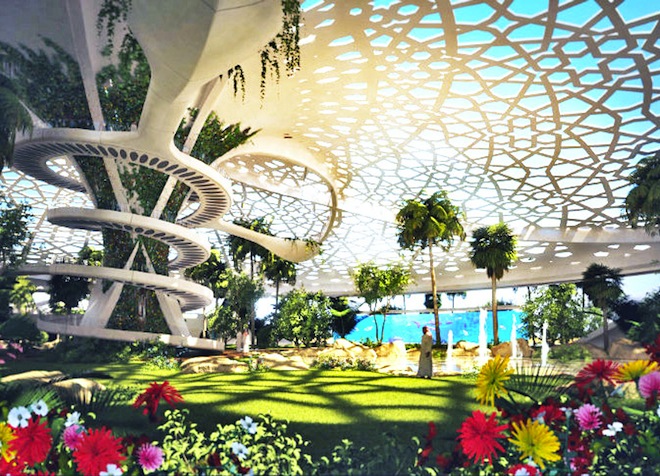
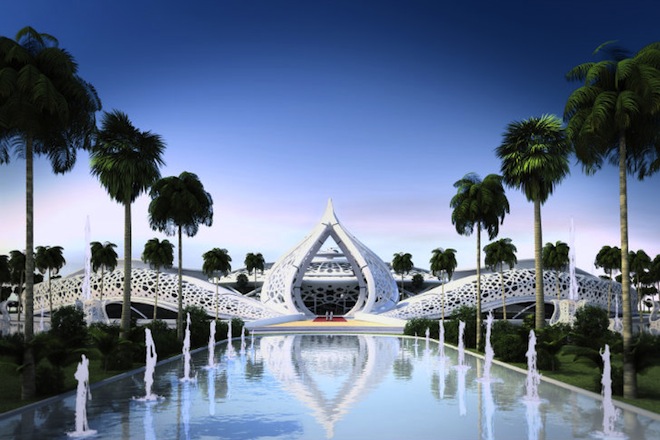
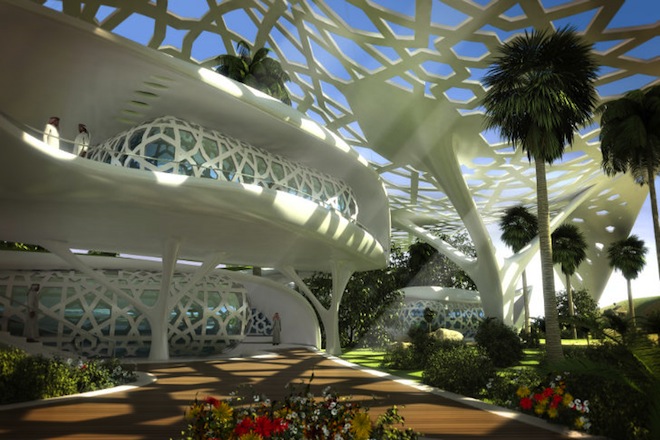
A contemporary take on various cultural motifs, such as the ubiquitous dome, and modeled after the sidra tree indigenous to the region, the 2,2925 square meter grounds incorporate both indoor and outdoor gardens, a sweeping shaded entryway, and the main dome covered with a perforated, undulating roof.

Photovoltaic panels are integrated into the roof’s outer skin, while a misting system built into the inner skin helps to maintain a comfortable microclimate. Everywhere there is greenery, a veritable oasis.

But Qatar is in the desert. How can the palace grounds be so lush? This is where it gets, tricky, where it so frequently gets tricky in the Middle East.
A Palace for Nature, Qatar architecture, green design, sustainable design, eco-design, solar power, water scarcity Middle East, botanical oasis, daylighting, energy efficient design, recycled gray water, on-site desalination

Too often, even in the middle of the desert where it’s not appropriate, developers in the Middle East associate being green with actual greenery – even the kind that can’t sustain itself in an arid, hot environment, where water is terribly scarce.

To account for this problem, Sanzpont proposes to not only recycle grey water, which is great, and an essential component of any new project in water scare Gulf countries, but there is one small way in which this firm that we typically respect a great deal goes wrong: they hope to derive water from underground aquifers.

Granted, in most coastal regions, groundwater is so salty that it is currently not fit for drinking, which is why Sanzpont proposes to build an on-site desalination facility and store water in landscaping pools, but the Gulf peninsula’s underground aquifers are incredibly valuable – not just for this generation, but for those to come, so they ought to be protected at all costs.

Are we really going to use it to make a palace so verdant?
A Palace for Nature, Qatar architecture, green design, sustainable design, eco-design, solar power, water scarcity Middle East, botanical oasis, daylighting, energy efficient design, recycled gray water, on-site desalination

Other than that, this project reveals that the Middle East is embracing more responsible design, that not all Arabs drive gold Mercedes and drink bottled water worth nearly $3,000.

In addition to producing its own clean energy, the energy that the residence does require is reduced by natural ventilation, daylighting, and LED lights.

“Architecture design should be integrated with its surrounding environment should reflect its culture in time,” writes Sanzpont, “so we studied their historical typologies and architectural language to evolve it into innovative vanguard design plenty of cultural heritage.”

Tafline Laylin
Tafline Laylinhttp://www.greenprophet.com
As a tour leader who led “eco-friendly” camping trips throughout North America, Tafline soon realized that she was instead leaving behind a trail of gas fumes, plastic bottles and Pringles. In fact, wherever she traveled – whether it was Viet Nam or South Africa or England – it became clear how inefficiently the mandate to re-think our consumer culture is reaching the general public. Born in Iran, raised in South Africa and the United States, she currently splits her time between Africa and the Middle East. Tafline can be reached at tafline (at) greenprophet (dot) com.
2 COMMENTS

LEAVE A REPLY

Please enter your comment!
Please enter your name here

TRENDING

Astro uses AI to help procure land for renewable energy

For oil-rich, environmentally vigilant Gulf states, Astro isn’t just another startup story. It is a blueprint for accelerating an energy transition that is now existential, not optional.

Don’t Regret Your Host: Alternatives to SiteGround That Impress

Discover top alternatives to SiteGround that offer impressive features and performance. Make an informed choice for your hosting needs today!

Asia Powers Ahead in Global Renewable Boom, But Africa Risks Being Left Behind

Asia continues to dominate global renewable energy growth, accounting for 71% of new capacity added in 2024, while Africa and other developing regions remain far behind despite their potential. Solar and wind lead the charge, comprising 97.5% of additions, with solar alone adding 453 GW. Although global renewables capacity hit a record 582 GW, the world is still off track to meet the COP28 goal of tripling capacity by 2030. Without faster growth and more equitable investment, the energy transition risks deepening the global divide.

Yosef Abramowitz: The Israeli Bringing the Sun to the World’s Darkest Places

Abramowitz employs what he calls the Quadruple Bottom Line Impact Platform when bringing solar energy to countries with limited resources and infrastructure. While not the primary driver, each project must provide returns for investors. While these returns may not turn a massive profit, projects must ensure financial viability. Second, every project contributes to climate mitigation.

Iraq’s Ancient Water Wisdom Faces a Modern Reckoning

The land between the Tigris and Euphrates was once a wellspring of invention. Thousands of years before modern irrigation, the Sumerians, Akkadians, Babylonians, and Assyrians carved canals, engineered flood basins, and developed qanat systems—ingenious underground channels that carried water from mountain springs to distant farms.

Qatar’s climate hypocrisy rides the London Underground

Qatar remains a master of doublethink—burning gas by the megaton while selling “sustainability” to a world desperate for clean air. Wake up from your slumber people.

How Quality of Hire Shapes Modern Recruitment

A 2024 survey by Deloitte found that 76% of talent leaders now consider long-term retention and workforce contribution among their most important hiring success metrics—far surpassing time-to-fill or cost-per-hire. As the expectations for new hires deepen, companies must also confront the inherent challenges in redefining and accurately measuring hiring quality.

8 Team-Building Exercises to Start the Week Off 

Team building to change the world! The best renewable energy companies are ones that function.

Thank you, LinkedIn — and what your Jobs on the Rise report means for sustainable careers

While “green jobs” aren’t always labeled as such, many of the fastest-growing roles are directly enabling the energy transition, climate resilience, and lower-carbon systems: Number one on their list is Artificial Intelligence engineers. But what does that mean? Vibe coding Claude? 

Somali pirates steal oil tankers

The pirates often stage their heists out of Somalia, a lawless country, with a weak central government that is grappling with a violent Islamist insurgency. Using speedboats that swarm the targets, the machine-gun-toting pirates take control of merchant ships and then hold the vessels, crew and cargo for ransom.

Leopoldo Alejandro Betancourt López Turned Ocean Plastic Into Profitable Sunglasses

Few fashion accessories carry the environmental burden of sunglasses. Most frames are constructed from petroleum-based plastics and acrylic polymers that linger in landfills for centuries, shedding microplastics into soil and waterways long after they've been discarded. Leopoldo Alejandro Betancourt López, president of the Spanish eyewear brand Hawkers, saw this problem differently than most industry executives.

Why Dr. Tony Jacob Sees Texas Business Egos as Warning Signs

Everything's bigger in Texas. Except business egos.  Dr. Tony Jacob figured...

Israel and America Sign Renewable Energy Cooperation Deal

Other announcements made at the conference include the Timna Renewable Energy Park, which will be a center for R&D, and the AORA Solar Thermal Module at Kibbutz Samar, the world's first commercial hybrid solar gas-turbine power plant that is already nearing completion. Solel Solar Systems announced it was beginning construction of a 50 MW solar field in Lebrija, Spain, and Brightsource Energy made a pre-conference announcement that it had inked the world's largest solar deal to date with Southern California Edison (SCE).

Related Articles

Popular Categories