

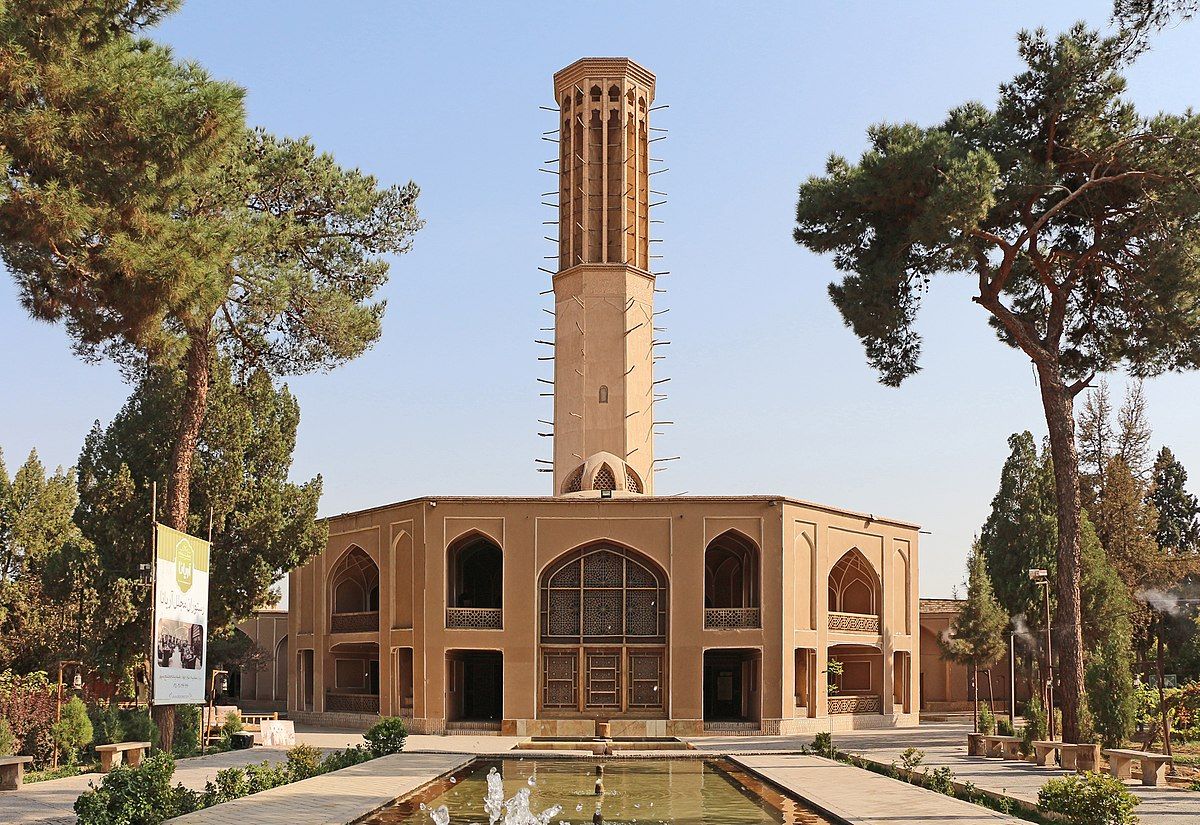
For centuries people living in hot climates have tried to cool buildings without electricity. Long before air conditioning, architecture itself acted as the cooling system. It’s called using passive energy. In Iran, for example, traditional homes used wind catchers, known as badgirs, tall towers that captured breezes and funneled cooler air down into homes. These passive ventilation systems have been used for thousands of years across the Middle East and can naturally cool buildings by directing airflow and expelling hot air.
In hot climates like the Middle East and North Africa, homes were also designed around inner courtyards with pools and shaded gardens, allowing for privacy, but also for cool air to circulate through thick mud-brick walls and shaded spaces during the day. In some cases, underground spaces connected to aqueducts or water channels were used to further cool incoming air before it entered the building.

Modern sustainable architecture has tried to rediscover these ancient ideas. Over the years we have covered everything from white roof paint that reflects sunlight to experimental passive cooling materials designed to reduce air-conditioning demand.

Now an Israeli startup says it may have taken the idea a step further: cooling surfaces using sunlight itself.
SolCold, a climate-tech company based in Ness Ziona, Israel, has developed a nanotechnology coating that actively cools surfaces when exposed to sunlight. The company was founded in 2016 by Yaron Shenhav and Dr. Yaron Shenhav (co-founder and CEO), based on research originating at the Hebrew University of Jerusalem.
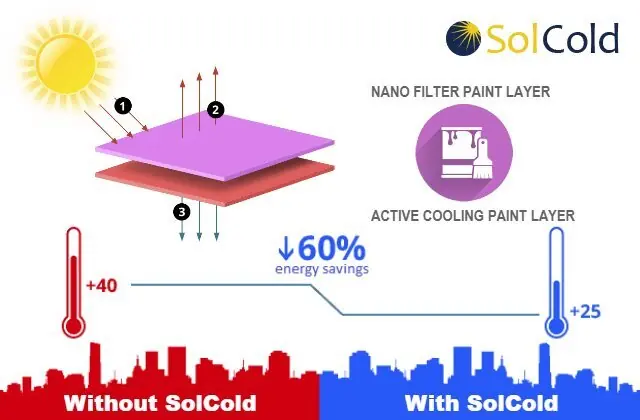
The coating can be applied to buildings, vehicles, shipping containers and even fabrics. When sunlight hits the material, it triggers a physical process that reflects most solar radiation, converts absorbed heat energy into light, and releases heat through radiative cooling. Sort of the way you cool down after you pop into the water and then stand in the air.
Unlike traditional reflective coatings or “cool roof” paints, which simply bounce sunlight away, SolCold’s technology actively removes heat from the surface. In direct sunlight, coated objects can become cooler than the surrounding air.
The hotter the environment and the stronger the sun, the stronger the cooling effect. In laboratory tests the coating has demonstrated temperature reductions of up to about 20°C below ambient conditions.
The company says the technology could significantly reduce air-conditioning demand in buildings, cut energy use in refrigerated shipping containers, and help lower the urban heat island effect that traps heat in cities.
SolCold has raised several million dollars in venture funding, with investors including the Israel Innovation Authority and private climate-tech investors, and has conducted dozens of pilot projects with global automotive and industrial companies, testing the coating on vehicles and equipment exposed to intense sunlight. Major global manufacturers have reportedly tested the technology for use on vehicles and industrial equipment exposed to heat.
The company is entering a growing field of passive cooling and reflective materials, competing with technologies such as cool roof coatings from companies like Cool Roof Rating Council partners, radiative cooling materials developed at Stanford and MIT, and reflective paints such as those commercialized by PPG and other building-materials manufacturers.
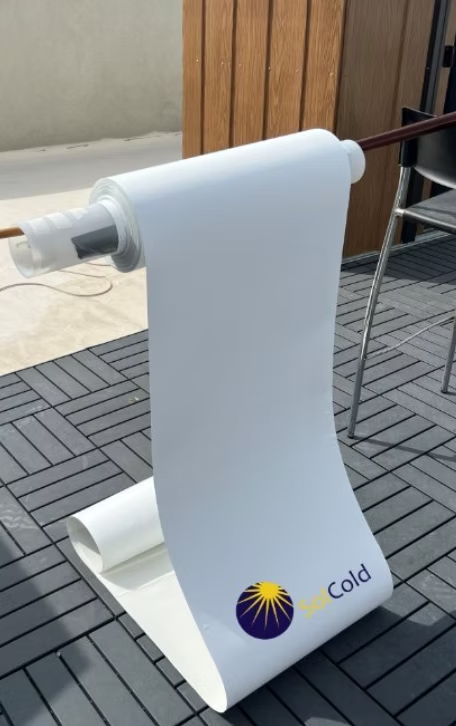
Its first product named “Glacier 110,” is an opaque, white solid film with a thickness of 350 µm, an area density of 0.3 kg/m2, and is highly durable, lasting for ten years in high-performance applications. The material’s optimal cooling power is 70W/m2 – 170 W/m2 at noon in summertime. It can be used on buses to keep occupants cool, for instance.
Glacier 110 has four layers: a smart filter that lets 1% of heat pass through it, an anti-stokes layer, a radiative cooling layer, and a mirror layer. The coating maintains a low ambient temperature throughout its entire architecture.
The main benefits of the company’s innovative products include zero electricity and fuel consumption and zero carbon emissions. Used in clothing, it protects the health of the wearer.
If the technology scales commercially, coatings that turn sunlight into cooling power could offer a modern, high-tech counterpart to the ancient passive cooling systems that shaped desert architecture for centuries.