
Parkour is often misunderstood as a fringe sport or a collection of stunts. In reality, it belongs to the same cultural lineage as grafitti, skateboarding and surfing: youth-led movement practices shaped by place, limitations, and the need to claim space.
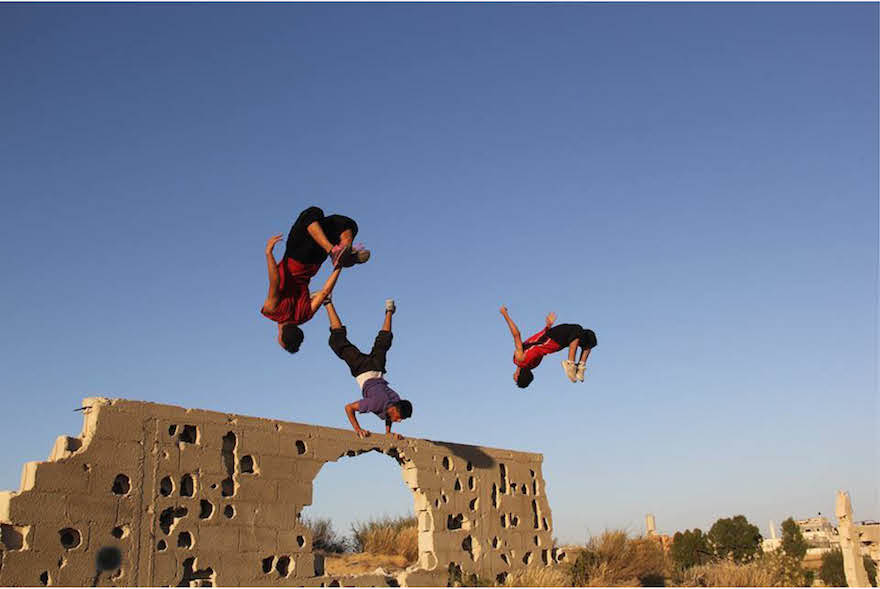
Parkour, a way of using acrobatics and stunts (sometimes death-defying) to move around the built environment, also caught on in Gaza. We wrote about the young parkour creators in 2012, and now there is a documentary film highlighting their lives and struggles.
For years, young people in Gaza used parkour to create structure and meaning in a restricted environment. Teenager boys trained on rooftops, in quiet streets, and among damaged buildings, learning how to move fluidly through spaces never designed for play. Like skateboarding in dense cities or surfing along contested coastlines, parkour offered discipline, community, and identity. (Boys and girls do not hang out in Gaza together, so the sport was limited to boys).
Yalla Parkour, directed by Areeb Zuaiter, captures this culture from within. The film follows Zuaiter’s long relationship with Ahmed Matar, a parkour athlete in Gaza, as she reflects on loss, memory, and belonging after the death of her mother. What begins as a personal search gradually opens into a portrait of how movement shapes young lives under constraint.
The documentary avoids spectacle. There are no competitions, rankings, or dramatic victories. Instead, the focus is on training, trust, and shared routines. Rooftops become practice spaces. Friends gather to watch, film, and learn from one another. Like skate crews or surf communities, Gaza’s parkour scene is built on mutual respect and collective risk.
Much of the film was developed and shot years before October 7, 2023. The Gaza shown on screen reflects pre-war daily life: informal training sessions, moments of calm between jumps, and a sense of continuity. The film now carries the weight of an unintended historical record, showing how beautiful and developed Gaza was. Any references to events after October 7 are reflective and editorial.
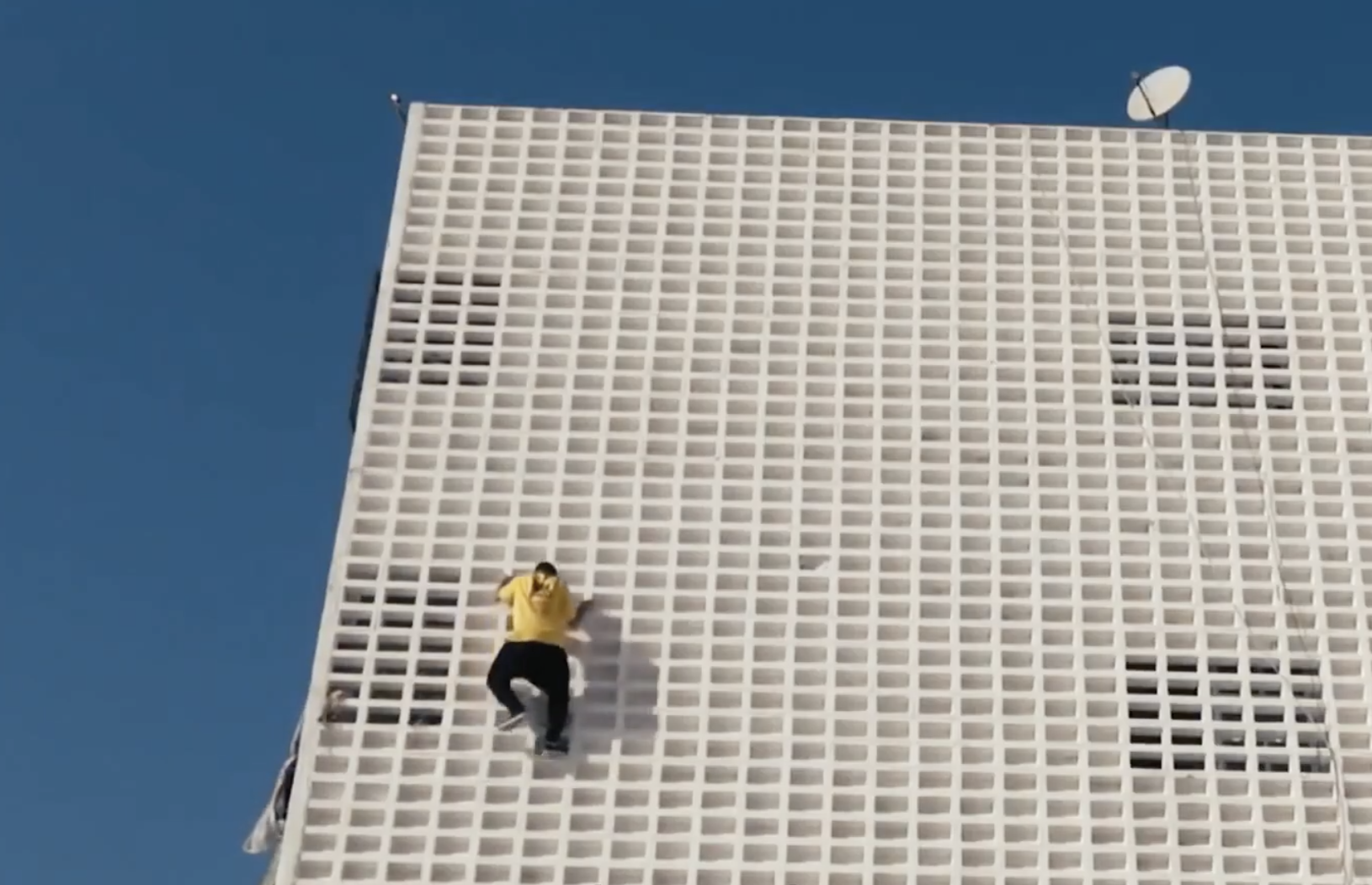
What Yalla Parkour ultimately shows is that parkour in Gaza was never about escape fantasies. It was about learning limits, adapting to obstacles, and staying grounded through physical practice. Like skateboarding and surfing, it offered young people a way to grow, build skill, and belong to something larger than themselves.
Seen this way, Yalla Parkour is not only a film about Gaza. It is a film about youth culture and movement, and about the universal human need to claim space, even when that space is sharply constrained.
If you love parkour, check out how girls in Afghanistan started skateboarding. Or how women in Cairo, Egypt could learn to cycle or jog, free from being sexually harassed by creating Harassmap.