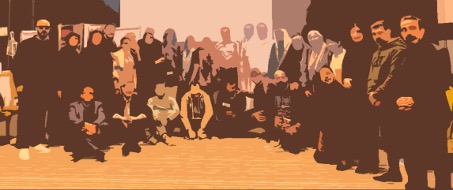
Istanbul, mid-December 2025. The global interfaith organization* of which I am currently the president organized, for the first time since October 7, 2023, a meeting of its Middle East – North Africa branch, with 50 participants chosen from among the leaders of the many “cooperation circles” that the organization has in these regions, for 4 full days.
They came from Israel, Palestine, Jordan, Iraq, Yemen, Morocco, Tunisia, Lebanon, Egypt… There are Sunni Muslims, Shiite Muslims, Jews (Orthodox and Reform), Orthodox Christians, Coptic Christians, Protestant Christians, Druze, Baha’is, a Scientologist.
I was, how can I put it, a little anxious about having Israeli Jews and Palestinians, and other worthy representatives of the Arab world, in the same room. I was wrong.
You don’t learn about the world through the media, whether social or otherwise. You learn by traveling, and for the past two years, Israel and Palestine haven’t been among my destinations. You also learn by listening to people who live what you want to learn about. And I learned so much in four days.
Everything that happened in Istanbul is shrouded in secrecy for the safety of the participants, especially regarding their identities. That is why I will primarily use fictitious first names.
From anti-Jewish fighter to peacekeeper
One of us, Amin, came to tell me his story. He’s in his fifties, slim, with an elegant bearing, a weathered face, and dark eyes that sparkle with life. Amin has lived in a refugee camp in Palestine, seemingly his whole life. He told me that when he was younger, he was a “fighter” against Israel. He was convinced that a good Jew was a dead Jew, and that he would earn his place in paradise by killing the enemy. Until the day he met our interfaith organization, fifteen years ago. In short, this encounter made him realize that he could talk to a Jew. And that if he could talk to him, it meant that the Jew was also a human being. With this realization, he understood that he had been lied to all his life, and he decided to dedicate his life to helping people see their humanity as something that transcends all prejudice. “ We are first and foremost human beings, before we are Jews, Muslims, Christians, or anything else, ” he told me. “ Without that, we are nothing, and war begins .”
Not only has Amin come a long way, but in his refugee camp, he faces daily the influence of Hamas and others who don’t share his view of the enemy’s humanity. He also has to deal with the abuses sometimes (or often, depending on who I listen to) committed by Israeli soldiers, which only complicate matters. But he remains steadfast. He explains that he teaches young people how to pass checkpoints by observing Israeli soldiers and imagining them at home, with their families, at the beach—anywhere they would find a human image, regardless of the soldiers’ behavior. The result, he tells me, is often (though not always) miraculous. It’s the soldiers who then change their attitude and become, in effect, more humane.
His analysis is this: each of the two groups (Israelis and Palestinians) sees the other as something devoid of humanity. If one of them infuses humanity into their gaze, then the other receives it and becomes what they have always been: human. It’s not much, but it’s all they have to fight for, and ultimately, it’s all that can make a difference in this part of the world. For him, that’s a divine mission.
The enemy children
Steven is a devout Israeli Jew who runs an organization in Tel Aviv that teaches dialogue for peace to young people. When the October 13th massacre occurred, he felt compelled to do something to prevent succumbing to hatred. He knew that nothing would ever be the same again, and even before, things weren’t great… So he launched a project for the young people who followed him—Palestinian Muslims and Christians, and Israeli Jews, Muslims, and Druze—to preserve and strengthen what he calls “the connection beyond divisions.” Through writing, young Israelis and Palestinians collaborate to express their suffering, their difficulties, their hopes, their resilience, and their courage—the courage to imagine a future of peace where the present seems to contradict them. Two books have already emerged from this project.
Yet his project was not universally accepted. Many of his students’ parents called him to criticize the fact that their children might sympathize “with the enemy.” He, too, remained steadfast. Often, it was the children themselves who convinced their parents of the merits of the approach, and of the “lack of merit” in the enemy’s rhetoric.
Do they hate it a little, a lot, passionately, or not at all?
One day, I asked Mohamed, a Palestinian from Bethlehem, if it was true that people in the West Bank hated Israelis. A somewhat silly, naive question, but if I didn’t ask him, who would I ask? Mohamed was Muslim, but he told me he didn’t really practice. He didn’t really care about practice. For him, God doesn’t express himself through practice. To each their own path. He replied, ” That’s true, but not only that. You have to understand that for many Palestinians, all they know about Jews are the soldiers, those they encounter at checkpoints, those who regularly mistreat them, those who have sometimes killed children in their neighborhoods. Before, there were more Palestinians who went to work in Israel and had more opportunities to interact. Since October 2023, that number has drastically decreased, and the divide has widened even further.” So yes, many people hate Israelis. Perhaps you would hate them too if you were in their situation. And then there’s the propaganda. Propaganda has a field day. It dehumanizes Jews, and every time a Jew commits a wrong here, it wins. There’s only one solution: dialogue and the recognition of our shared humanity. This shared humanity comes up like a recurring theme, day after day, conversation after conversation.
Equal height and equal rights?
Then there’s Karin, an Israeli journalist, who manages to speak to me privately. She tells me I absolutely must talk to Sara, a young Baha’i woman from Jordan, because she’s convinced that a solution in the Middle East might come from the Scientologists and the Baha’is, because the Jews (including herself), Muslims, and Christians are too entangled in these age-old conflicts; they’re trapped in existential struggles that prevent them from seeing things from a broader perspective. They want to save their own skin, and to do that, they have to destroy “the other.”
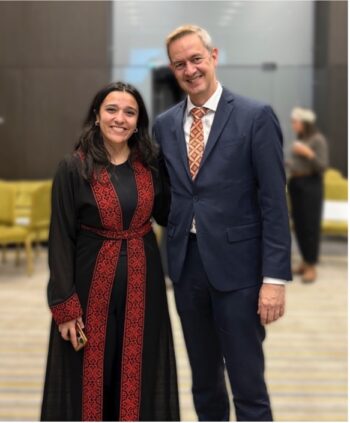
So I talk to Sara, who is absolutely fantastic. Every day she takes five hours on trains (yes, trains, not just one) to help children in a refugee camp on the border with Palestine. Once, I ask her if Baha’is face discrimination in Jordan. She immediately says no, but when I ask her a little more, I learn that they don’t have the same rights as others (which, of course, is the very definition of discrimination). The difference in rights, from what she tells me, mainly concerns family rights, but the more I talk to her, the more she shows me that they are, in fact, discriminated against. We get used to everything, to the point where we don’t even see the problem anymore. She says she loves her country, and that for that reason, she’s willing to accept the hardships. I tell myself that I love my country too, but that doesn’t change my rejection of discrimination. I think we’re being taken for a ride when they manage to make us believe we have to accept the unacceptable in the name of some kind of patriotism. But anyway, it doesn’t matter, Sara is brilliant and full of genuine kindness.
There’s also Kamal, a Lebanese Druze. When Kamal learns that I’m friends with Sheikh Bader Kasem, a prominent figure in Druze Islam (who lives in Israel), he wants to learn more about Scientology . When he learns that I, too, believe we are immortal spiritual beings who pass from body to body, life after life, he’s happy because he’s no longer alone.
All these religions are a breath of fresh air.
There’s also Mina, a Christian from Egypt, a renowned professor of medicine, who didn’t even know my religion existed. It’s the first time he’s heard its name. He knows me, but it had never occurred to him. So, he starts talking about it while we’re all gathered together. And everyone begins discussing how there’s nothing better than learning that there aren’t just five major religions in the world (Christianity, Islam, Druze, Judaism, and Baha’i). They want me to tell them about all these religions they know so little about. It’s a breath of fresh air for them. The world is vast, diverse, and rich. It reinforces their belief that the most important thing is that we are all human. Hallelujah.
Adar, for his part, is Kurdish, from Iraq. He talks about Mandaeism , an ancient religion that now only has a few thousand followers, mainly in Iraq. I ask him if he practices it; he says no, he’s Christian. But he says that in Kurdistan, everyone does what they want. I doubt it, but I don’t really know. So he invites me, along with his two companions, one of whom is part of the Kurdish government. I said I’d go. And I will.
The other’s language
And then there’s Shlomo. Shlomo is Jewish, but he taught Arabic in Israel his whole life. For him, language is the gateway to peace. If you speak the language, you understand. If you understand, you don’t wage war. He published a Hebrew/Arabic dictionary, which has been reprinted several times. He explained to me that his parents, in his younger years, were very disappointed with his life path. Teaching Arabic, you have to be a little crazy. But anyway, he became the National Inspector of the Arabic Language, a lecturer at the Faculty of Education of the Hebrew University of Jerusalem, and Israel’s representative to the European Committee for Reading and Literacy. So they were forced to admit that he had made something of his life, and they changed their minds. Shlomo seems not to care; he’s old and he’s seen it all. And yet he is still present at all the gatherings, even at over 80 years old.
Mariam, from Hebron in Palestine, is a Christian. She speaks a grating Arabic, not because it isn’t beautiful, but because she speaks so loudly and always seems to be yelling at you, even when she smiles and you understand that she likes you. She complains. She complains about Israel, which “makes her life miserable.” She complains about Hamas, which “makes her life miserable,” she complains about the Palestinian Authority and its “corrupt President,” which “makes her life miserable.” But she pats everyone on the shoulder, Jews included, with an energy that knows no bounds.
She also tells me about the Israeli settlers. She says that in many places the settlers and the Palestinians get along very well. They live together and work together. Why am I surprised?
Peace?
Understand this clearly: these are not pro-Israel Arabs. They are not pro-Palestine Jews. They are not eccentric dreamers from some beatnik fantasy. These are people who have lived through the harsh realities of war, and who continue to grapple with them, but who have not lost their intelligence or their humanity.
Finally, on the last evening, we celebrated Hanukkah, lit the candles, and listened to the prayers in Hebrew. No photos, please; it’s not like we’re having a village festival. And taking photos is dangerous. But we celebrated anyway. Together.
And then everyone went their separate ways. On the group messaging app, which some had to leave and delete from their phones before returning to their countries, the conversations continued for several days. Everyone went back home, to the fight, the fight for a better world, for a better region, for a better neighborhood, for better people. We promised we would see each other again. And we did.
And we know. We know that peace is possible and that those who say otherwise are, deep down, the ones who don’t want it. We know that war is not inherent to humankind, because, precisely, humanity is the solution to war. From the moment we see it, recognize it, and grant it its humanity. Does that sound naive? No, it’s a flower nourished by the blood of victims, which, despite everything, has grown, and which defies the status quo.
* This is the world’s largest grassroots interreligious organization, with over 1,200 affiliated groups in more than 110 countries. Founded by the former Episcopal Bishop of California, Reverend Bill Swing, it celebrated its 25th anniversary last year. Beyond its creation and scale, these 25 years have primarily demonstrated the strength of its model: decentralized interreligious cooperation, driven by local actors themselves. URI has enabled very diverse communities to meet, overcome religious and cultural divides, and work together for peace, reconciliation, education, equality, social justice, and the care of the Earth. By prioritizing inclusion, shared governance, and concrete action over rhetoric, it has helped to embed interreligious dialogue in daily life and make it a genuine driver of lasting social transformation.
This article was first printed in French, on Rebelles. It is reprinted with permission.