

From Green Energy to Healthy Societies: Why old systems thinking is becoming relevant again

Heinz J. Sturm is a system architect and analyst exploring integrated climate, energy, water, and health systems as initiator of the Bonn Climate Project and developer of Ars Medica Nova.
Heinz J. Sturm is a system architect and analyst exploring integrated climate, energy, water, and health systems as initiator of the Bonn Climate Project and developer of Ars Medica Nova. Image: supplied.

Across the Middle East and North Africa, large investments are being made in green hydrogen, renewable energy, water infrastructure and sustainability. Most of these efforts are discussed in the context of climate change, decarbonization and economic diversification. That framing is important, but it may not capture their full value.

If these systems are designed well, they can do more than produce clean energy or reduce emissions. They can help create healthier societies and greater long-term stability.

Today, health is usually treated as a medical issue. We think of hospitals, drugs and treatments. From a systems and economic perspective, this approach is becoming increasingly expensive and limited. Health does not begin in hospitals. It begins much earlier, in the conditions people live in every day.

Clean water, healthy soil, reliable energy, nutritious food and safe environments shape human health long before anyone sees a doctor. When these foundations are weak, chronic illness increases, healthcare costs rise and societies become more fragile. Medical systems then try to manage the consequences, often treating symptoms rather than underlying causes.

This challenge exists everywhere, but it is especially visible in regions facing water scarcity, climate stress, rapid urban growth and demographic change, including the Levant, the Gulf states and the wider MENA region.

From a health-economics perspective, many modern healthcare systems function as repair systems. They step in late, once disease has already developed, and continue treatment over long periods of time. 

As a result, healthcare spending grows faster than the economy, chronic disease consumes a growing share of public budgets, and long-term affordability becomes a serious concern.

For many countries, copying high-cost Western healthcare models is neither realistic nor necessary. The more important question is how societies can reduce the need for medical intervention in the first place.

This is where green energy, water and food systems become relevant in a different way. When renewable energy and green hydrogen are developed together with clean water supply, sustainable agriculture and resilient food systems, they form the real infrastructure of prevention. Clean energy supports water security. Clean water supports fertile soil and healthy food. Good food supports stable human health.
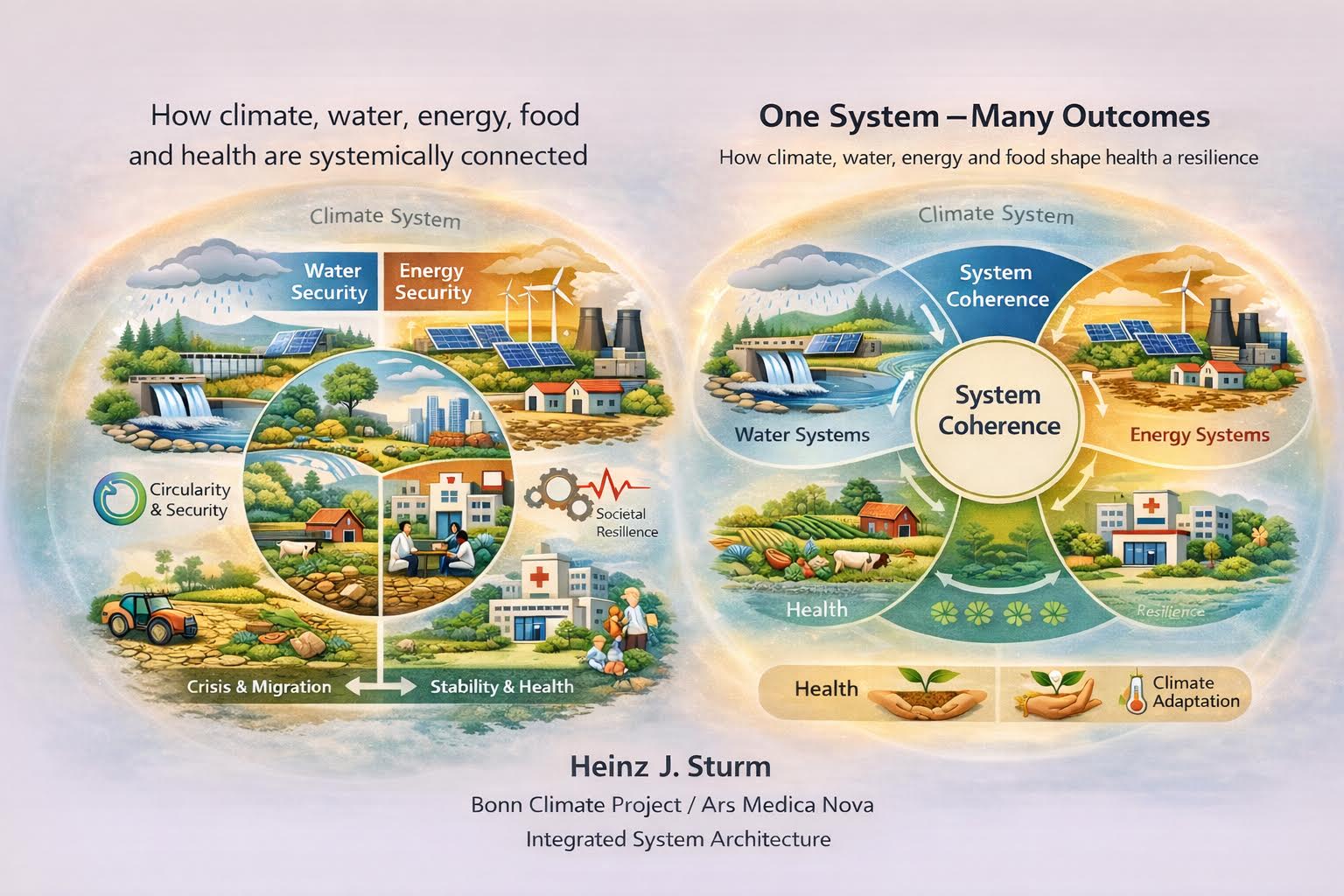
The Bonn Climate Program: supplied.


Seen this way, health is not something that constantly needs to be repaired. It emerges naturally when systems are designed properly.

This way of thinking is not new in the Middle East. The Levant and surrounding regions were once centers of advanced medical and scientific knowledge. Thinkers such as Hippocrates, and later scholars including Ibn Sina, ar-Razi and al-Kindi, understood health as a balance between the human body, the environment and daily life. Their focus was on water quality, nutrition, lifestyle and the relationship between people and their surroundings.

In modern terms, this was forward-looking knowledge. Not mystical, but practical. It recognized that the way systems are designed determines long-term outcomes.

What is new today is our ability to explain this older systems wisdom using modern science, including biochemistry, electrochemistry and economics, and to apply it to today’s policy and investment decisions.

If green hydrogen and renewable energy projects are seen only as climate measures, their potential remains limited. When they are connected to water, food and health systems, they become foundations of societal resilience. This has clear economic benefits: lower healthcare costs over time, fewer chronic diseases, better returns on sustainability investments and greater social stability.

The next phase of the energy transition is therefore not only about reducing emissions. It is about creating the conditions in which healthy societies can emerge.

Medical care will always be important, but it cannot carry the system alone. Health grows upstream, in water, energy, food and living conditions. When these systems work, health follows naturally, at lower cost and with greater stability.

This idea is old. But in a time of rising costs and increasing pressure on societies, it may be more relevant than ever.

::Bonn Climate Project

___

Heinz J. Sturm is a system architect and analyst working at the intersection of energy, water, health, and societal resilience. He is the initiator of the Bonn Climate Project, where he develops integrated system frameworks linking climate action with public health and long-term stability. Sturm is also the developer of Ars Medica Nova, a conceptual platform exploring new models of preventive health that draw on systems thinking, biology, and infrastructure design. His work focuses on translating complex system architectures into practical narratives for policymakers, researchers, and civil society.

Heinz Sturm
Heinz Sturmhttps://www.greenprophet.com/
Heinz J. Sturm is a system architect and analyst based in Bonn, Germany, working at the intersection of health systems sustainability, climate policy, energy systems and long-term resilience. He is the developer of the Bonn Climate Project and of Ars Medica Nova, a systemic framework linking water, food, energy and health as inte-grated foundations of societal stability. His work focuses on analyzing the long-term economic unsustainability of interven-tion-driven health systems and on developing preventive, system-level concepts that support governments and institutions in making resilient and economically viable decisions. He has been active in advisory and project-development contexts, with a particular focus on the Levant, the Gulf region and North Africa

TRENDING

BM Studios is designing systems, not just buildings in the UAE

Balsam Madi is an architect and systems thinker whose work bridges culture, sustainability, and design intelligence across the Middle East and Europe.

Why Health Systems Are Reaching a Turning Point

Health emerges from a continuous energy and material flow from water through food to human physiology. Technical energy systems support this cycle through water treatment, agriculture, and infrastructure.

Leading Through a Dual-Energy Transition: Balancing Decarbonisation with Energy Security

Experience in one area of the energy industry isn't enough to guarantee readiness across all the others. That's where a structured program like an MBA in energy can come in. Today's advanced curricula explore energy economics, finance, policy, and strategic management alongside the technical subjects. And when pursuing an energy MBA online, professionals can skill up and retrain without having to step out of the labor market -- an important perk at a time when skilled professionals are already in short supply.

What is the Jewish Climate Trust?

Jewish Climate Trust has quickly attracted the attention and support of some of the most influential voices in Jewish philanthropy, drawing backing from prominent family foundations and business leaders connected to the Bronfman and Schusterman philanthropic networks, alongside climate-focused investors and community builders aligned with founding leader Nigel Savage. Together, these donors have committed many millions of dollars to build a serious, long-term climate platform for the Jewish world — not as a symbolic gesture, but as a strategic intervention in one of the defining challenges of this generation.

Charbone produces first hydrogen at Quebec’s local “model” UHP plant

The Sorel-Tracy site is the first decentralized clean UHP hydrogen production facility in Quebec and is positioned as a model for North America. The plant is part of CHARBONE’s five-phase plan to deploy a network of modular hydrogen production facilities across the continent, supported by the company’s growing specialty-gas distribution platform.

Tracking the Impacts of a Hydroelectric Dam Along the Tigris River

For the next two months, I'll be taking a break from my usual Green Prophet posts to report on a transnational environmental issue: the Ilısu Dam currently under construction in Turkey, and the ways it will transform life along the Tigris River.

6 Payment Processors With the Fastest Onboarding for SMBs

Get your SMB up and running fast with these 6 payment processors. Compare the quickest onboarding options to start accepting customer payments without delay.

Qatar’s climate hypocrisy rides the London Underground

Qatar remains a master of doublethink—burning gas by the megaton while selling “sustainability” to a world desperate for clean air. Wake up from your slumber people.

How Quality of Hire Shapes Modern Recruitment

A 2024 survey by Deloitte found that 76% of talent leaders now consider long-term retention and workforce contribution among their most important hiring success metrics—far surpassing time-to-fill or cost-per-hire. As the expectations for new hires deepen, companies must also confront the inherent challenges in redefining and accurately measuring hiring quality.

8 Team-Building Exercises to Start the Week Off 

Team building to change the world! The best renewable energy companies are ones that function.

Thank you, LinkedIn — and what your Jobs on the Rise report means for sustainable careers

While “green jobs” aren’t always labeled as such, many of the fastest-growing roles are directly enabling the energy transition, climate resilience, and lower-carbon systems: Number one on their list is Artificial Intelligence engineers. But what does that mean? Vibe coding Claude? 

Somali pirates steal oil tankers

The pirates often stage their heists out of Somalia, a lawless country, with a weak central government that is grappling with a violent Islamist insurgency. Using speedboats that swarm the targets, the machine-gun-toting pirates take control of merchant ships and then hold the vessels, crew and cargo for ransom.

Leopoldo Alejandro Betancourt López Turned Ocean Plastic Into Profitable Sunglasses

Few fashion accessories carry the environmental burden of sunglasses. Most frames are constructed from petroleum-based plastics and acrylic polymers that linger in landfills for centuries, shedding microplastics into soil and waterways long after they've been discarded. Leopoldo Alejandro Betancourt López, president of the Spanish eyewear brand Hawkers, saw this problem differently than most industry executives.

Related Articles

Popular Categories