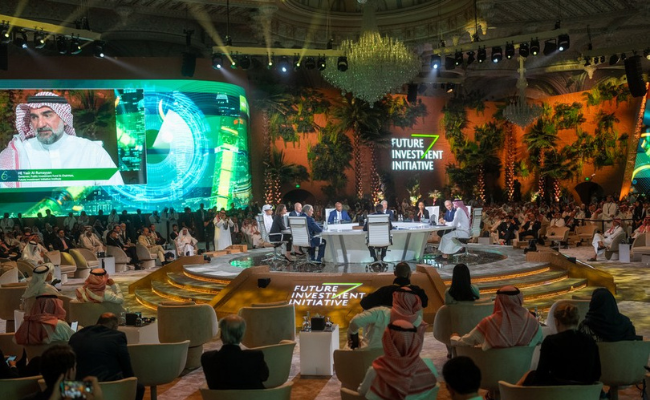
Over the last month Saudi Arabia’s government-owned ACWA Power has signed roughly $10 billion in clean-energy and water-infrastructure agreements, stretching from the Gulf to Central Asia and Africa. On paper, it’s a renewables story as they erect gigawatt-scale solar farms, grid-scale batteries, and desalination plants powered by clean electricity. Development finance is flowing into emerging economies. The deals were signed at the Future Investment Initiative (FII9) in Riyadh known as Davos of the Middle East.
But strip away the slick branding and this feels uncomfortably like a new-era greenwash: the same wealth built on hydrocarbons now deciding the fate of clean power. One truth remains — oil money is now one of the biggest buyers of renewable infrastructure on the planet.
Should we cheer or flinch? It’s a moral knot: the petro-economies that fueled climate breakdown are now financing the transition — selling the sickness and then the cure. If this is the price of decarbonization, it forces a reckoning. Who gets to build the future? And why do we trust the arsonists to run the fire brigade?
ACWA’s largest shareholder is the Public Investment Fund of Saudi Arabia which is owned by Saudi Aramco. PIF’s finances come largely from oil revenue and Aramco dividends. Those petrodollars are now underwriting solar and wind farms abroad such as Uzbekistan’s vast steppe, North Africa’s desert grids, along with water-stressed coastlines from the Red Sea to the Indian Ocean.
The company announced the commercial commissioning of the Karatau Wind 100 MW Project in the Qorao’zak and Beruniy districts of Karakalpakstan, Uzbekistan. The project comprises 16 Envision Energy wind turbines of 6.5 MW each, a 15.4 km overhead transmission line, and a 220 kV substation, with associated Balance of Plant facilities. Electricity will be supplied under a 25-year Power Purchase Agreement to the National Electric Grid of Uzbekistan (NEGU).
For Africa, ACWA Power deepened its long-standing partnership with the International Finance Corporation (IFC) through two strategic agreements aimed at accelerating clean energy and water infrastructure deployment on the continent. The first Framework Agreement, valued at up to USD 1 billion, will provide project and corporate financing as well as capacity building and advisory support for ACWA Power’s growing portfolio across Africa.
This includes participation in the OPEC Fund for project financing, equity bridge loans, as well as equity investments support with USD 450 million as the initial target. “The agreement reflects the parties shared commitment to advancing utility-scale clean energy and water projects that drive inclusive, low-carbon growth across the developing world,” says ACWA, signaling its virtuousness as saving the world it is helping us destroy.

Saudi Arabia is modernizing, however, and this may open the monarchy up for criticism. Saudi Arabia let women drive in 2018, and this year users on social media showed how a Halloween party, considered haram by Muslims, was allowed to take place in Riyadh.

The country is scaling up for tourism and a culture shift by building megacity projects under the name of NEOM. Celebrities in favor of a great paycheck are already lining up to visit places like Shebara, a pristine island in the Red Sea built with no sustainability impact report.

This is not philanthropy but strategy. While Saudi Arabia can announce the “discovery” of a new oil reserve as a PR drill, consumers and oil importers will change loyalties the minute a university invents a way to create practical, unlimited, non-pollution energy. Saudis, whose wealth knows no limits, are building stakes in a post-oil world, and they’re doing it faster and more decisively than many Western democracies whose politics have stalled climate spending.
In Washington, clean-energy capital flows through regulatory funnels and election cycles. In Riyadh, it’s sovereign mandate and execution, but it’s complex because Saudis do not have convention ambitions in size and scale of anything they create, with little concern for the environment except “on paper”. See The Line.
ACWA’s $10 billion announcement is about procurement, equipment orders, power-purchase frameworks, project finance. Meanwhile, the West is still arguing over heat pumps and carbon taxes. (Luckily Torus, connected to Warren Buffet’s company Berkshire Hathaway is putting practical energy in motion with a flywheel invention to stabilize the grid.)
There is a paradox here in every move ACWA and Aramco makes. Some call it green hypocrisy or hedging. But the more honest description is energy geopolitics moving into its next phase. Whoever builds and finances tomorrow’s grids will shape tomorrow’s trade routes, alliances, and dependencies — just as oil once did. So if you enjoy the west and your freedoms, fight for renewable energy independence by raising up and influencing projects and companies locally.
China understood this early through batteries, solar manufacturing, and Belt-and-Road transmission lines. Now the Gulf sovereigns have joined the board. They don’t want to be buyers of technology, but as builders and exporters of clean-power megaprojects.
The uncomfortable question is not whether oil money should fund renewables but maybe if anyone else can move this fast.