On November 6, 2025, Houston welcomed its newest civic landmark: the Ismaili Center, Houston, a luminous Shia Muslim complex overlooking Buffalo Bayou Park that merges Islamic art, architecture, and landscape design.
It was inaugurated by Mayor John Whitmire alongside Rahim Aga Khan V.
Related: 5 eco mosques in the world
Aga Khan is the new Imam of the world’s Shia Ismaili Muslims — the Center marks the first Ismaili civic and cultural complex in the United States, and perhaps the most ambitious example of faith-based sustainable design built in the South. It is the first Ismaili Center in the United States, joining those in London, Vancouver, Lisbon, Dubai, Dushanbe, and Toronto. The project fulfills a vision set in motion by Shia leader Karim Aga Khan IV (1936–2025) and realized by his son and successor.
But in Texas, a state where political tensions are now rising over pluralism, and at a time when the Aga Khan’s own architecture awards have faced accusations of greenwashing, Houston’s newest monument is more than a work of beauty — it’s a test of credibility.
In September 2025, Governor Abbott signed a law banning what the state describes as “Sharia compounds” — developments “open only to Muslims” or controlled by religious law structures. This was in response to a Muslim-built EPIC city that discriminates on who can buy homes in the community based on religion.
A Civic Oasis in a Divided State?

The estimated $170 million project sits at the intersection of Allen Parkway and Montrose Boulevard, within walking distance of the Rothko Chapel and the Menil Collection — Houston’s spiritual-artistic corridor.
That spirit will be tested. In recent months, Governor Greg Abbott has come under fire for launching a campaign to halt construction of a proposed Islamic-planned community near Dallas, drawing accusations of Islamophobia from faith leaders and civil-rights groups (Houston Chronicle). Elsewhere, redistricting maps have cut Black and Latino representation in Houston by half, prompting protests by local clergy and activists (Houston Chronicle).
Amid this climate, a Muslim-led institution dedicated to “shared human values” carries political resonance. The Ismaili Center, Houston, designed by London-based architect Farshid Moussavi and landscape architect Thomas Woltz, aims to model pluralism through design witnessed by open courtyards, shaded eivans (verandas), and gardens meant for dialogue, art, and quiet reflection.

The building’s green credentials are strong — at least on paper. Rising above the 500-year floodplain, its underground garage doubles as a flood reservoir. The 11-acre landscape slopes gently toward the Bayou, channeling runoff through terraces, reflecting basins, and flood-adaptive gardens. It’s parking lot underground can hold runoff in the case of a flood.
Woltz calls it “a transect of Texas,” planted with desert agave, prairie grasses, and Gulf Coast reeds — a living metaphor for ecological and cultural adaptation.
Materials were chosen for longevity — stone, steel, and ultra-high-performance concrete with a 100-year life cycle. Natural light filters through perforated screens that recall Persian craft traditions. The design philosophy echoes the global movement for regenerative Islamic architecture explored in Green Prophet’s stories on Hassan Fathy’s legacy and green architecture across MENA.

The Shadow of Aga Khan Greenwashing

The Aga Khan Development Network (AKDN), which oversees the Ismaili Centers and funds the prestigious Aga Khan Award for Architecture, has faced increasing scrutiny over how it markets “sustainability.”
Green Prophet’s recent investigation, “When Greenwashing Overwrites Ecology at the Superadobe Majara Residence”, questioned the ecological validity of one of the Aga Khan Award’s 2025 winners in Iran. That project — celebrated for its earthy “superadobe” domes — was found to rely heavily on unsustainable materials, tourist economics, and a romanticized desert aesthetic. They did not reply to our questions and ignored an Iranian architect Ronak Roshan who embodies ecological integrity above all in her practice.
Another Green Prophet piece on the 2025 Aga Khan Architecture Winners argued that the Award risks functioning as a form of cultural branding — celebrating Islamic modernity while skimming over deeper environmental costs and issues. These critiques raise a question for Houston: will this Center be an authentic green civic landmark, or a monumental case study in eco-optics and religious politics?
As we’ve explored in “Saudi Greenwashing at NEOM” and “UAE Green Finance and COP29”, even projects wrapped in the language of sustainability can mask carbon-heavy construction and elitist urbanism.
A Real Test of “Faith in Practice”
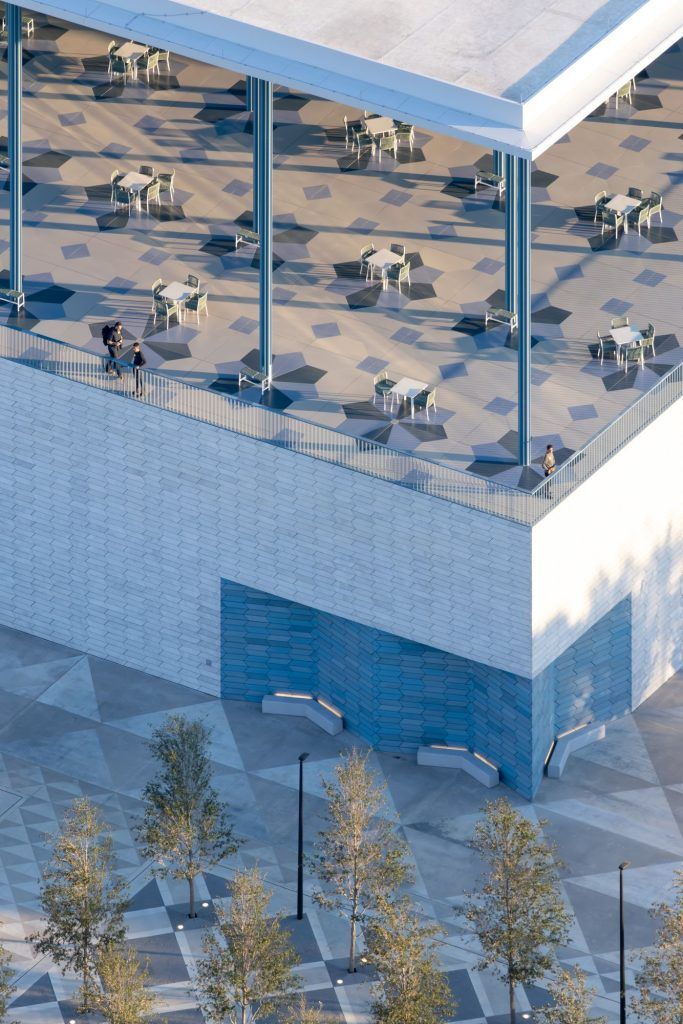
Unlike many mosques or churches, the Ismaili Center Houston explicitly presents itself as civic infrastructure: a place for performances, classes, and lectures, with a café and art exhibitions open to all. The Aga Khan center does the same in Toronto. Yet when we see the way a dominant group politically includes projects with little merit for the sake of politics, we believe this is more politics and optics than true pluralism.
The Aga Khan’s global network has a record of genuine impact — funding hospitals, universities, and rural-resilience projects from East Africa to Pakistan. Yet critics note a lack of public reporting on carbon metrics or third-party audits.
If the Ismaili Center Houston truly evolves into a community green hub — hosting lectures on climate justice, native gardening workshops, or open dialogues on the energy transition — it could redefine how faith institutions serve cities in crisis. But given the rise of antisemitism across the United States and Canada, much of it fueled by extremist rhetoric, it’s fair to ask whether this is also a political project dressed in the language of pluralism. If its lush gardens and polished stone remain mostly symbolic, the Center risks becoming yet another addition to the Aga Khan’s portfolio of beautifully designed but tightly managed “sustainable” showcases.
Whether the Ismaili Center becomes a true model for green faith architecture or just another chapter in the Aga Khan’s controversial brand of eco-diplomacy will depend on what happens after the press photos fade.