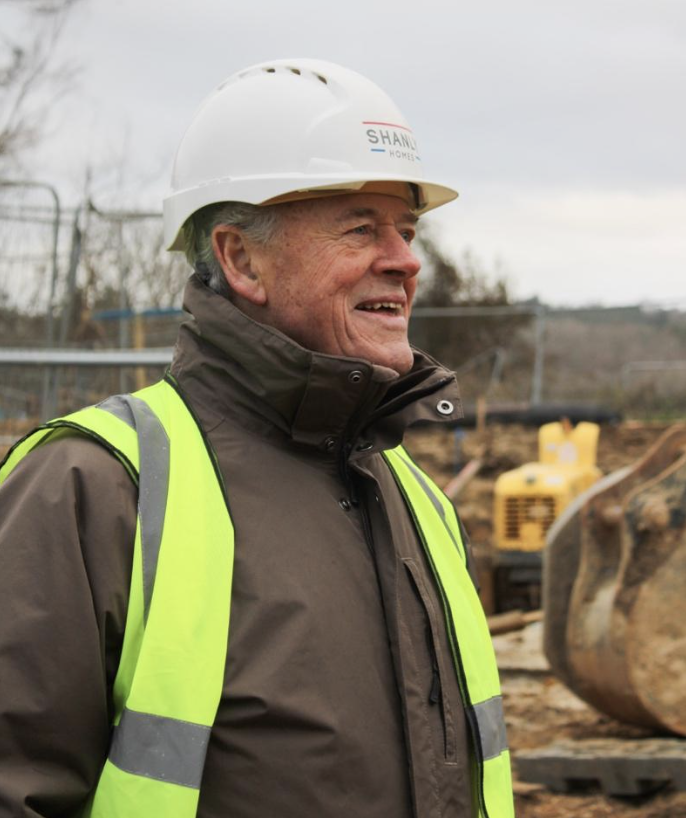
Most developers see economic downturns as something to endure. Michael Shanly has consistently seen them as opportunities to strengthen his business for the long term. Across five major crises – from the 1974 property crash to the COVID-19 pandemic – his approach has remained remarkably steady: adapt quickly, stay close to operations, and make decisions that build resilience rather than short-term relief.
The record speaks for itself. While many of his competitors have retrenched, restructured, or disappeared altogether during economic turbulence, Michael Shanly has emerged from each cycle stronger. His companies have built more than 12,000 homes, developed 1,500 commercial tenancies and maintained consistently high standards of quality – all while facing the same economic headwinds that have undone much of Britain’s property sector.
This isn’t a story of good fortune. Over five decades, luck evens out. The more interesting question is what principles have allowed Shanly to keep finding stability when others could not.
1974: Building a Foundation in Crisis
In 1974, Britain’s economy was in disarray. The global oil shock had sent inflation spiralling, credit was tightening, and the property market was grinding to a halt. Mortgage rates soared and development finance all but dried up.
At a construction site in Maidenhead, Shanly found himself managing a project that had suddenly become financially uncertain. Where most developers chose to pause and wait for the market to recover, he took a more pragmatic view. On the site sat a house marked for demolition. Rather than proceed with the original plan, he converted it into rental flats to generate income that would support the wider development.
It was a small, adaptive decision that kept the project alive when others stalled. More importantly, it revealed a broader truth: property could be managed for steady, long-term income rather than short-term speculation.
That insight became the foundation of what would later be Sorbon Estates, formally incorporated in 1994 but built on habits formed two decades earlier. The willingness to adapt, to find practical solutions rather than wait for ideal conditions, would define his career and shape the group’s approach to every crisis that followed.
Principle One: Lead from the Ground, Not the Boardroom
The most telling part of that 1974 episode isn’t the rental conversion itself, but how Shanly handled it. He took over day-to-day site management to control costs and keep the project on track. It wasn’t symbolic; it was necessary.
That operational involvement became a consistent feature of his leadership. By understanding the details of his developments first-hand, Shanly has always been able to make decisions grounded in practical reality. It also set a cultural tone: accountability starts at the top, and leadership means engagement, not distance.
As he puts it, “I like to do things the best we can. I still go round our sites tweaking and improving so we can be proud of what we’ve built.”
This attention to the operational side of business builds credibility internally and foresight externally. Problems are spotted earlier, decisions are more informed, and teams are more aligned. It’s a habit that compounds over time.
2020: Agility in a New Kind of Crisis
By 2020, Shanly had weathered recessions, housing slumps and banking crises. The COVID-19 pandemic posed a different challenge altogether – not a property collapse, but a nationwide standstill that disrupted every sector at once.
The response of the Shanly Foundation showed how deeply the group’s long-term principles had taken root. Within weeks, the foundation had created an emergency fund distributing nearly £185,000 to more than 100 local charities supporting those most affected by the crisis.
This was not a reactive act of goodwill but an example of institutional readiness. The systems and relationships built over decades allowed the foundation to act quickly and effectively. Agility, in this case, wasn’t improvised – it was the natural outcome of long-term planning.
The lesson was clear: resilience is not built during the crisis. It’s built in advance, through decisions that favour strength and stability over convenience.
Thinking in Decades, Not Quarters
Shanly’s approach rests on a simple but often neglected principle: think in decades, not quarters.
The most sustainable advantages come from long-term thinking – prioritising relationships, quality and reputation over immediate returns. Sorbon Estates has embodied this by holding its properties rather than selling them on, favouring stable income and tenant longevity over speculative growth.
That philosophy shapes its tenant mix too. More than half of Sorbon’s retail tenants are independents, a deliberate choice that brings diversity and resilience to local high streets. When national chains falter, independent traders tend to adapt and endure. It’s a quieter, steadier model that has repeatedly proved its worth in difficult markets.
In downturns, this focus on quality and relationships provides a buffer. Tenants who are treated as partners are more likely to renew, diversify and grow. The real advantage comes afterwards: when the market recovers, companies that have stayed consistent, kept their standards and maintained their reputation are in a far stronger position to grow.
Quality as a Form of Insurance
Perhaps the most distinctive part of Michael Shanly’s approach is his insistence on quality, even when conditions are toughest. Where others cut costs, he has chosen to protect standards.
His philosophy is straightforward: “True development is not about speed or cost-cutting, but about crafting spaces with lasting value that meet the needs of their communities and endure for generations.”
It’s a principle that pays off over time. Well-built developments hold their value better, attract repeat buyers and tenants, and build trust with planners and communities. Those who compromise during crises often spend years rebuilding both their reputation and their margins.
The Shanly Group’s integrated model – from land acquisition through to construction, investment and affordable housing – allows this quality control at every stage. It’s one reason Shanly Homes was recognised as Thames Valley’s Housebuilder of the Year in 2021 and 2025 and Sorbon Estates was awarded Commercial Landlord of the Year, also in 2025.
The Compounding Effect of Consistency
Across five decades and five major crises, Shanly’s career demonstrates how resilience compounds. Each downturn provided lessons and systems that strengthened the organisation for the next.
The decision to convert a single house into rental flats in 1974 led to an income-based investment model that underpins Sorbon Estates today. The careful infrastructure behind the Shanly Foundation allowed a rapid pandemic response in 2020. The refusal to compromise on quality has become a brand asset in its own right.
For business leaders, the message is straightforward. Resilience isn’t built from grand gestures or sudden innovation, but from steady, consistent decisions repeated over time.
Lead from the ground. Maintain standards. Think long-term. Build relationships.
None of these ideas are new. But few have been applied with such consistency, across so many challenges, for so long.