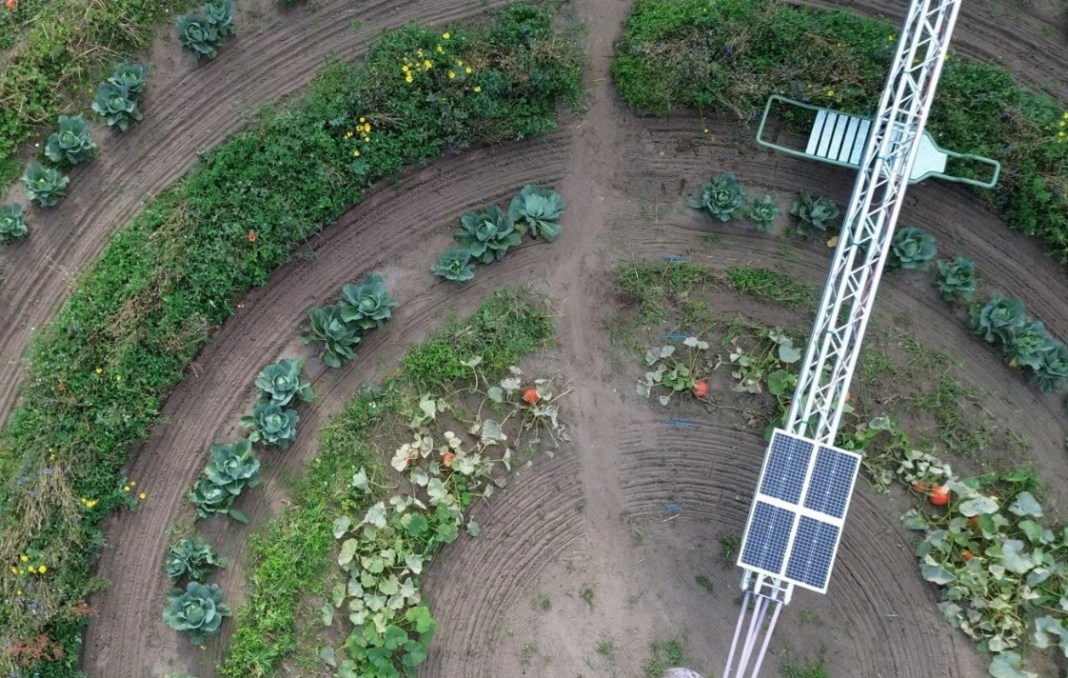
Regenerative circling faming with man, AI, robots and solar power


In the next wave of regenerative agriculture, the farm is no longer a grid of efficiency but a living circle—with the human spirit at its core. Instead of replacing the farmer, AI and robotics now orbit like silent companions, extending our hands rather than erasing them. A rotating robotic arm moves through the plot not as a master, but as an assistant, guided by ecological intelligence and human intuition. This is not automation for profit—it’s a return to sacred design, where technology becomes humble, circular, and in service to the soil, the grower, and the wider web of life.

During Covid, when the world lost its bearings and I feared the global food distribution system would snap like a dry twig, I did the only sensible thing a mother could do: I built a garden. Not a Pinterest garden, but a functional, wartime-style victory garden (download the original here), a mashup of raised Middle Eastern circular plant beds with permaculture herbs spiraling from the center, borrowing wisdom from desert farmers and American agricultural resilience manuals from the 1940s. We planted beans, cucumbers, tomatoes, molokhia (it grows faster than hemp), lettuce, zucchinis, melons and more.

The reward wasn’t just food security — it was witnessing life return. Birds began swooping low to take a peek and eat bugs during the day, chasing the pollinators that came to kiss the flowers. A watermelon I planted was one day the  size of an egg and then ballooned into a full, striped universe almost overnight, as if showing me how quickly life responds when humans step back and design with respect. Life happens!

Floris Schoonderbeek

Now, in a strange and beautiful echo of my inherited Dutch farming ancestry, a Dutch industrial designer, Floris Schoonderbeek, is proposing a new way to farm — in circles, not squares. They call it Circle Farming, an invention that I see it as a technological reverence for something ancient. Farming in circles in the Middle East isn’t new. Look from above and you will see circular crops irrigated in Libyan deserts. 
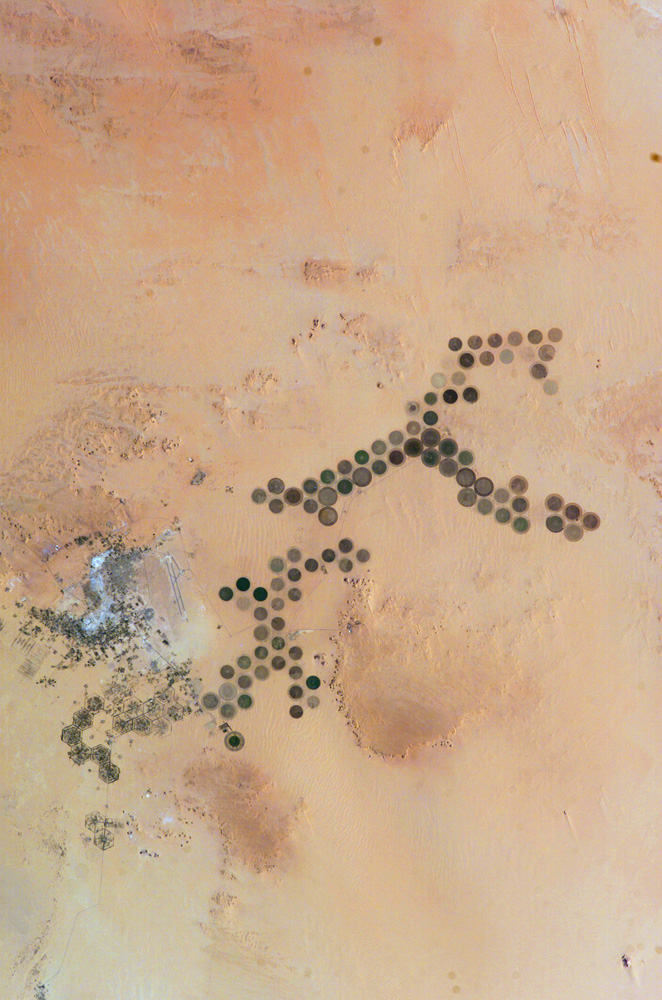
Pivot irrigation is used in California and Libya but the scale of farming takes out the “man” in the center

The Al Khufrah Oasis in southeastern Libya, near the Egyptian border (photo above is from 2004), is one of the country’s largest agricultural developments and a distinct geometric landmark of pivot irrigation is easily spotted by astronauts aboard the International Space Station. Since only about 2 percent of Libya’s land receives enough rainfall for farming, the project relies entirely on fossil water pumped from a deep underground aquifer. In tandem, the Libyan government launched the Great Man-Made River project to transport these groundwater reserves to the coast to support population growth and industrial expansion.

Today, parts of the system are still functioning, but years of conflict. the death of Gaddafi, and lack of maintenance have reduced its reliability. While water continues to reach some agricultural and urban areas, the original vision of full capacity and expansion has largely stalled.

circle farming innovation, regenerative agriculture technology, human centered farming design, AI farming robotics, circular agro design future, sustainable robotic agriculture, next gen irrigation AI, farmer and robot collaboration, regenerative farm architecture, circular plot farming AI arm, tech supported agriculture human, modern agro robotics design, future of farming circular systems, agroecology meets technology, precision farming circular layout, man at center agriculture tech, AI powered permaculture circle, robotic irrigation regenerative design, tech for soil healing, circular farming reinvented, sustainable agro robotics harmony, farm technology without replacing farmers
Circle Farming founder enjoying his work on the farm without breaking his back

But the Dutch, famous for stubbornly living and growing on land that is supposed to be emerged are updating the instead of plowing rectangles with tractors, a robotic arm is fixed at the center of a 30-meter circle. It moves slowly, like a clock hand made of steel, pulling familiar agricultural tools behind it — for weeding, watering, even harvesting — except now without carving brutal tire tracks through the earth. The land between circles is left untouched — a commons for insects, wildflowers, birds, even humans to linger. Farming becomes a woven pattern instead of an industrial grid.

Each circular strip holds a different crop, creating a precision-farming mandala that’s both productive and biodiverse. Sensors and AI whisper data back to the farmer — moisture here, pest pressure there — giving advice like an oracle rather than a command chain.

Workers aren’t expected to bend and break their spines in the fields. Instead, they lie belly-down on suspended beds attached to the rotating arm, gliding over the crops with dignity — hovering like dragonflies as they weed, prune, harvest by hand. It turns farming from grunt labor into something closer to communion with the land.

This model is being designed for small peri-urban farms, the exact kind of places that struggle to compete with industrial agriculture but carry the soul of food sovereignty. It’s automation not as replacement, but as companion. A bridge for urban people longing for meaningful work, who might rather float over lettuce than sit under fluorescent lights answering emails for a salary that buys them tasteless tomatoes.

circle farming innovation, regenerative agriculture technology, human centered farming design, AI farming robotics, circular agro design future, sustainable robotic agriculture, next gen irrigation AI, farmer and robot collaboration, regenerative farm architecture, circular plot farming AI arm, tech supported agriculture human, modern agro robotics design, future of farming circular systems, agroecology meets technology, precision farming circular layout, man at center agriculture tech, AI powered permaculture circle, robotic irrigation regenerative design, tech for soil healing, circular farming reinvented, sustainable agro robotics harmony, farm technology without replacing farmers

This is the new agricultural aesthetic: not tech versus nature, but tech in service to a more intelligent form of nature-culture. Circular design — which ancient farmers, Bedouins, and mothers like me already knew — is returning, this time with robotics and AI strapped in for the ride. What happens when farming becomes beautiful again? When robots don’t dominate, but make room for birds, wildflowers, kids, rest, and wonder?

Greenhouse farming which allows the farmer to adjust micro-specific conditions to the plant is a market dominated by Dutch and Israeli technology. Will the Dutch own regenerative farming? Given the history of farming and efficiency in both of these countries, it will be technology that will be available to all of humanity.

Read up on the history of Dutch irrigation farming

In Israel: Simcha Blass and the perfection of modern drip irrigation in Israel

::Circle Farming

Karin Kloosterman
Karin Kloostermanhttp://www.greenprophet.com
Karin Kloosterman is an award-winning journalist, innovation strategist, and founder of Green Prophet, one of the Middle East’s pioneering sustainability platforms. She has ranked in the Top 10 of Verizon innovation competitions, participated in NASA-linked challenges, and spoken worldwide on climate, food security, and future resilience. With an IoT technology patent, features in Canada’s National Post, and leadership inside teams building next-generation agricultural and planetary systems — including Mars-farming concepts — Karin operates at the intersection of storytelling, science, and systems change. She doesn’t report on the future – she helps design it. Reach out directly to [email protected]

TRENDING

PETA pressures H&M to ban mohair again after new farm abuse investigation

Remember PETA? The group of animal activists that threw...

Ancient Roman strategy game figured out with AI

Two thousand years ago, someone scratched a web of lines into stone in a Roman settlement on the empire’s northern edge. Soldiers, traders, or locals passing time in Coriovallum—now Heerlen in the Netherlands, moved small counters across those lines in a tactical duel of blockade and entrapment.

Astro uses AI to help procure land for renewable energy

For oil-rich, environmentally vigilant Gulf states, Astro isn’t just another startup story. It is a blueprint for accelerating an energy transition that is now existential, not optional.

Kia’s bootcamp trains car mechanics on EVs and the future 

During Bootcamp 1.0 in 2025, their pilot program, Kia trained 87 professional mechanics, and 34 have already secured jobs at local dealerships. Another 50 trainees are currently in training in Morocco.

What Renewable Energy Means for Long-Term Environmental Planning

In the context of American energy policy (setting the stage for the world as oil prices are in USD), the relevance of renewable energy planning is increasingly evident. Federal agencies are preparing final biofuel blending mandates under the Renewable Fuel Standard, with decisions expected early in 2026 after delays that have left investors and producers in limbo.

Should You Invest in the Private Market?

startustartup Unlike public stock exchanges, which offer daily trading, strict...

How to build a 100-year-company

Kongō Gumi is a Japanese construction company, purportedly founded in 578 A.D., making it the world's oldest documented company. What can we learn about building sustainable businesses from them?

From Pilot Plant to Global Stage: How Aduro Clean Technologies’ 2026 Expansion Signals a Turning Point for Chemical Recycling Investors Like Yazan Al Homsi

The company's Next Generation Process (NGP) Pilot Plant in London, Ontario, has officially moved into initial operating campaigns, generating the kind of structured, repeatable data that separates laboratory promise from commercial viability.

How AI Helps SaaS Companies Reduce Repetitive Customer Support Work

SaaS products are designed for large numbers of users with different levels of experience, and also in renewable energy.

Pulling Water from the Air

Faced with water shortage in Amman, Laurie digs up...

Turning Your Energy Consultancy into an LLC: 4 Legal Steps for Founders in Texas

If you are starting a renewable energy business in Texas, learn how to start an LLC by the books.

Tracking the Impacts of a Hydroelectric Dam Along the Tigris River

For the next two months, I'll be taking a break from my usual Green Prophet posts to report on a transnational environmental issue: the Ilısu Dam currently under construction in Turkey, and the ways it will transform life along the Tigris River.

6 Payment Processors With the Fastest Onboarding for SMBs

Get your SMB up and running fast with these 6 payment processors. Compare the quickest onboarding options to start accepting customer payments without delay.

Related Articles

Popular Categories