Living Plastics That Clean Water and Heal Themselves—Powered by Sunlight

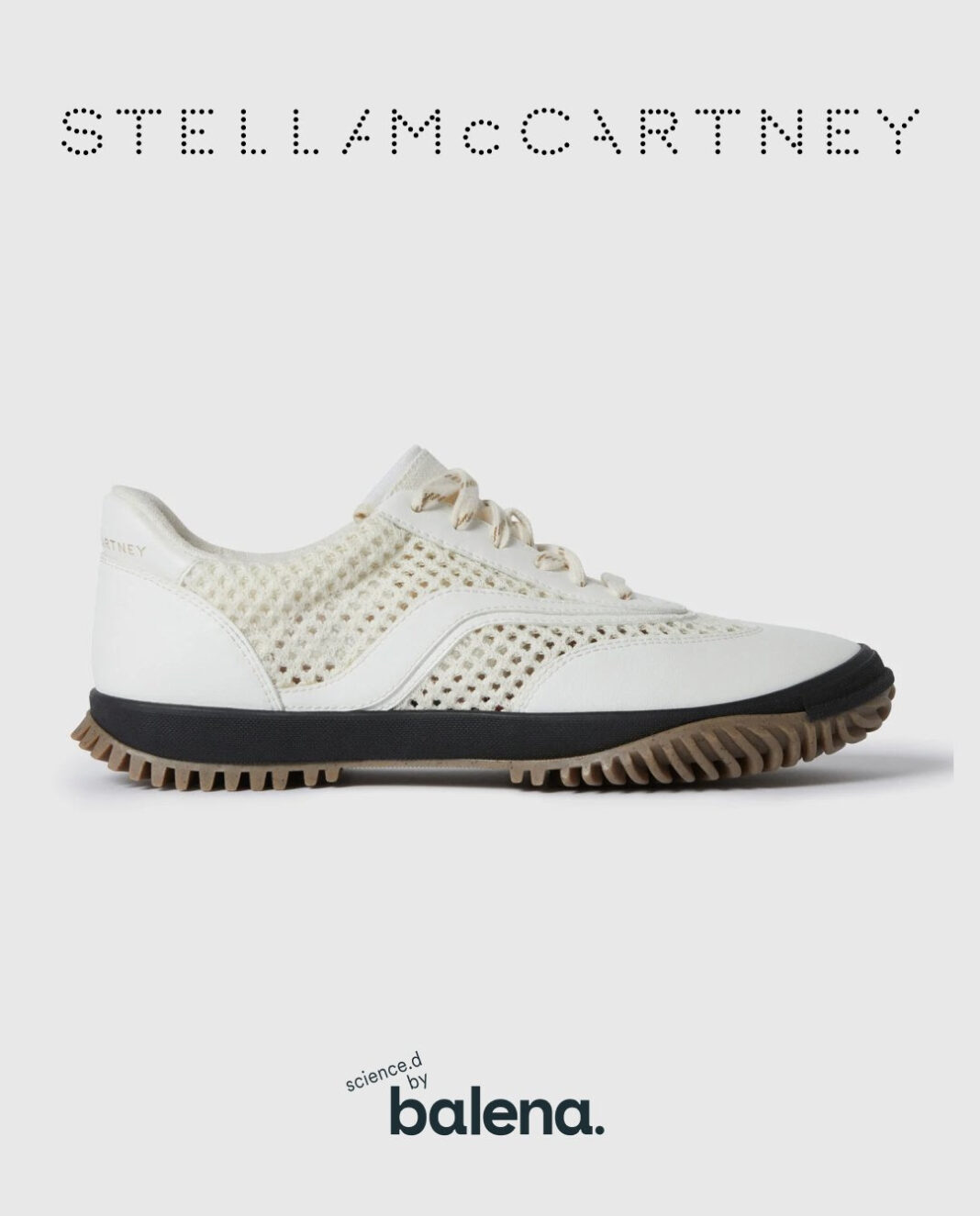
Stella McCartney makes fashion out of a mushroom leather

Imagine a wound dressing that releases oxygen as it heals, or a building material that cleans your wastewater while changing shape with the sun. These futuristic-sounding ideas may soon enter the design mainstream, thanks to new research into Engineered Living Materials (ELMs)—a field funded by DARPA and which stands at the intersection of materials science, microbiology, and sustainability.

A team of researchers at the University of California San Diego has cracked open the toolbox for ELM creation, allowing scientists to work with a much broader range of polymers, even those previously considered toxic to living cells.

Their breakthrough, recently published in the Proceedings of the National Academy of Sciences, uses a diffusion-based method that enables cyanobacteria—sunlight-powered microbes—to infiltrate and transform pre-formed polymers. The result? A living material that can change shape, soften over time, and respond to its environment, all while powered by the sun.

“We have shown for the first time that diffusion is a viable method of creating ELMs,” said co-first author Lisa Tang, a Ph.D. student in chemical engineering at UC San Diego. “This opens the door to using a wider variety of polymers.”

The study was led by Prof. Jinhye Bae (Chemical and Nano Engineering) and Prof. Susan Golden (Molecular Biology), under the umbrella of UCSD’s Materials Research Science and Engineering Center. Co-author Nathan Soulier, a postdoctoral scholar in Golden’s lab, emphasized the scientific impact:

“Such surprising findings highlight the value of studying dynamic, non-equilibrium systems like ELMs.”

A Biotech Renaissance in Material Design

This development could radically influence sustainable design across multiple industries. In the fashion world, Stella McCartney has already collaborated with synthetic biologists at companies like Bolt Threads to develop mycelium leather, an earlier example of living materials. At the MIT Media Lab, designer and materials innovator Neri Oxman has pioneered the concept of “material ecology,” merging computational design with microbial growth and environmental data to create biodegradable architecture and wearables.

stella mccartney fungus
Stella McCartney is going beyond traditional dyes and is using fungus to dye her clothes in Bolt Threads

In Israel, Tel Aviv University’s Prof. Oded Shoseyov (inventor of the Ashpoopie) has been a leader in applying plant and bacterial proteins to smart materials and bio-fabricated textiles, often collaborating with biotech startups on sustainable production methods.
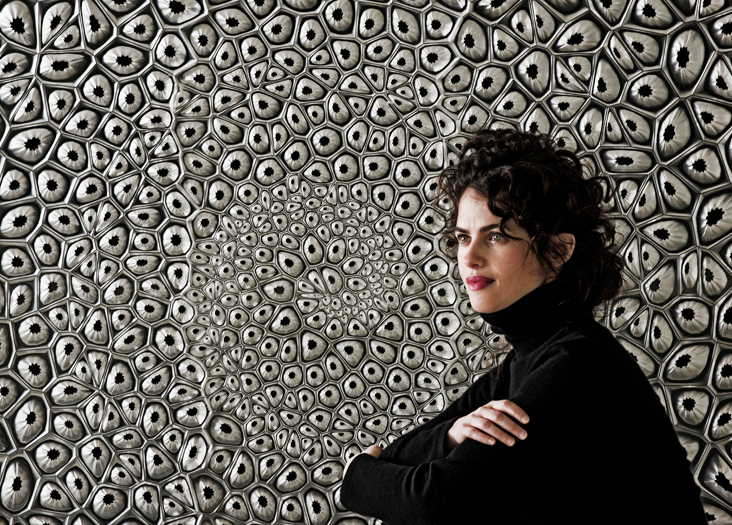
Neri Oxman
Neri Oxman

With the new method developed at UCSD, even synthetic polymers with harsh precursors could now become home to living, functional organisms. In the team’s experiment, they used a shape-memory polymer that expands and contracts with temperature shifts—mimicking a sponge. Once returned to room temperature, the polymer absorbed a suspension of cyanobacteria, which not only survived but thrived—altering the material’s structure and producing enzymes that degraded it in novel ways.

Why It Matters: From Wastewater to Wearables

Bacteria art in a petri dish

Cyanobacteria can be genetically programmed to perform specific tasks, such as breaking down pollutants or producing biofuels—meaning these living materials could clean water, capture carbon, or even sense toxins. And because they run on solar energy, they don’t need batteries or chemical power sources.

Neri Oxman, bacteria in printed fashion

This has major implications for green construction, regenerative medicine, and zero-waste fashion. In architecture, self-healing facades and living insulation could reduce reliance on petroleum-based materials. In medical contexts, bioactive scaffolds could accelerate healing while reducing infection risk.

As demand grows for biodegradable, responsive, and resource-efficient materials, this diffusion-based method could become a cornerstone in post-petroleum design—a path toward truly circular, regenerative systems.

The UCSD team is already exploring how other polymers—those sensitive to pH or capable of conducting electricity—might host living cells. The idea is to create multi-functional, multi-sensory materials that behave more like biological tissues than inert plastic.
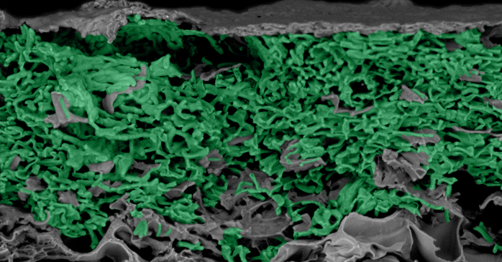
Scanning electron microscope image of an engineered living material created by diffusion of live cyanobacteria cells (green) into poly(N-isopropylacrylamide), a temperature-responsive polymer.

“By integrating photosynthetic organisms into materials science, we can harness the sun’s renewable energy to create valuable materials,” said Bae. “There is a great need for sustainable alternatives to current practices that rely on finite resources.”

In a world running short on raw materials but rich in sunlight and microbial ingenuity, the age of engineered living matter may be just beginning.

LEAVE A REPLY

Please enter your comment!
Please enter your name here

TRENDING

A 3D bra and intimates printed just for you –– and they decompose after use!

What happens when high-tech materials meet heartfelt design? Colombian designer Neyla Coronel has an answer—and it comes in the form of a bra. Made using Balena.Filaflex, a flexible, bio-based and fully compostable filament co-developed by Balena and Recreus, Neyla’s creation is challenging everything we thought we knew about intimate apparel, sustainability, and the power of design to liberate the body.

Printing coral reefs in Abu Dhabi

ADQ, an Abu Dhabi-based investment company, the Environment Agency – Abu Dhabi (EAD), the region’s largest environmental regulator, and Archireef, a climate technology company based in Hong Kong, have deployed artificial 3D printed terracotta reef tiles to aid coral restoration in the Persian Gulf off the shore of Abu Dhabi.

Nyxo’s 3D printed office at Dubai Design Week

3D printing an expo booth, designing a table to look like a desert fossil and a ceramic mug that holds heat; meat Nyxo from Dubai

Innovation in Construction: The interplay between software, hardware and education

Cybe is pushing the boundaries and collaborating with Lab040 in Eindhoven to create the first-ever, 3D printed, four-story apartment.

Sustainable printing tips: How to be more eco-friendly

3D printing means fast, rabid prototyping with less waste. There are all kinds of eco printing, 3D and on paper. Like this printer that builds homes.

Qatar’s climate hypocrisy rides the London Underground

Qatar remains a master of doublethink—burning gas by the megaton while selling “sustainability” to a world desperate for clean air. Wake up from your slumber people.

How Quality of Hire Shapes Modern Recruitment

A 2024 survey by Deloitte found that 76% of talent leaders now consider long-term retention and workforce contribution among their most important hiring success metrics—far surpassing time-to-fill or cost-per-hire. As the expectations for new hires deepen, companies must also confront the inherent challenges in redefining and accurately measuring hiring quality.

8 Team-Building Exercises to Start the Week Off 

Team building to change the world! The best renewable energy companies are ones that function.

Thank you, LinkedIn — and what your Jobs on the Rise report means for sustainable careers

While “green jobs” aren’t always labeled as such, many of the fastest-growing roles are directly enabling the energy transition, climate resilience, and lower-carbon systems: Number one on their list is Artificial Intelligence engineers. But what does that mean? Vibe coding Claude? 

Somali pirates steal oil tankers

The pirates often stage their heists out of Somalia, a lawless country, with a weak central government that is grappling with a violent Islamist insurgency. Using speedboats that swarm the targets, the machine-gun-toting pirates take control of merchant ships and then hold the vessels, crew and cargo for ransom.

Leopoldo Alejandro Betancourt López Turned Ocean Plastic Into Profitable Sunglasses

Few fashion accessories carry the environmental burden of sunglasses. Most frames are constructed from petroleum-based plastics and acrylic polymers that linger in landfills for centuries, shedding microplastics into soil and waterways long after they've been discarded. Leopoldo Alejandro Betancourt López, president of the Spanish eyewear brand Hawkers, saw this problem differently than most industry executives.

Why Dr. Tony Jacob Sees Texas Business Egos as Warning Signs

Everything's bigger in Texas. Except business egos.  Dr. Tony Jacob figured...

Israel and America Sign Renewable Energy Cooperation Deal

Other announcements made at the conference include the Timna Renewable Energy Park, which will be a center for R&D, and the AORA Solar Thermal Module at Kibbutz Samar, the world's first commercial hybrid solar gas-turbine power plant that is already nearing completion. Solel Solar Systems announced it was beginning construction of a 50 MW solar field in Lebrija, Spain, and Brightsource Energy made a pre-conference announcement that it had inked the world's largest solar deal to date with Southern California Edison (SCE).

Related Articles

Popular Categories