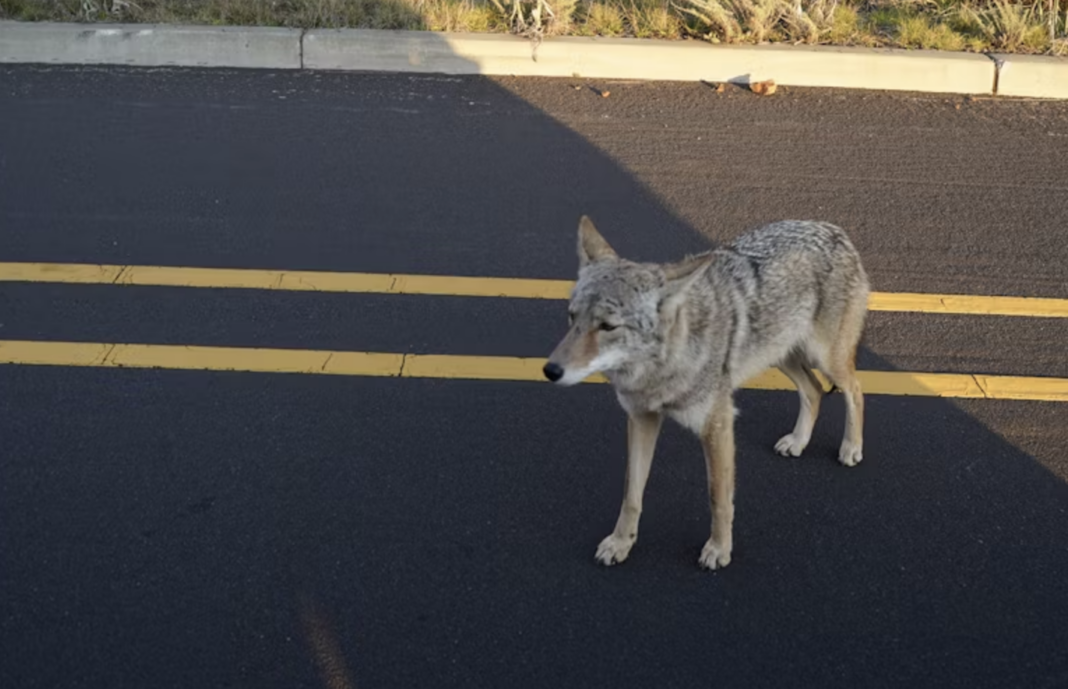
Chicago coyotes live longer around people. You can stop feeling guilty now

coyote in Chicago

As suburbs grow and cottage country expands, how do mammals fare with humans encroaching on wild spaces?  Tracking coyote movement in metropolitan areas shows the animals spend lots of time in natural settings, but a new study suggests the human element of city life has a bigger impact than the environment on urban coyote survival.

Researchers monitoring coyotes in Chicago found that habitat – areas with relatively high levels of vegetation cover and low levels of human infrastructure – did not influence coyote survival in positive or negative ways. Instead, areas densely populated with humans were associated with longer coyote lifespans. This means coyotes lived longer around people than out in the wild.

“What we found was really interesting, in that the societal characteristics seem to play a much more important role in predicting coyote survival time than the environmental characteristics,” said Emily Zepeda from The Ohio State University. “And then we found this positive effect of human population density on survival time. Both of those things are unexpected because we usually associate human activity with detrimental effects on wildlife.”

The study was published recently in the journal Urban Ecosystems.

Urban coyote researchers

The data comes from the Urban Coyote Research Project, a long-term study of coyote ecology in the Chicago Metropolitan Area led by Stan Gehrt, a wildlife ecologist at Ohio State and senior author of the new paper.

Gehrt and colleagues estimate that 4,000 coyotes live in Chicago, one of the largest metropolitan areas in North America. Gehrt’s previous behavioral, genetics and biological studies offer hints at how coyotes have adjusted to life in the city. This new work sought to identify the diverse urban factors that help or hinder their ability to survive.

Putting on a VHF radio-collar

Tracking data on the movement of 214 coyotes living in the Chicago area between 2013 and 2021 was used for the study. The duration of each coyote’s tracking period served as a proxy of its survival time.

Potential factors the researchers predicted would affect urban coyote survival included a mix of societal and environmental characteristics: neighborhood median income, human density and demographics; and road density, parks and golf courses, and “disturbed” regions dominated by infrastructure and vacant land. These factors were analyzed alongside the coyote monitoring data in a statistical model to determine their relationships with survival time.

The results showed a positive relationship between survival rate and human population density – at low human densities, coyote survival was generally low. The data also revealed an interaction between neighborhood income and density: In areas with low human density, median income was not significantly associated with survival, likely due to the absence of humans. However, at moderate and high levels of human density, coyotes in lower-income areas were 1 1/2 times more likely to survive to age 2 than coyotes in high-income areas.

City coyote – coyote attacks are rare

“We’ve hypothesized that population density may have a positive effect because it’s actually providing resources like human-related structures or food that allow coyotes to weather the harsh conditions of the winter, which is a major mortality factor for Chicago coyotes,” Zepeda said.

Plentiful resources might become problematic, she said, when the food and shelter, combined with more vegetation and less pollution in high-income areas, draws a crowd of coyotes – which leads to higher disease transmission and fighting over territory.

“There might be more individuals in those areas, but survival time may be shorter there,” she said. “You might die younger in an area where there are a lot of competitors.”

The findings build on growing evidence that societal processes that benefit and marginalize human populations trickle down to urban ecosystems – suggesting that the presence, or lack, of humans, and the conditions in which they live, has potential to override natural influences on urban wildlife.

And yet, it was surprising not to find a connection between natural habitats and longer survival, Zepeda said, because “anecdotally, we see really high densities of coyotes in nature preserves and urban parks. That’s often where you see coyotes in the city if you see them at all.”

Researchers can only speculate, but Zepeda said it could mean the habitat categories on city maps aren’t specific enough or that hunting and trapping is more common in natural settings. Or it could simply be a sign of how crafty coyotes are.

“It could speak to how adaptable they are that they might prefer natural habitat, but at least in terms of survival, they can do just as well in more urbanized areas,” she sad.

::Urban Coyote Research Project

TRENDING

Microplastics Are Becoming Superbug Highways — New Study Warns Beachgoers to Wear Gloves

Prof. Pennie Lindeque added that microplastics “act as carriers for antimicrobial-resistant bacteria, enhancing their survival and spread… each particle becomes a tiny vehicle capable of transporting pathogens from sewage works to beaches, swimming areas and shellfish-growing sites.”

Who gave the first kiss?

When you experience your first kiss you might feel like you are the first in the world to feel that way. Kissing, scientists say, occurs in a variety of animals (even if today it's not in every culture), and it presents an evolutionary puzzle: kissing, a learned behavior, carries high risks, such as disease transmission like herpes and hepititis, while offering no obvious reproductive or survival advantage.

Biodiversity Blueprint Set for 2026

If we seize this moment, the 2026 review can catalyse a new wave of finance (see Green Finance mechanisms in the UAE), innovation and policy coherence — and move us closer to the vision of a nature-positive world by 2050. If not, the checkpoint risks becoming another missed opportunity while ecosystems, livelihoods and economies continue to degrade.

Tonka Bean Trees Attract Lightning to Win the Rainforest Arms Race—And Science Thinks That’s Electrifying

Lightning is one of the leading natural causes of tree death in tropical forests. The raw voltage and heat from a strike can instantly boil sap, splinter wood, and reduce a once-living organism to charcoal. But not tonka trees.

Six “Green” Reasons To Drink Camel’s Milk

With 5 times the amount of Vitamin C in camel's milk, and full of iron, camel's milk needs no nutritional help. It has a shelf life of 5 days before pasteurization, after which it will survive for up to 3 weeks. Camel's milk is just as versatile as other milk, used as it is to produce low-fat varieties of cheese, chocolate, and a fermented delicacy that is used in areas that lack refrigeration.

Qatar’s climate hypocrisy rides the London Underground

Qatar remains a master of doublethink—burning gas by the megaton while selling “sustainability” to a world desperate for clean air. Wake up from your slumber people.

How Quality of Hire Shapes Modern Recruitment

A 2024 survey by Deloitte found that 76% of talent leaders now consider long-term retention and workforce contribution among their most important hiring success metrics—far surpassing time-to-fill or cost-per-hire. As the expectations for new hires deepen, companies must also confront the inherent challenges in redefining and accurately measuring hiring quality.

8 Team-Building Exercises to Start the Week Off 

Team building to change the world! The best renewable energy companies are ones that function.

Thank you, LinkedIn — and what your Jobs on the Rise report means for sustainable careers

While “green jobs” aren’t always labeled as such, many of the fastest-growing roles are directly enabling the energy transition, climate resilience, and lower-carbon systems: Number one on their list is Artificial Intelligence engineers. But what does that mean? Vibe coding Claude? 

Somali pirates steal oil tankers

The pirates often stage their heists out of Somalia, a lawless country, with a weak central government that is grappling with a violent Islamist insurgency. Using speedboats that swarm the targets, the machine-gun-toting pirates take control of merchant ships and then hold the vessels, crew and cargo for ransom.

Leopoldo Alejandro Betancourt López Turned Ocean Plastic Into Profitable Sunglasses

Few fashion accessories carry the environmental burden of sunglasses. Most frames are constructed from petroleum-based plastics and acrylic polymers that linger in landfills for centuries, shedding microplastics into soil and waterways long after they've been discarded. Leopoldo Alejandro Betancourt López, president of the Spanish eyewear brand Hawkers, saw this problem differently than most industry executives.

Why Dr. Tony Jacob Sees Texas Business Egos as Warning Signs

Everything's bigger in Texas. Except business egos.  Dr. Tony Jacob figured...

Israel and America Sign Renewable Energy Cooperation Deal

Other announcements made at the conference include the Timna Renewable Energy Park, which will be a center for R&D, and the AORA Solar Thermal Module at Kibbutz Samar, the world's first commercial hybrid solar gas-turbine power plant that is already nearing completion. Solel Solar Systems announced it was beginning construction of a 50 MW solar field in Lebrija, Spain, and Brightsource Energy made a pre-conference announcement that it had inked the world's largest solar deal to date with Southern California Edison (SCE).

Related Articles

Popular Categories