Meet the Marsh Arabs of Iraq at Dubai Design Week

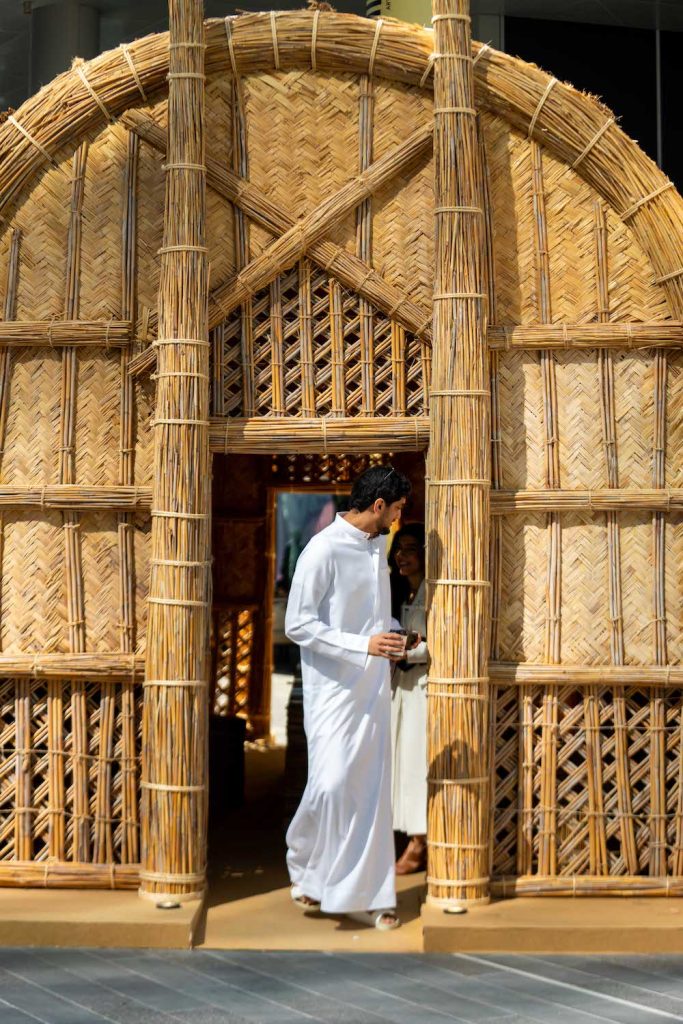
Mudhif, from the Arab Marsh people built at Dubai Design Week

We got so much international attention when we wrote about the Iraqi mudhouse called a mudhif built with US veterans and Iraqi refugees in the US. You can read the story here. Vernacular architecture is that built without a plan by local people is taking the world by storm as people consciously and subconsciously are drawn to simpler times when design was functional and from materials that nature made.

Mudhif

Mudhif, from the Arab Marsh people built at Dubai Design Week

The proof is in the pudding at Dubai Design Week where a designer from Kuwait, with Mesopotamian origins, recreates an Iraqi or Mesopotamian mudhouse. Don’t you feel like you’d like to step inside?

Mudhif, from the Arab Marsh people built at Dubai Design Week

Mudhif, from the Arab Marsh people built at Dubai Design Week

In the US they were constructed of phragmites, an invasive reed grass, and built on the grounds of the Schuylkill Center for Environmental Education in Northwest Philadelphia.

Ola Znad, the designer, turns the traditional gathering place for Marsh Arab communities into a multi-sensory experience. The buildings were designed, of course, for centuries before without any one person taking claim. She says they were crafted in Iraq from locally sourced reeds and mud: the materials that have supported Marsh Arab communities for generations.

According to the paper The Ecology of the Mudhif, the mudhif was built and used, by the Marsh Arabs of the region, until 1993 when Saddam Hussein began to drain and dam the marshes, in an attempt to destroy the life and culture of those Arabs. But after his defeat 10 years later in 2003, the Arabs dug up his dykes, canals and damns, re-flooded the marshes and began to resume their ancient way of life.

Inherently nomadic, the author muses: “the prejudice against a fixed life is strong, only the lowest of the tribe will condescend to remain stationary; but change is in progress.”
Related: What is Vernacular Architecture

The paper notes that mudhifs were built by the culture which not only developed the world’s first cities, with their great mud-brick ziggurats and temples; it also invented writing, for the keeping of temple records. And of course, for sustenance, the cities had to be surrounded by agricultural villages hence, in the marshes, buildings constructed entirely of reeds. Is this why our pull toward them is strong?

Related: read about the origins of writing in Iraq

By portraying the Mudhif as an open and inclusive space, Znad says she “reflects the traditional architecture of the Marsh Arabs and emphasizes the contemporary need for sustainable design.”

This is true in every culture everywhere especially the UAE which has designed itself out of the desert from scratch over the last 50 years. It may be why cardboard was also featured this year. We are all going back to the basics.

Enjoy the photos and if you are at the Dubai Design Week this week drop us a line.


Karin Kloosterman
Karin Kloostermanhttp://www.greenprophet.com
Karin Kloosterman is an award-winning journalist, innovation strategist, and founder of Green Prophet, one of the Middle East’s pioneering sustainability platforms. She has ranked in the Top 10 of Verizon innovation competitions, participated in NASA-linked challenges, and spoken worldwide on climate, food security, and future resilience. With an IoT technology patent, features in Canada’s National Post, and leadership inside teams building next-generation agricultural and planetary systems — including Mars-farming concepts — Karin operates at the intersection of storytelling, science, and systems change. She doesn’t report on the future – she helps design it. Reach out directly to [email protected]

TRENDING

Emergency housing and refugee shelters made from mud

Rather than treating displacement as a temporary emergency, this project is reframed as a human condition requiring stability, community, and dignity. By combining vernacular wisdom with adaptable modular planning, the project offers a model for refugee housing that is scalable, low-carbon, and deeply respectful of local identity. For Somalia’s displaced families, a mud-brick home may be the most modern solution of all.

Inca Hernández Brings Liwa Farm Village to Life in Abu Dhabi, Rooted in Desert Heritage

Greenhouses, aquaculture systems, and crops of lemongrass and lavender tie the project to contemporary concerns: food security, ecological resilience, and sustainable livelihoods in a fragile region facing climate extremes. 

Ancient mud buildings in the Muslim world are spectacular and sustainable

Other notable mud structures in the wider Muslim world include the Bob Dioulasso Grand Mosque in Burkina Faso, and the Khiva Wall in Uzbekistan, which is built around a collection of Islamic schools and mosques. The Siwa Oasis in Egypt (which we visited and posted about here) and the Eastern Castle in Syria have also employed mud bricks in their construction, and research shows that the famous walls of Jericho were built using sun-dried mud bricks.

Make mersu, the oldest known dessert in history

Mersu is energy-dense and sweet—think of it as a Bronze Age power snack.

5 Brilliant eco-architect alternatives to Foster + Partners

In the world of architecture and design, there’s a growing movement towards exploring new, uncharted territories. While renowned firms like Foster + Partners and Zaha Hadid have undeniably shaped the skyline of modern architecture, there’s a wealth of untapped potential in emerging voices that can offer bold, innovative, and sustainable alternatives. These next five studios are pushing the boundaries of creativity, blending technology with art, and designing spaces that respond to the future needs of communities and the planet. Let’s take a closer look at these pioneers who are crafting tomorrow’s architectural landscape today.

Turning Your Energy Consultancy into an LLC: 4 Legal Steps for Founders in Texas

If you are starting a renewable energy business in Texas, learn how to start an LLC by the books.

Tracking the Impacts of a Hydroelectric Dam Along the Tigris River

For the next two months, I'll be taking a break from my usual Green Prophet posts to report on a transnational environmental issue: the Ilısu Dam currently under construction in Turkey, and the ways it will transform life along the Tigris River.

6 Payment Processors With the Fastest Onboarding for SMBs

Get your SMB up and running fast with these 6 payment processors. Compare the quickest onboarding options to start accepting customer payments without delay.

Qatar’s climate hypocrisy rides the London Underground

Qatar remains a master of doublethink—burning gas by the megaton while selling “sustainability” to a world desperate for clean air. Wake up from your slumber people.

How Quality of Hire Shapes Modern Recruitment

A 2024 survey by Deloitte found that 76% of talent leaders now consider long-term retention and workforce contribution among their most important hiring success metrics—far surpassing time-to-fill or cost-per-hire. As the expectations for new hires deepen, companies must also confront the inherent challenges in redefining and accurately measuring hiring quality.

8 Team-Building Exercises to Start the Week Off 

Team building to change the world! The best renewable energy companies are ones that function.

Thank you, LinkedIn — and what your Jobs on the Rise report means for sustainable careers

While “green jobs” aren’t always labeled as such, many of the fastest-growing roles are directly enabling the energy transition, climate resilience, and lower-carbon systems: Number one on their list is Artificial Intelligence engineers. But what does that mean? Vibe coding Claude? 

Somali pirates steal oil tankers

The pirates often stage their heists out of Somalia, a lawless country, with a weak central government that is grappling with a violent Islamist insurgency. Using speedboats that swarm the targets, the machine-gun-toting pirates take control of merchant ships and then hold the vessels, crew and cargo for ransom.

Related Articles

Popular Categories