Landing spots for Moon to Mars mission selected

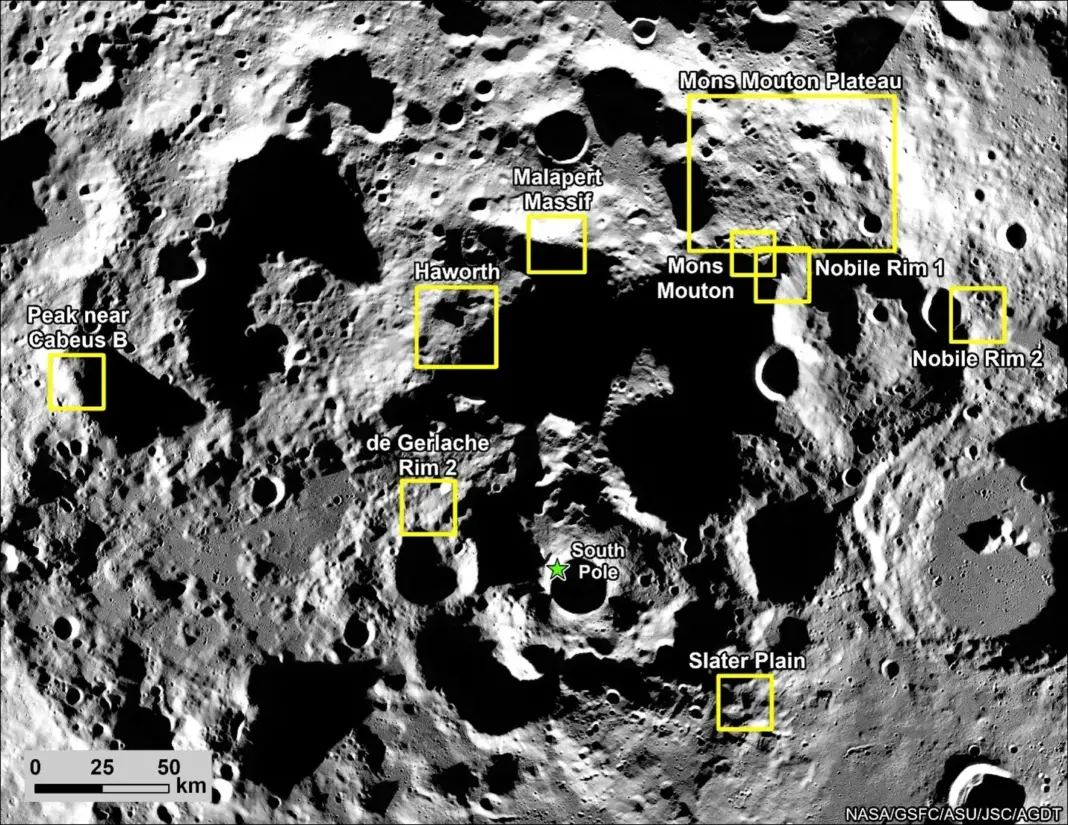
This image shows nine candidate landing regions for NASA’s Artemis III mission, with each region containing multiple potential sites for the first crewed landing on the Moon in more than 50 years. The background image of the lunar South Pole terrain within the nine regions is a mosaic of LRO (Lunar Reconnaissance Orbiter) WAC (Wide Angle Camera) images.Credit: NASA
This image shows nine candidate landing regions for NASA’s Artemis III mission, with each region containing multiple potential sites for the first crewed landing on the Moon in more than 50 years. The background image of the lunar South Pole terrain within the nine regions is a mosaic of LRO (Lunar Reconnaissance Orbiter) WAC (Wide Angle Camera) images. Credit: NASA

America’s space agency NASA has identified nine potential landing regions for its upcoming Artemis III mission, the first crewed Moon landing since 1972.

The regions are all near the lunar South Pole, an area of the Moon that has never been explored. Selection criteria included terrain suitability, lighting conditions and communication capabilities with Earth.

“The Moon’s South Pole is a completely different environment than where we landed during the Apollo missions,” says Sarah Noble, Artemis lunar science lead. “It offers access to some of the Moon’s oldest terrain, as well as cold, shadowed regions that may contain water and other compounds.”

Related: read all about space junk

These regions contain diverse geological characteristics and offer flexibility for mission availability. The lunar South Pole has never been explored by a crewed mission and contains permanently shadowed areas that can preserve resources, including water.

The refined candidate Artemis III lunar landing regions are, in no priority order:

  • Peak near Cabeus B
  • Haworth
  • Malapert Massif
  • Mons Mouton Plateau
  • Mons Mouton
  • Nobile Rim 1
  • Nobile Rim 2
  • de Gerlache Rim 2
  • Slater Plain

To select these landing regions, a multidisciplinary team of scientists and engineers analyzed the lunar South Pole region using data from NASA’s Lunar Reconnaissance Orbiter and a vast body of lunar science research.

Factors in the selection process included science potential, launch window availability, terrain suitability, communication capabilities with Earth, and lighting conditions. Additionally, the team assessed the combined trajectory capabilities of NASA’s SLS (Space Launch System) rocket, the Orion spacecraft, and Starship HLS (Human Landing System) to ensure safe and accessible landing sites.

Read more: on light pollution

“Artemis III will be the first time that astronauts will land in the south polar region of the Moon. They will be flying on a new lander into a terrain that is unique from our past Apollo experience,” said Jacob Bleacher, NASA’s chief exploration scientist. “Finding the right locations for this historic moment begins with identifying safe places for this first landing, and then trying to match that with opportunities for science from this new place on the Moon.”

NASA’s site assessment team will engage the lunar science community through conferences and workshops to gather data, build geologic maps, and assess the regional geology of eventual landing sites. The team also will continue surveying the entire lunar South Pole region for science value and mission availability for future Artemis missions. This will include planning for expanded science opportunities during Artemis IV, and suitability for the LTV (Lunar Terrain Vehicle) as part of Artemis V.

Related: NASA heads to Jupiter moon to look for water

Under NASA’s Artemis campaign, the agency will establish the foundation for long-term scientific exploration at the Moon, land the first woman, first person of color, and its first international partner astronaut on the lunar surface, and prepare for human expeditions to Mars for the benefit of all.

More on the mission here

TRENDING

What a martian ice age left behind tells us about our future

We have heard that peak climate change might be...

Perseverance Rover Uncovers Ancient Martian Chemistry — And Raises the Question: Could This Hint at Past Life?

On Earth, similar mineral–organic interactions can be biological or abiotic. In Jezero Crater, the long geological timescales suggest the reduced vivianite and sulfides may have formed without biology — but organic compounds could still have driven the chemistry.

The Satellite That Sees Earth Breathe: How NISAR Could Transform Sustainability From Space

Critically, NISAR’s data will be publicly available. That means not only scientists and governments, but also nonprofits, local planners, and startups can build tools and services using the data.

Space travel sunscreen found in new fungus experiment

Moving to Mars? He's a new fungus-based sunscreen to...

Why Is the Martian Night Sky So Bright? New NASA Video Sheds Light on the Red Planet’s Glow

Another factor is sunlight scattering at high altitudes. Even though the Sun sets on Mars just as it does on Earth, light continues to scatter off the high-altitude dust, keeping the sky bright for hours. This is why astronauts may one day be able to navigate or work during the “night” without artificial lighting—at least in the early evening.

Qatar’s climate hypocrisy rides the London Underground

Qatar remains a master of doublethink—burning gas by the megaton while selling “sustainability” to a world desperate for clean air. Wake up from your slumber people.

How Quality of Hire Shapes Modern Recruitment

A 2024 survey by Deloitte found that 76% of talent leaders now consider long-term retention and workforce contribution among their most important hiring success metrics—far surpassing time-to-fill or cost-per-hire. As the expectations for new hires deepen, companies must also confront the inherent challenges in redefining and accurately measuring hiring quality.

8 Team-Building Exercises to Start the Week Off 

Team building to change the world! The best renewable energy companies are ones that function.

Thank you, LinkedIn — and what your Jobs on the Rise report means for sustainable careers

While “green jobs” aren’t always labeled as such, many of the fastest-growing roles are directly enabling the energy transition, climate resilience, and lower-carbon systems: Number one on their list is Artificial Intelligence engineers. But what does that mean? Vibe coding Claude? 

Somali pirates steal oil tankers

The pirates often stage their heists out of Somalia, a lawless country, with a weak central government that is grappling with a violent Islamist insurgency. Using speedboats that swarm the targets, the machine-gun-toting pirates take control of merchant ships and then hold the vessels, crew and cargo for ransom.

Leopoldo Alejandro Betancourt López Turned Ocean Plastic Into Profitable Sunglasses

Few fashion accessories carry the environmental burden of sunglasses. Most frames are constructed from petroleum-based plastics and acrylic polymers that linger in landfills for centuries, shedding microplastics into soil and waterways long after they've been discarded. Leopoldo Alejandro Betancourt López, president of the Spanish eyewear brand Hawkers, saw this problem differently than most industry executives.

Why Dr. Tony Jacob Sees Texas Business Egos as Warning Signs

Everything's bigger in Texas. Except business egos.  Dr. Tony Jacob figured...

Israel and America Sign Renewable Energy Cooperation Deal

Other announcements made at the conference include the Timna Renewable Energy Park, which will be a center for R&D, and the AORA Solar Thermal Module at Kibbutz Samar, the world's first commercial hybrid solar gas-turbine power plant that is already nearing completion. Solel Solar Systems announced it was beginning construction of a 50 MW solar field in Lebrija, Spain, and Brightsource Energy made a pre-conference announcement that it had inked the world's largest solar deal to date with Southern California Edison (SCE).

Related Articles

Popular Categories