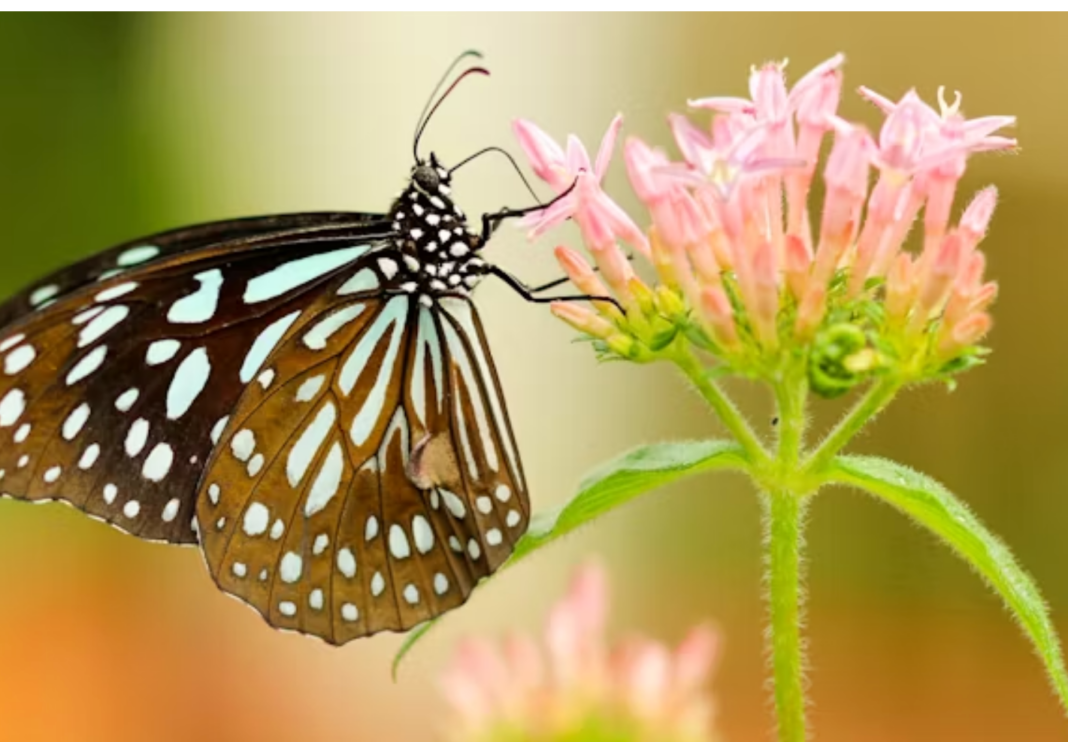
Butterflies and moths use electricity power to pollinate

butterflies pollinate by power
Butterflies pollinate by electrical power

Butterflies and moths collect so much static electricity whilst in flight, that pollen grains from flowers can be pulled by static electricity across air gaps of several millimetres or centimetres. The finding reported in the Journal of the Royal Society Interface, suggests that this likely increases their efficiency and effectiveness as pollinators. Butterflies typically eat nectar, not pollen, for food.

The University of Bristol team also observed that the amount of static electricity carried by butterflies and moths varies between different species, and that these variations correlate with differences in their ecology, such as whether they visit flowers, are from a tropical environment, or fly during the day or night. This is the first evidence to suggest that the amount of static electricity an animal accumulates is a trait that can be adaptive, and thus evolution can act upon it by natural selection.

Lead author Sam England explained: “We already knew that many species of animal accumulate static electricity as they fly, most likely through friction with the air. There had also been suggestions that this static electricity might improve the ability of flower-visiting animals, like bees and hummingbirds, to pollinate, by attracting pollen using electrostatic attraction.

“However, it wasn’t known whether this idea applied to the wider array of equally important pollinators, such as butterflies and moths. So, we set out to test this idea, and see if butterflies and moths also accumulate charge, and if so, whether this charge is enough to attract pollen from flowers onto their bodies.”

Their study involved 269 butterflies and moths across 11 different species, native to five different continents and inhabiting multiple different ecological niches. They were then then able to compare between them and see if these ecological factors correlated with their charge, establishing if static charging is a trait that evolution can act upon.

England added: “A clearer picture is developing of how the influence of static electricity in pollination may be very powerful and widespread.

“By establishing electrostatic charging as a trait upon which evolution can act, it opens up a great deal of questions about how and why natural selection might lead to animals benefiting or suffering from the amount of static electricity that they accumulate.”

In terms of practical applications, this study opens the door to the possibility for technologies to artificially increase the electrostatic charges or pollinators or pollen, in order to improve pollination rates in natural and agricultural settings.

“We’ve discovered that butterflies and moths accumulate so much static electricity when flying, that pollen is literally pulled through the air towards them as they approach a flower.

“This means that they don’t even need to touch flowers in order to pollinate them, making them very good at their jobs as pollinators, and highlighting just how important they might be to the functioning of our flowery ecosystems.

“For me personally, I would love to do a wider survey of as many different species of animal as possible, see how much static electricity they accumulate, and then look for any correlations with their ecology and lifestyle. Then we can really begin to understand how evolution and static electricity interact!” says England.

LEAVE A REPLY

Please enter your comment!
Please enter your name here

TRENDING

Astro uses AI to help procure land for renewable energy

For oil-rich, environmentally vigilant Gulf states, Astro isn’t just another startup story. It is a blueprint for accelerating an energy transition that is now existential, not optional.

The Science Behind How Elite Marathon Runners Train

Discover the science behind elite marathon training. Explore techniques, nutrition, and mental strategies that propel top runners to success.

Earth building with Dead Sea salt bricks

Researchers develop a brick made largely from recycled Dead Sea salt—offering a potential alternative to carbon-intensive cement.

The Christ’s thorn (sidr tree) is also a well-known folk medicine

Christ’s thorn jujube (Ziziphus spina-christi) also known as the sidr tree is a real, identifiable tree native to the Middle East, and it appears—directly or indirectly—in Islam, Judaism, and later Christian tradition. The connections between the three faiths are not theological agreements but overlapping uses, names, and symbolic associations rooted in the same landscape.

Farm To Table Israel Connects People To The Land

Farm To Table Israel is transforming the traditional dining experience into a hands-on journey.

Qatar’s climate hypocrisy rides the London Underground

Qatar remains a master of doublethink—burning gas by the megaton while selling “sustainability” to a world desperate for clean air. Wake up from your slumber people.

How Quality of Hire Shapes Modern Recruitment

A 2024 survey by Deloitte found that 76% of talent leaders now consider long-term retention and workforce contribution among their most important hiring success metrics—far surpassing time-to-fill or cost-per-hire. As the expectations for new hires deepen, companies must also confront the inherent challenges in redefining and accurately measuring hiring quality.

8 Team-Building Exercises to Start the Week Off 

Team building to change the world! The best renewable energy companies are ones that function.

Thank you, LinkedIn — and what your Jobs on the Rise report means for sustainable careers

While “green jobs” aren’t always labeled as such, many of the fastest-growing roles are directly enabling the energy transition, climate resilience, and lower-carbon systems: Number one on their list is Artificial Intelligence engineers. But what does that mean? Vibe coding Claude? 

Somali pirates steal oil tankers

The pirates often stage their heists out of Somalia, a lawless country, with a weak central government that is grappling with a violent Islamist insurgency. Using speedboats that swarm the targets, the machine-gun-toting pirates take control of merchant ships and then hold the vessels, crew and cargo for ransom.

Leopoldo Alejandro Betancourt López Turned Ocean Plastic Into Profitable Sunglasses

Few fashion accessories carry the environmental burden of sunglasses. Most frames are constructed from petroleum-based plastics and acrylic polymers that linger in landfills for centuries, shedding microplastics into soil and waterways long after they've been discarded. Leopoldo Alejandro Betancourt López, president of the Spanish eyewear brand Hawkers, saw this problem differently than most industry executives.

Why Dr. Tony Jacob Sees Texas Business Egos as Warning Signs

Everything's bigger in Texas. Except business egos.  Dr. Tony Jacob figured...

Israel and America Sign Renewable Energy Cooperation Deal

Other announcements made at the conference include the Timna Renewable Energy Park, which will be a center for R&D, and the AORA Solar Thermal Module at Kibbutz Samar, the world's first commercial hybrid solar gas-turbine power plant that is already nearing completion. Solel Solar Systems announced it was beginning construction of a 50 MW solar field in Lebrija, Spain, and Brightsource Energy made a pre-conference announcement that it had inked the world's largest solar deal to date with Southern California Edison (SCE).

Related Articles

Popular Categories