Who was Mária Telkes, the solar energy Sun Queen?

Mária Telkes, solar energy pioneer

Mária Telkes, a solar energy pioneer. The Hungarian-American biophysicist and inventor Mária Telkes pioneered solar energy by inventing a solar oven, a solar desalination kit and, in the late 1940s, she helped design one of the first solar-heated houses.

Mária Telkes, born on December 12, 1900, in Budapest, Hungary, emerged as a solar energy pioneer long before the world would turn to renewable energy. She invented a solar oven, a solar desalination kit and, in the late 1940s, she helped design one of the first solar-heated houses. She is known as the Sun Queen.


Telkes, who came from a Jewish family that converted to Christianity, studied at the University of Budapest and then later in Switzerland at the University of Geneva where she mastered chemistry and physics, and earned a Ph.D. in 1924.

In 1925, while visiting her uncle in Cleveland, USA, she worked along the renowned surgeon George Washington Crile who performed the first successful blood transfusion.

Telkes dedicated the next 12 years of her life to researching the energy changes cells undergo during death or cancer, resulting in the publication of their findings in a collaborative book.

Upon becoming an American in 1937, Telkes joined Westinghouse Electric, where her focus shifted towards solar energy in 1939 upon becoming a member of the Massachusetts Institute of Technology’s (MIT) Solar Energy Conversion project.

As the world grappled with the Second World War, Telkes was enlisted by the Office of Scientific Research and Development (OSRD), which worked on the Manhattan Project. Her task was to leverage solar energy to transform salty water into drinkable water, addressing the critical issue of dehydration faced by soldiers at sea.
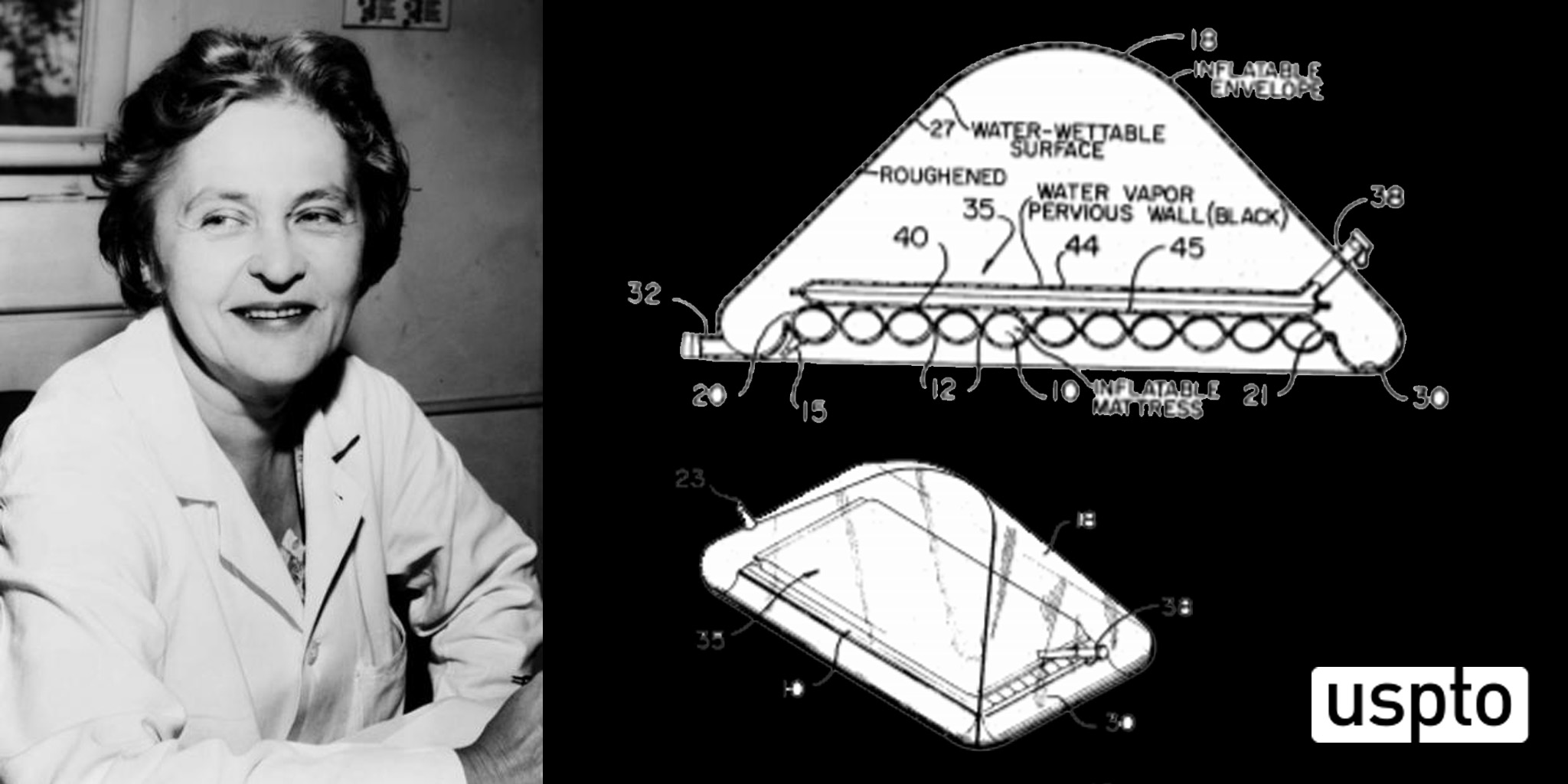
Maria Telkes invention so soldiers could drink water at sea
Maria Telkes solar energy invention so soldiers could drink water at sea

In response, Telkes invented the first solar water distillation device, capable of producing one liter of drinkable water per day using seawater. This innovation quickly became a standard component in every soldier’s pack, earning her a merit from OSRD for her invaluable contribution.
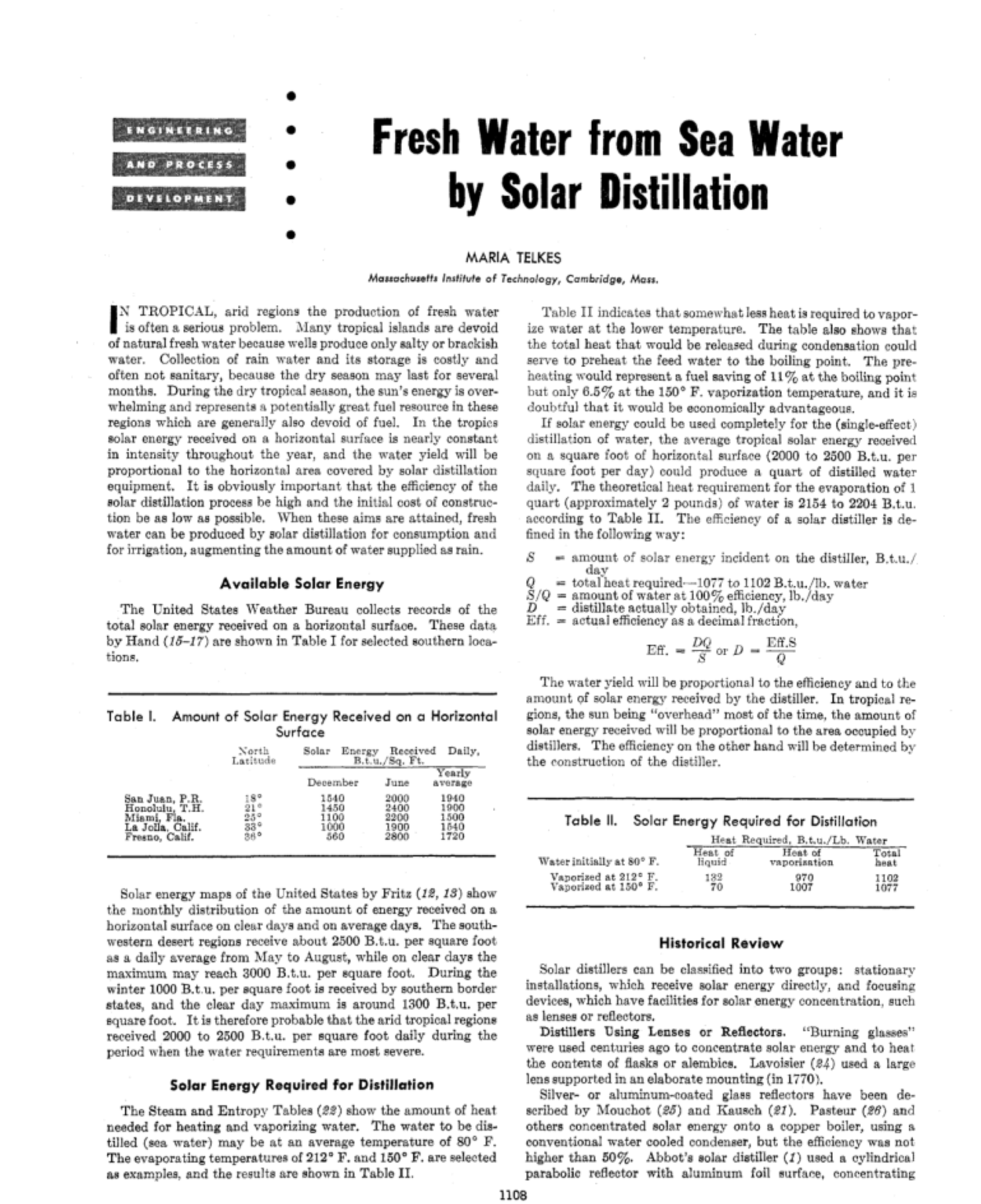
Maria Telkes saltwater sea solar energy paper
Maria Telkes dscribed the science of solar desalination in this paper from 1953

However, Telkes’ most renowned invention was the creation of the first solar house in 1948, the Dover Sun House, near Boston, designed by Eleanor Raymond and tested by the Némethy family, Telkes’ relatives.

Maria Telkes and the Dover Sun House image
Maria Telkes and the Dover Sun House. The large windows faced the sun and collected heat and stored the energy in salts. Dover Sun House was one of the world’s first solar-heated houses. It was designed by architect Eleanor Raymond and had a heating system developed by physicist Mária Telkes. Client Amelia Peabody made it noteworthy for being “exclusively a feminine project.”

To tackle the challenge of storing solar energy for use on cloudy days, Telkes ingeniously employed a glauber salt solution (natrium sulfuricium) with a low melting point (32 °C) and high enthalpy of fusion, capable of storing solar energy for up to ten days.
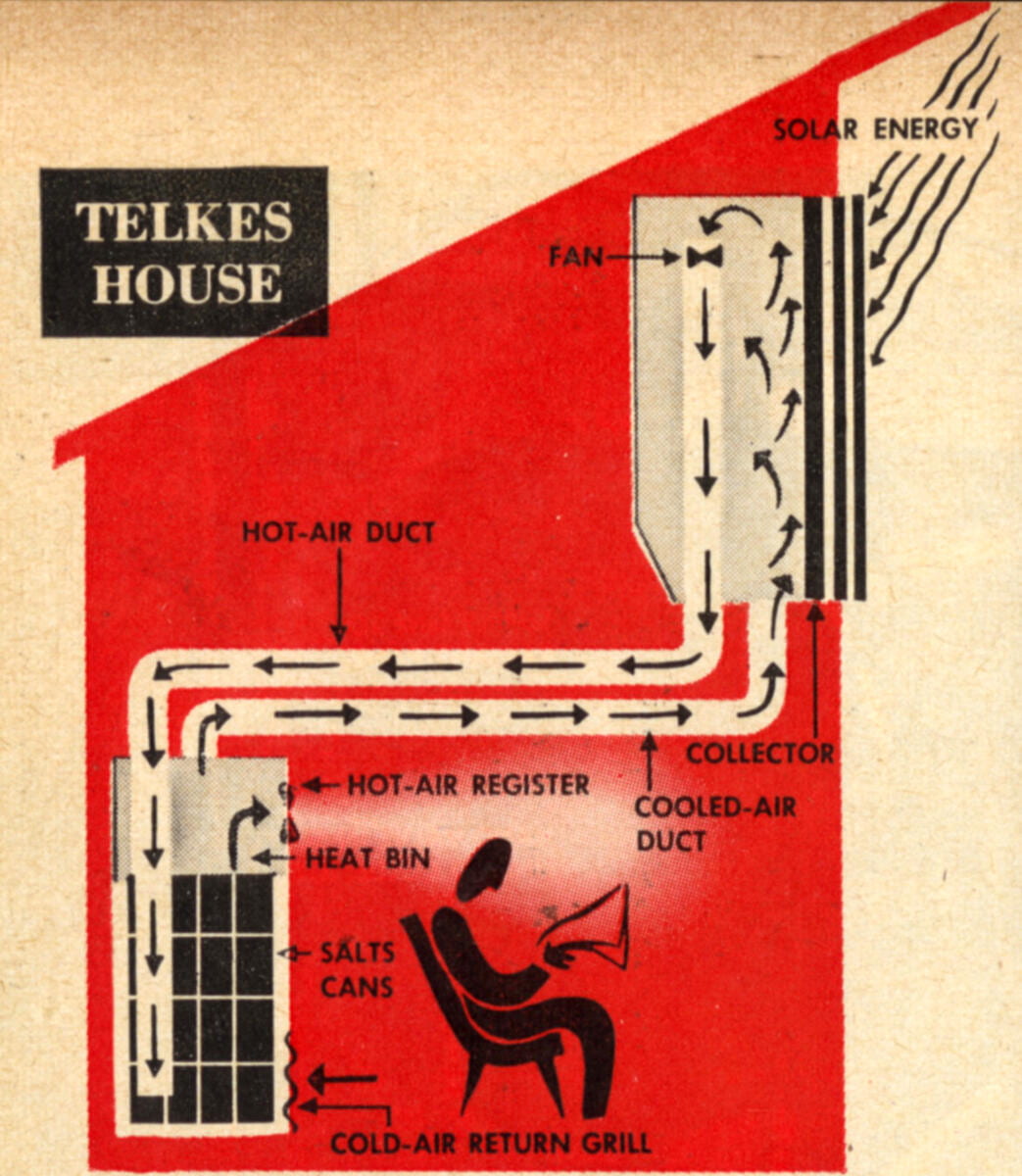

Maria Telkes and the Dover Sun House Maria Telkes and the Dover Sun House image

Despite initial challenges – the unusually cold winter of 1948 and subsequent leakage in the solution tanks in 1953 – the solar house laid the groundwork for the acceptance of solar energy as a viable heating source.

Maria Telkes outside the Dover Sun House

“It was a proof of premise, a radical idea for her to be thinking that broadly and to think that far ahead and actually create a liveable house as an experiment,” says Andrew Nemethy, who was a boy who lived in the Dover Sun House growing up. “She needed astronauts, and I guess we were the lucky ones,” he said in a PBS documentary.

This marked a significant shift, considering that sustainable development was not yet a recognized term. People began incorporating solar panels into house designs, often complemented by traditional heating systems in areas with insufficient sunny days.

The Dover Sun House was demolished in 2010. A PBS documentary explores the contribution of Telkers and the Dover Sun House that would be heated only by the sun in a New England winter.


Inside the Dover Sun House. Gauber salts stored and released heat from the windows.

Maria Telkes outside the Dover Sun House
Maria Telkes outside the Dover Sun House in the PBS documentary about the Dover Sun House.

Telkes received the Society of Women Engineers Award in 1952, earning the moniker “The Sun Queen” in the United States.

In 1953, when Telkes was at New York University, she received a Ford Foundation grant to develop a solar stove that could be used in developing countries. Like the designs previous, she took a simple approach.

The stove was constructed as an insulated metal box equipped with doors on both ends, topped with glass over the food placement area. Harnessing the sun’s rays, the glass amplified their intensity, aided by four metal plates strategically angled at 60 degrees.

Maria Telkes solar cooker
Diagram of Maria Telkes solar cooker

Triangular mirrors positioned between the plates further enhanced the amplification of solar wavelengths. Remarkably, the stove could reach temperatures of 400 degrees, requiring no specialized materials for its construction and boasting an affordable price tag of merely four dollars.
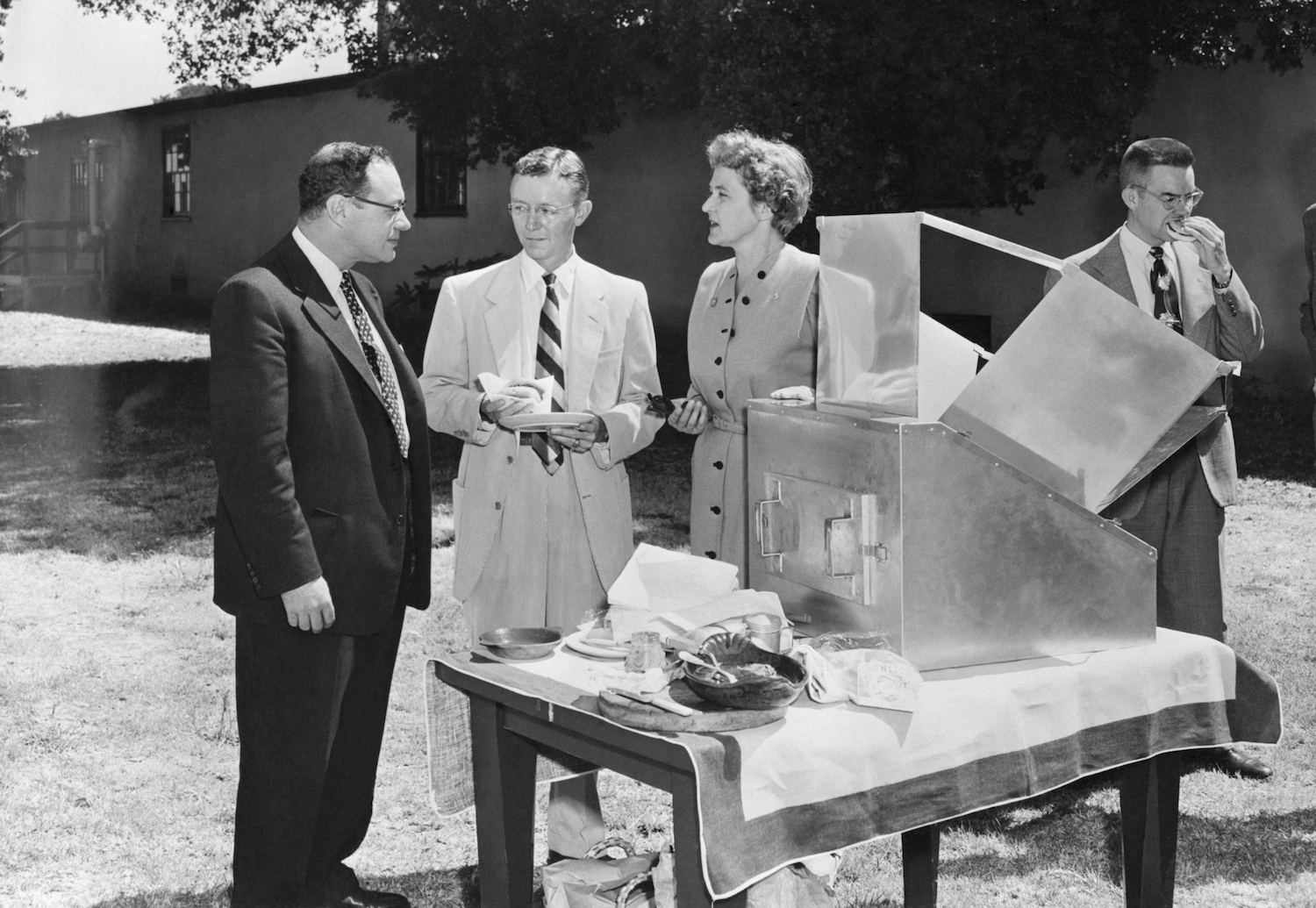
Maria Telkes and her solar cooker invention
Dr. Maria Telkes, “world’s most famous woman inventor in solar energy,” speaks with Dr. J.E. Hobson (left) and Thomas K. Hitch.

Its user-friendly design (you can download the instructions here) found a welcoming market in midcentury India, precisely the tropical climate its inventor had envisioned. Telkes enthusiastically praised its merits to a reporter during a cooking demonstration, expressing, “Everything seems to taste so much better when it is cooked by the sun.”

In 1977, the American Solar Energy Society honored her with the Charles Greeley Abbot Award. At the age of 90 in 1990, Telkes submitted her last invention, leaving an indelible mark on the field.

Returning to her hometown, Budapest, after 70 years, Telkes passed away on December 2, 1995, at the age of 94. In recognition of her unparalleled contributions, she was posthumously inducted into the National Inventors Hall of Fame in 2012, alongside physicist Dénes Gábor.

Mária Telkes’ legacy endures as an inspiration for future innovators and a testament to the transformative power of solar energy in shaping a sustainable future.

Karin Kloosterman
Karin Kloostermanhttp://www.greenprophet.com
Karin Kloosterman is an award-winning journalist, innovation strategist, and founder of Green Prophet, one of the Middle East’s pioneering sustainability platforms. She has ranked in the Top 10 of Verizon innovation competitions, participated in NASA-linked challenges, and spoken worldwide on climate, food security, and future resilience. With an IoT technology patent, features in Canada’s National Post, and leadership inside teams building next-generation agricultural and planetary systems — including Mars-farming concepts — Karin operates at the intersection of storytelling, science, and systems change. She doesn’t report on the future – she helps design it. Reach out directly to [email protected]

LEAVE A REPLY

Please enter your comment!
Please enter your name here

TRENDING

10 Proven Israeli Technologies to Help Somaliland Build Food, Water, and Energy Security

Israel’s water and agricultural technologies didn’t emerge from ideal conditions. They were developed under pressure: low rainfall, saline water, political isolation, lack of energy resources, and the constant need to feed a growing population with limited land. Over the years, I’ve written about many of these companies not as miracle-makers, but as problem-solvers. That’s what makes them relevant to places like Somaliland. Israel was the first country in the world to recognize Somaliland as an independent state although Ethiopia has been treating the nation as such for decades.

Dead shark on beach injured by fishing nets

  A dead shark that washed ashore this week at...

Investing in the Middle East? These 20 Energy consultants can de-risk your portfolio

For instance is your clean tech firm or company in wastewater treatment considering an office in Riyadh or should you stick with Dubai?  Below is a curated spotlight on 20 firms that shine for their deep expertise and proven ability to manage the complex risks of sustainable energy investment.

Choosing Riyadh over Dubai? What Investors Should Know

Saudi Arabia is deploying capital at unmatched scale to catalyze tourism and advanced industry while rewiring its power-and-water backbone. The investable frontier is widening—especially in renewables, grid storage, water efficiency/desal retrofits, and hospitality operating platforms. Prudent investors will insist on phased delivery, enforceable KPIs (energy, water, biodiversity), and RHQ/zone compliance—while pricing political-economy and reputational risks alongside growth upside.

Saudi Arabia’s oil-powered desalination “success” consumes 20% of its domestic oil use

Nearly 20% of Saudi Arabia’s oil powers desalination, with projections rising to 50% by 2030. Experts warn it should remain a last-resort solution due to high energy and environmental costs.

Qatar’s climate hypocrisy rides the London Underground

Qatar remains a master of doublethink—burning gas by the megaton while selling “sustainability” to a world desperate for clean air. Wake up from your slumber people.

How Quality of Hire Shapes Modern Recruitment

A 2024 survey by Deloitte found that 76% of talent leaders now consider long-term retention and workforce contribution among their most important hiring success metrics—far surpassing time-to-fill or cost-per-hire. As the expectations for new hires deepen, companies must also confront the inherent challenges in redefining and accurately measuring hiring quality.

8 Team-Building Exercises to Start the Week Off 

Team building to change the world! The best renewable energy companies are ones that function.

Thank you, LinkedIn — and what your Jobs on the Rise report means for sustainable careers

While “green jobs” aren’t always labeled as such, many of the fastest-growing roles are directly enabling the energy transition, climate resilience, and lower-carbon systems: Number one on their list is Artificial Intelligence engineers. But what does that mean? Vibe coding Claude? 

Somali pirates steal oil tankers

The pirates often stage their heists out of Somalia, a lawless country, with a weak central government that is grappling with a violent Islamist insurgency. Using speedboats that swarm the targets, the machine-gun-toting pirates take control of merchant ships and then hold the vessels, crew and cargo for ransom.

Leopoldo Alejandro Betancourt López Turned Ocean Plastic Into Profitable Sunglasses

Few fashion accessories carry the environmental burden of sunglasses. Most frames are constructed from petroleum-based plastics and acrylic polymers that linger in landfills for centuries, shedding microplastics into soil and waterways long after they've been discarded. Leopoldo Alejandro Betancourt López, president of the Spanish eyewear brand Hawkers, saw this problem differently than most industry executives.

Why Dr. Tony Jacob Sees Texas Business Egos as Warning Signs

Everything's bigger in Texas. Except business egos.  Dr. Tony Jacob figured...

Israel and America Sign Renewable Energy Cooperation Deal

Other announcements made at the conference include the Timna Renewable Energy Park, which will be a center for R&D, and the AORA Solar Thermal Module at Kibbutz Samar, the world's first commercial hybrid solar gas-turbine power plant that is already nearing completion. Solel Solar Systems announced it was beginning construction of a 50 MW solar field in Lebrija, Spain, and Brightsource Energy made a pre-conference announcement that it had inked the world's largest solar deal to date with Southern California Edison (SCE).

Related Articles

Popular Categories